10-Year U.S. Treasury Yield at 4.78% as Oil Tops $91
If a 4.78% Treasury yield and $91 oil make you sell shares today, you were never investing — you were renting a dopamine machine.
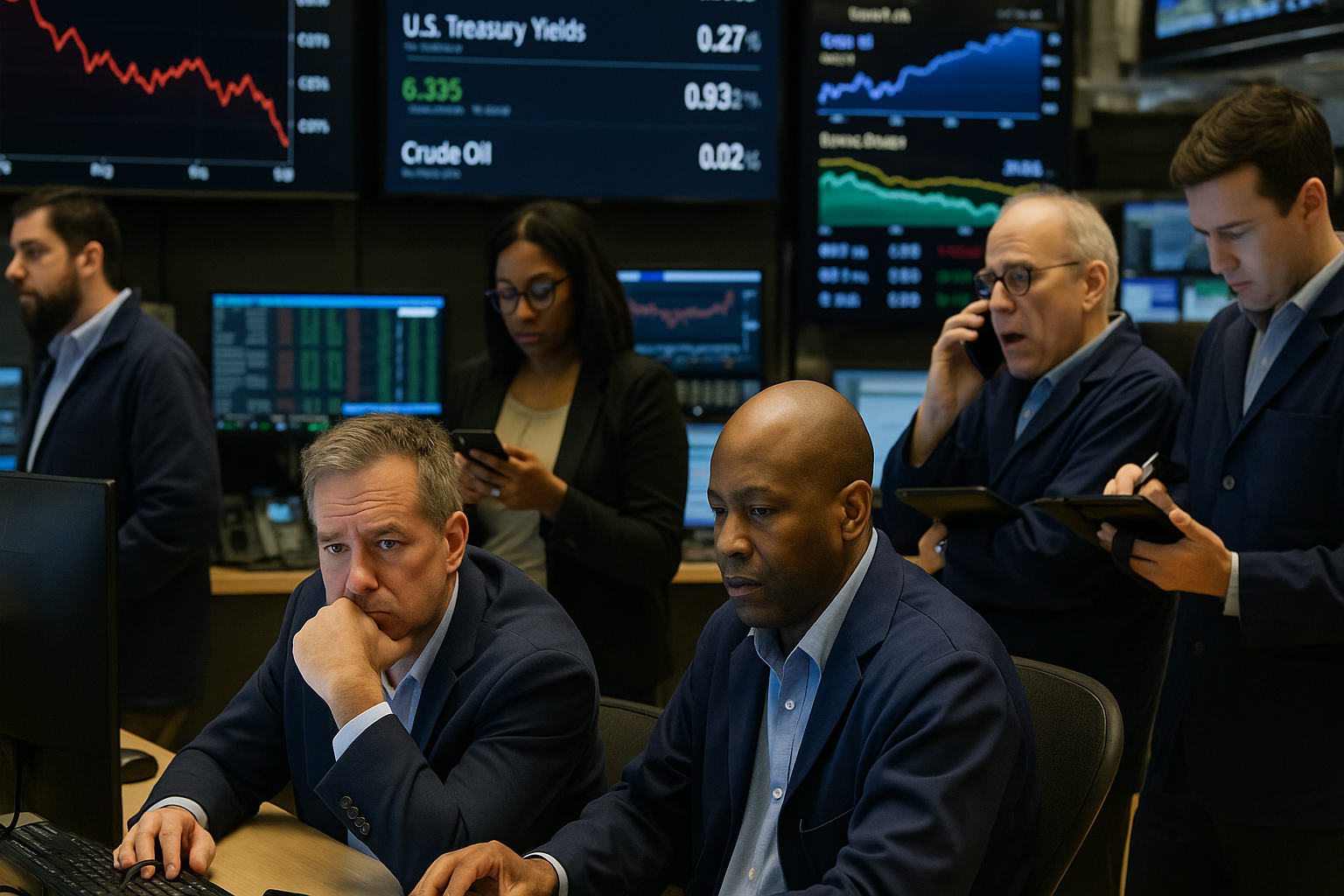
If a 4.78% Treasury yield and $91 oil make you sell shares today, you were never investing — you were renting a dopamine machine.
That is not an insult. It is a diagnosis. And it is fixable — but only if you stop treating every ugly market day as a personal emergency.
On September 1, the market is being hit by a nasty little cocktail: oil above $90 a barrel, bond yields climbing, fresh Middle East uncertainty and traders suddenly giving a September Federal Reserve rate hike better-than-even odds. This is exactly when people who claim to be long-term investors discover they were actually short-term punters with a nicer spreadsheet. ([investing.com](https://www.investing.com/news/economy-news/bond-selloff-pressures-stocks-as-oil-crosses-91-a-barrel-4883440))
The numbers that matter — and the ones that don’t
Start with what actually happened.
The 10-year U.S. Treasury yield rose to 4.78%, its highest level in roughly 20 months. Brent crude pushed above $91 a barrel. The catalyst was renewed fighting involving the United States and Iran, with disruption around the Strait of Hormuz keeping energy markets on edge. That waterway had previously carried about 20% of global oil shipments. ([investing.com](https://www.investing.com/news/economy-news/bond-selloff-pressures-stocks-as-oil-crosses-91-a-barrel-4883440))
Then Wall Street did what Wall Street does when the cost of money and the cost of energy both look set to rise: it got twitchy. On Monday, the S&P 500 fell 0.36% to 7,684.37. The Nasdaq slipped 0.16% to 26,360.91. The Dow dropped 0.71%, or 380.22 points, to 53,179.77. ([m.economictimes.com](https://m.economictimes.com/markets/us-stocks/news/us-stocks-today-wall-street-closes-lower-as-oil-prices-jump-indexes-notch-monthly-gains/amp_articleshow/133662681.cms))
None of that is pleasant. None of it is remotely surprising.
The more important number is not the Dow’s one-day fall. It is the market’s changing view of the Federal Reserve. Traders were pricing more than a 65% chance of a 25-basis-point rate increase at the September meeting after Federal Reserve Chair Kevin Warsh’s hawkish Jackson Hole remarks. A week earlier, the implied odds were 41.4%. ([m.economictimes.com](https://m.economictimes.com/markets/us-stocks/news/us-stocks-today-wall-street-closes-lower-as-oil-prices-jump-indexes-notch-monthly-gains/amp_articleshow/133662681.cms))
That is a massive repricing in a few days. And it matters because higher rates change the maths everywhere: company valuations, mortgages, business loans, commercial property, private equity deals and the return you demand before putting capital at risk.
But here is the bit people get wrong: a changing price of money is not a command to smash the sell button.
Why a 4.78% Treasury yield punches above its weight
A Treasury yield sounds like something only bond nerds and central bankers should care about. Wrong.
The 10-year Treasury is one of the market’s big reference prices. When its yield rises, investors can get more return from assets backed by the U.S. government. That makes riskier assets — shares, property, venture capital, speculative tech and plenty of private-market nonsense — compete harder for your money.
It also puts pressure on “long-duration” assets. That is finance jargon for assets whose hoped-for cash flows sit a long way in the future. Plenty of fast-growing technology companies fit the bill. Their valuations can look brilliant when money is cheap and rather silly when money is expensive.
Reuters reported that rising yields, geopolitical risk, inflation pressure and fiscal concerns were converging to make the backdrop tougher for bonds and risk assets. That is the adult version of the story. The childish version is: “Oil up, stocks down, panic.” ([investing.com](https://www.investing.com/news/economy-news/bond-selloff-pressures-stocks-as-oil-crosses-91-a-barrel-4883440))
I know which version gets more clicks. I also know which version makes people wealthier.
The current pressure is not only about the Fed. Oil above $90 is a tax that nobody voted for. It filters through petrol, transport, logistics, manufacturing and household spending. If that becomes persistent, it can make inflation harder to kill. And if inflation refuses to behave, the Fed has less room to cut rates — or may feel forced to raise them.
That is why the oil price matters more than the daily chatter around whether Nvidia rose or fell by a percent.
The market’s real problem is uncertainty, not one ugly session
Markets can cope with bad news. They hate not knowing the size or duration of the bill.
Investors do not yet know whether the Strait of Hormuz disruption will be brief, whether oil stays around current levels, what the next U.S. jobs report will show on September 4, or whether Warsh follows his rhetoric with a September rate hike. Reuters noted that the jobs data could be pivotal to whether an interest-rate hiking cycle begins as soon as this month. ([investing.com](https://www.investing.com/news/economy-news/bond-selloff-pressures-stocks-as-oil-crosses-91-a-barrel-4883440))
So the market is trying to price four things at once: growth, inflation, war risk and rates. Of course it looks nervous.
The temptation is to respond with activity. Sell something. Buy oil stocks. Buy gold. Buy a leveraged inverse ETF with a name that sounds like a cough syrup. Do anything that creates the feeling of control.
That feeling is expensive.
The market has already made the obvious first move: energy was the standout sector while nearly everything else was under pressure. Halliburton and Valero rose; utility company PG&E was hammered. ([m.economictimes.com](https://m.economictimes.com/markets/us-stocks/news/us-stocks-today-wall-street-closes-lower-as-oil-prices-jump-indexes-notch-monthly-gains/amp_articleshow/133662681.cms))
Buying whatever went up yesterday is not a strategy. It is a delayed reaction dressed up as insight.
The overlooked angle: higher rates are not bad for everyone
Here is the contrarian bit. Higher rates are not universally terrible. They are terrible for people and businesses that need to borrow constantly, have weak cash flow, or depend on investors believing a profit will arrive one glorious day in the future.
They can be quite good for people with cash, low debt and patience.
For years, savers were trained to accept rubbish returns on cash while being pushed further out the risk curve. That world has changed. A higher-risk-free rate raises the hurdle for every investment opportunity. Frankly, that is healthy. It forces founders to build businesses with real economics rather than PowerPoint economics. It forces investors to ask whether a deal is genuinely good or merely better than leaving money idle.
As someone building Agave Finder, I take that seriously. When capital is cheap, almost every startup can invent a story about scale. When capital costs more, you need customers, margins and a reason to exist. Annoying, yes. Also useful.
For individual investors, the overlooked advantage is optionality. If you have liquidity, sensible debt levels and a portfolio built for your actual time horizon, volatility gives you choices. If you are maxed out on consumer debt, an interest-rate rise makes every market headline feel like a punch in the throat.
Your wealth is not just your investment account. It is your balance sheet. Most people learn that far too late.
Don’t confuse a rate-hike probability with a forecast you can trade
The market putting 65% odds on a September hike does not mean a hike is guaranteed. It means the collective pile of traders, funds and algorithms thinks that outcome is more likely than not based on the information available now. ([m.economictimes.com](https://m.economictimes.com/markets/us-stocks/news/us-stocks-today-wall-street-closes-lower-as-oil-prices-jump-indexes-notch-monthly-gains/amp_articleshow/133662681.cms))
That distinction matters.
Trying to trade each change in those odds is a mugs’ game for most people. You are competing against institutions with better data, more staff, faster execution and absolutely no hesitation about cutting a losing position. You do not beat that crowd by checking your phone between meetings.
You win by owning assets you understand, keeping enough cash that you are never forced to sell at the wrong time, and refusing to let a week of headlines rewrite a plan built for a decade.
There is a difference between being alert and being reactive. Alert investors check whether their assumptions have changed. Reactive investors check the price, feel sick, and call that research.
What this means for you
Here is what I would do tomorrow morning — not because I have a crystal ball, but because boring preparation beats dramatic prediction.
First, inspect your debt. Write down every loan, its interest rate, whether it is fixed or variable, and when the fixed period ends. If another rate rise would materially damage your cash flow, you do not have an investment problem. You have a balance-sheet problem. Cut optional spending, build cash and deal with it before the bank forces the conversation.
Second, set a real cash target. I would want enough accessible cash to handle a job loss, business wobble or urgent family issue without raiding long-term investments. Pick a number that lets you sleep — three, six or more months of essential costs depending on how volatile your income is — and make it non-negotiable.
Third, check allocation, not headlines. If shares are 80% of your portfolio, make sure that is because you can genuinely tolerate an ugly drawdown, not because 80% sounded aggressive and clever in a bull market. Rebalance deliberately. Do not redesign your portfolio because oil had a big Tuesday.
Fourth, stop treating energy stocks as emergency insurance. If you want energy exposure, own it because it belongs in a diversified plan — not because Brent crude just crossed $91. Chasing the day’s winner is how people turn a sensible hedge into a concentrated bet.
Finally, make your next investment decision slower. Give yourself 24 hours before buying or selling anything prompted by a headline. Read the facts. Ask what would have to be true for the trade to work. Then ask the more useful question: what happens if I am wrong?
The market is warning that money may stay expensive and inflation may prove stubborn. Listen to that warning. Do not worship it.
Get your cash flow right. Keep your debt manageable. Own quality assets for a long enough period. Then let everyone else spend September panicking over what might happen at the next Federal Reserve meeting.