Amen Thompson’s $208M Rockets Deal Is a $44M Bet on a Broken Jumper
The Houston Rockets just gave Amen Thompson $208 million despite a 21.6% three-point shot. That isn’t madness—it’s a very expensive bet that defence and decision-making age better than hype.
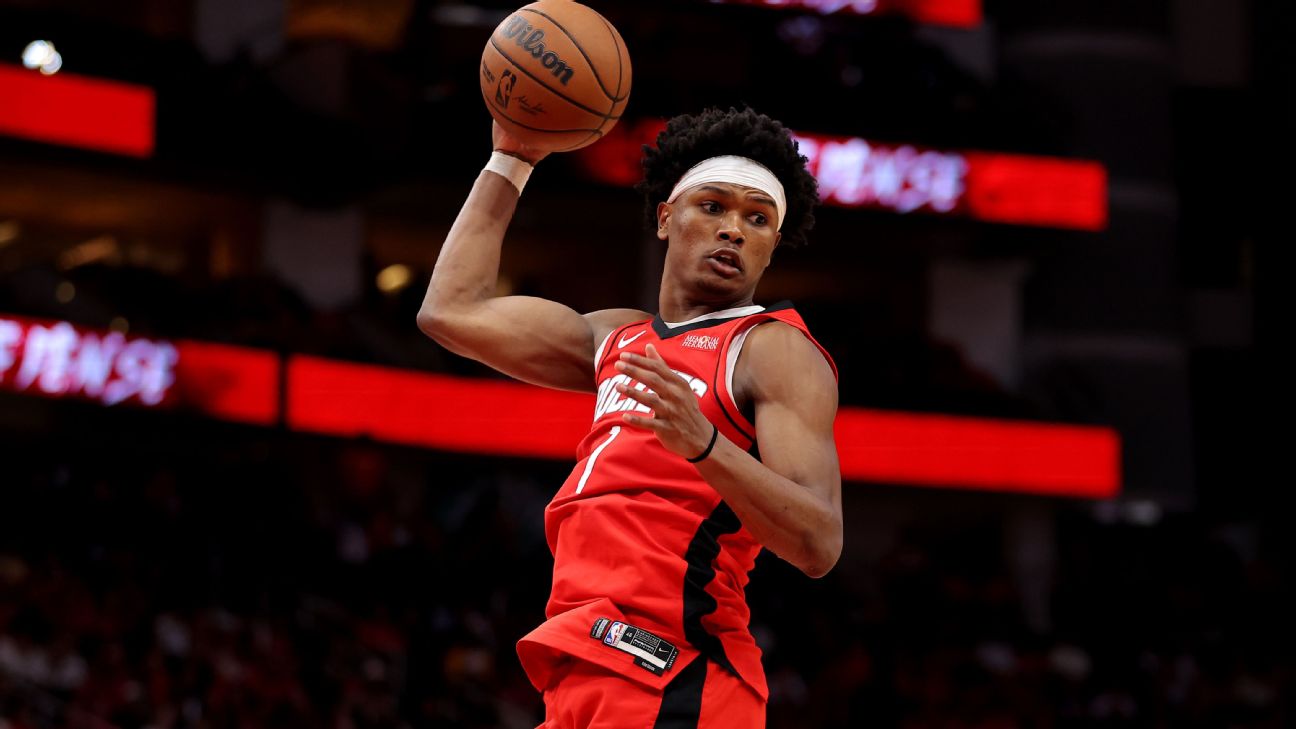
Houston just committed $208 million to a bloke who shot 21.6% from three last season. If you think that sounds insane, you’re looking at basketball like a fan rather than an owner.
The Houston Rockets’ five-year extension for Amen Thompson is not payment for what he is today. It is a $208 million wager on what matters when the games get ugly: size, defensive versatility, availability, instincts and the ability to affect a game without needing 25 shots. Houston has decided those things are rarer—and safer—than a pretty jumper. ([nba.com](https://www.nba.com/news/amen-thompson-5-year-extension-rockets?utm_source=openai))
The $208 million decision Houston made before the market made it for them
On September 3, the Rockets agreed to a five-year, $208 million rookie-scale extension with Thompson, their 23-year-old former No. 4 pick. The deal includes a 10% trade kicker and keeps him under contract through 2032. Thompson was eligible for a five-year deal worth roughly $252 million, so Houston got him done about $44 million below the 25% maximum. That is not loose change. That is the price of retaining some breathing room when the roster gets more expensive. ([abc13.com](https://abc13.com/post/sources-rockets-amen-thompson-agrees-5-year-208m-extension/19784824/?utm_source=openai))
Let’s call it plainly: the Rockets didn’t get a bargain in the normal-person sense. They committed the sort of money that changes generations of a family. Thompson will average $41.6 million a year across the extension.
But NBA teams don’t compete against normal-person economics. They compete against the cost of replacing scarce talent. A 6-foot-7 athlete who can credibly defend across positions, rebound, create offence, play enormous minutes and still improve at 23 is expensive because there are bugger-all of them.
Thompson started all 79 games he played in 2025-26, led the NBA in total minutes and averaged 18.3 points, 7.8 rebounds, 5.3 assists and 1.51 steals in 37.4 minutes a night. He had already earned First Team All-Defense recognition in 2024-25. Houston is not paying for a social-media workout video. It is paying for production, durability and a defensive profile that travels in April and May. ([nba.com](https://www.nba.com/news/amen-thompson-5-year-extension-rockets?utm_source=openai))
That distinction matters. Plenty of players put up numbers when everyone is jogging through February. Far fewer can be the person your coach trusts to guard the best scorer, grab a defensive rebound, push the pace, find a teammate and do it again after 39 minutes. Thompson has built a serious case that he is that player.
The jumper is still the whole risk—and Houston knows it
Now for the bit Rockets fans should not ignore because the contract announcement had shiny graphics around it: Thompson’s shooting remains a genuine problem.
He made 21.6% of his three-point attempts last season. That is not a minor blemish you hide under the rug with phrases like “developing nicely.” In playoff basketball, opponents identify the weakest part of your offensive game and punch it until either you solve it or the coach takes you off the floor. Houston has just guaranteed that Thompson will be tested there for years. ([nba.com](https://www.nba.com/gamenotes/rockets.pdf?utm_source=openai))
The contrarian point is that Houston may be more comfortable with that risk than outsiders are. Shooting is visible. Everyone can see a missed corner three and become an unpaid scout. What is harder to notice is how much a player creates by blowing up actions before they begin, switching without panic, recovering after a mistake, turning loose balls into possessions and forcing an opponent to start its offence later and further from the basket.
Those skills don’t make viral mixtapes. They make winning teams miserable to play against.
And unlike a one-dimensional scorer, Thompson does not need to become Stephen Curry for this deal to work. He needs to become merely credible enough as a shooter that teams cannot completely ignore him, while continuing to improve as a passer and finisher. That is a much lower hurdle—and a much more realistic one.
Still, there is no free lunch here. If the jumper never improves, Houston will have paid star money for a player whose best offensive role could depend heavily on the roster around him. That makes the next few personnel decisions very important. You cannot surround a non-shooter with other non-shooters, shrug, and call it culture.
Rafael Stone is building a roster, not collecting names
This extension makes more sense when you look at the Rockets’ broader architecture.
Houston previously signed Alperen Sengun to a five-year, $185 million extension at a similar share of the cap. Kevin Durant also accepted a two-year, $90 million extension that was reportedly about $30 million below the maximum available to him. That is three different deals, for three different players, pointing in the same direction: the Rockets are trying to preserve a competitive window rather than win every negotiation headline. ([abc13.com](https://abc13.com/post/sources-rockets-amen-thompson-agrees-5-year-208m-extension/19784824/?utm_source=openai))
Durant taking less than his maximum is particularly telling. Superstars talk endlessly about winning. Very few actually leave money on the table to give the front office options. Durant did. Thompson, meanwhile, took less than the maximum he could have chased by waiting for a bigger season and restricted free agency. Houston’s front office, led by Rafael Stone, has used that willingness to lock in core pieces without automatically handing every young player the full freight.
That is proper roster building. Not sexy. Proper.
The 2026-27 NBA salary cap is $164.961 million, with the first apron at $209.015 million and the second apron at $221.686 million. Those apron lines are not decorative. The current collective bargaining agreement makes roster management meaningfully more painful once teams climb too high, limiting the tricks rich franchises once used to patch holes with trades and exceptions. ([nba.com](https://www.nba.com/news/nba-salary-cap-2026-27-season?utm_source=openai))
Houston is not merely trying to avoid paying luxury tax. It is trying to avoid becoming a prisoner of its own success.
That is the important business story here. A lot of franchises treat cap room like a holiday fund: spend it because it is there, then act shocked when the bill arrives. The Rockets are making earlier trade-offs. They are paying elite young talent, but not at the absolute maximum rate where possible. That leaves room for mistakes, injuries, role players and the one thing every contender discovers it needs too late: optionality.
The overlooked angle: this is also a bet against restricted free agency
People love saying, “Why pay him now? Make him prove it for another year.” That sounds tough. It is also often expensive.
If Thompson has a genuine breakout season, makes an All-NBA team or becomes the face of a deep Houston playoff run, the conversation changes quickly. The $208 million deal begins to look cheap, and the Rockets either pay more or deal with restricted free agency—the NBA’s version of an awkward family dinner where everyone pretends they are not staring at the cheque.
There is value in certainty.
Houston has transferred some upside to Thompson. That is what the $44 million discount buys the club: it pays him very well now in exchange for avoiding the possibility that he becomes impossible to sign cheaply later. If he becomes a bona fide two-way star, the Rockets win. If he plateaus as an excellent defender with offensive limitations, they have paid a painful but manageable number rather than a full max. ([cbssports.com](https://www.cbssports.com/nba/news/amen-thompson-contract-extension-houston-rockets/?utm_source=openai))
The 10% trade kicker adds another wrinkle. It gives Thompson more protection if Houston decides to move him. In other words, the Rockets are signalling that they expect him to be part of the furniture, not a nice asset they will flip at the first shiny opportunity. ([abc13.com](https://abc13.com/post/sources-rockets-amen-thompson-agrees-5-year-208m-extension/19784824/?utm_source=openai))
That kind of commitment can be useful inside a young team. Players notice whether a club rewards development or treats everyone as inventory. But it also means Stone now has less margin for error around Thompson. The coaching staff must get the shooting and decision-making better. The front office must find spacing. And Thompson has to embrace the boring work that turns a physical marvel into an all-round weapon.
What this means for you
There is a business lesson in this deal that has nothing to do with basketball: pay for the things that remain valuable when conditions get hard.
A flashy sales hire looks brilliant when leads are raining from the sky. A calm operator who keeps customers, protects margins, solves problems and makes everyone around them better is the person you want when the market turns ugly. Amen Thompson is Houston’s version of that bet. His three-point shot is the obvious gap. His less glamorous skills are the foundation.
If you run a business, use this tomorrow:
1. Separate visible skill from durable value. Ask what your best people do when the easy conditions disappear. That is usually their real worth.
2. Pay early when the evidence is real. Waiting for total certainty is how you end up paying top-of-market prices. You do not need perfection; you need enough proof that the upside is worth owning.
3. Do not pay maximum prices for potential by default. Houston gave Thompson life-changing money but preserved $44 million versus his maximum. A good deal gives both sides a reason to sign it.
4. Build around known weaknesses. If someone has a clear limitation but extraordinary strengths, do not complain about the limitation after hiring them. Design the team so their best work can actually matter.
The Rockets have not bought a finished superstar. They have bought a difficult, valuable problem: a rare defender and playmaker who still needs to become a respectable shooter. That is a better problem than paying $252 million for a bloke who already looks finished.
And if Thompson fixes the jumper? Houston will look very clever indeed.