Anthropic’s $35B Lambda Deal Proves AI Is Now a Financing Business
Anthropic just committed $35 billion to Lambda for computing power. If that number doesn’t make you uncomfortable, you’re confusing an AI boom with a normal software market.
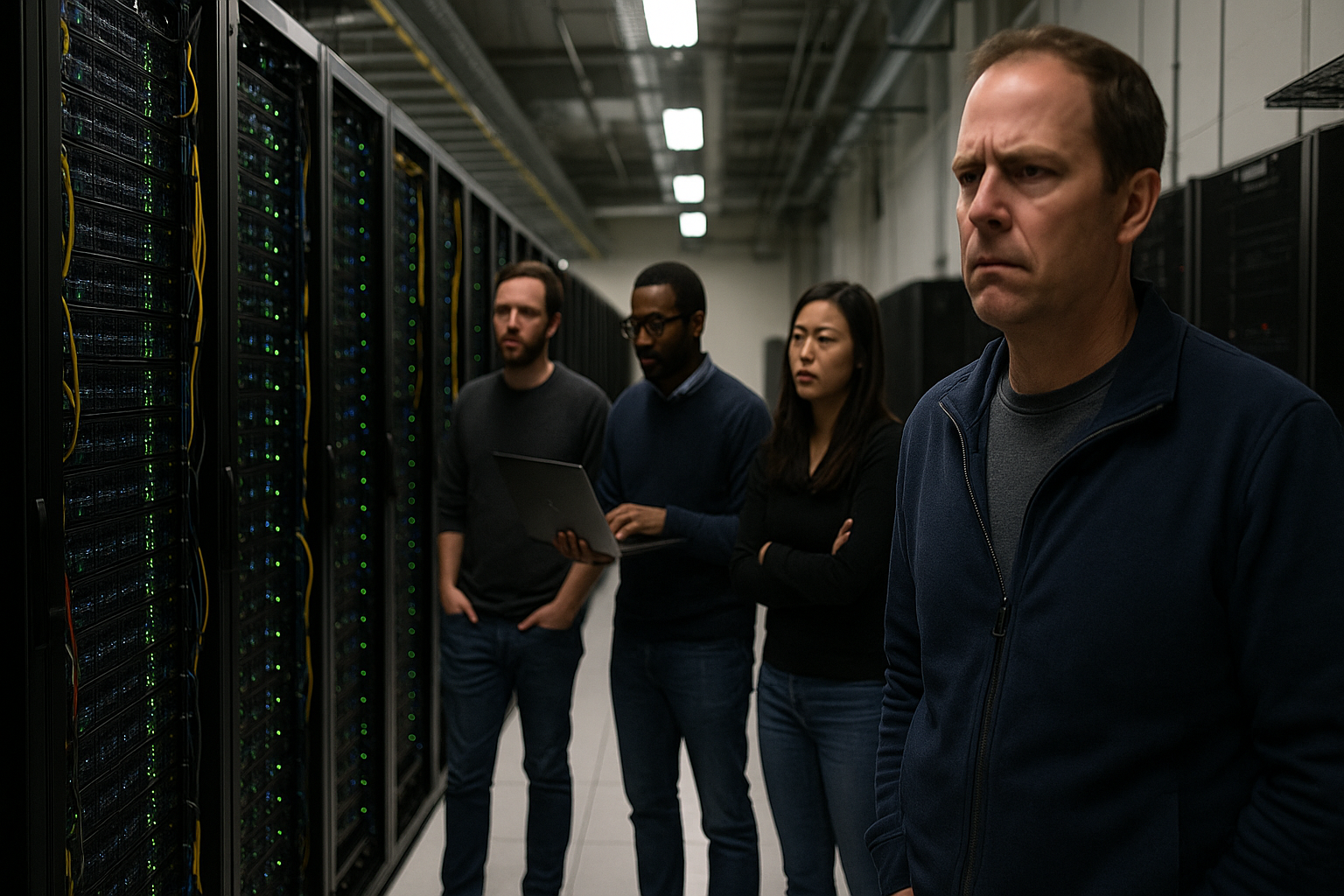
Anthropic has reportedly signed a $35 billion cloud-computing deal with Nvidia-backed Lambda. That is not a software contract. It is a giant, leveraged bet that enough people will keep paying for Claude to justify building an industrial estate of machines before the revenue is safely in the bank.
That is where AI is now: less like SaaS and more like railroads, oil fields and casinos with very clever engineers.
Reuters reported on August 31 that Anthropic had signed the deal with Lambda to bring more Nvidia capacity online for Claude. Bloomberg separately reported the same arrangement, citing a person familiar with the matter. The Wall Street Journal first reported it. Anthropic and Lambda have not publicly laid out every commercial term, so treat the $35 billion as reported deal value, not cash already wired.
Still, the direction is undeniable. The race to build better models has become a race to reserve electricity, land, chips, networking gear and debt capacity. The chatbot is merely the shopfront.
The $35 billion deal is the headline. The supply chain is the story.
A decade ago, a serious software company needed talented people, cloud credits and enough patience to survive the sales cycle. Today, the frontier AI firms need all that plus the capital appetite of a mining company.
Anthropic is buying access to compute from Lambda, a specialist cloud provider backed by Nvidia. Lambda’s job is not glamorous: get the data-centre capacity, put Nvidia gear inside it, keep it powered and available, then rent the horsepower to customers desperate not to be short of compute.
That last bit matters. In a constrained market, owning the best model means very little if you cannot serve customers quickly, reliably and at a tolerable cost. A brilliant AI model that goes unavailable at 2pm because demand spikes is not intelligence. It is an expensive demo.
The Lambda agreement also lands in the middle of an extraordinary pile of Anthropic infrastructure commitments. In April, the Associated Press reported Anthropic had agreed to commit more than $100 billion over 10 years to Amazon Web Services for training and running Claude. That followed an arrangement with Microsoft under which Anthropic committed to buy $30 billion of Azure capacity. Google, meanwhile, said it would invest up to $40 billion in Anthropic through cash and compute.
Then there is the Google-Broadcom expansion announced in April, which TechCrunch reported would add multiple gigawatts of TPU-based compute capacity beginning in 2027. A Broadcom filing put that capacity at 3.5 gigawatts.
Don’t lazily add every headline number together and pretend it is one clean invoice. Different deals have different durations, conditions, forms of financing and options. But you would need to be trying very hard not to see the obvious: Anthropic is locking up an enormous amount of future industrial capacity.
AI’s best businesses are becoming capital-intensive monsters
This is where plenty of investors and founders get themselves into trouble. They see AI revenue growing quickly and assume the underlying economics must look like software: build once, sell many times, print margins.
Maybe, eventually. But not yet at the frontier.
Training models is expensive. Running them for millions of users is expensive. Improving them requires more research, more data work, more chips and more power. And the competitive pressure is relentless because nobody wants to be the company that saves money on infrastructure only to watch customers leave for a faster or smarter rival.
The old venture-capital playbook says: grow, prove demand, then scale the machinery behind the business. The current AI playbook is closer to: secure the machinery first, because if you wait until demand is fully proven, somebody else has already reserved the chips.
That creates a nasty feedback loop. Model makers need infrastructure providers. Infrastructure providers need enormous financing to buy Nvidia systems and build facilities. Chip suppliers benefit from the whole frenzy. Investors fund the companies buying the chips, the cloud firms renting them out and sometimes the data-centre projects housing them.
Everyone is selling shovels to everyone else, while everyone is also promising to dig a very large hole.
I’m not saying it is fake. I am saying it is financially fragile in a way people are far too polite about.
The uncomfortable question: who wears the downside?
The bullish case is straightforward. Claude usage keeps climbing. Businesses move AI from experiments into core workflows. Coding, research, customer support, legal work, finance and operations become substantially more productive. Compute demand stays ahead of supply. Anthropic’s long-term reservations look brilliant because it secured the scarce resource before it became even scarcer.
That can happen.
But the downside case is not that AI suddenly becomes useless. That is cartoonish. The real risk is more mundane: model capability improves, prices fall, competitors catch up and customers become far more selective about what they will pay for.
If intelligence gets cheaper faster than infrastructure costs can be absorbed, somebody is left holding very expensive capacity.
That somebody might be the model company. It might be the cloud provider. It might be the lenders financing the data centres. It might be investors who thought they owned a tidy software growth story but actually owned exposure to power, hardware depreciation and customer concentration.
That is why the Lambda deal matters beyond Anthropic. It is another sign that the AI race is moving risk away from the app layer and into a web of long-term infrastructure contracts.
Founders should pay attention because the biggest companies in your market are no longer competing only with product teams. They are competing with balance sheets.
Nvidia is not just selling chips. It is shaping the market around them.
The clever bit for Nvidia is that it does not need to own every cloud provider or build every data centre to benefit from the expansion. If a Nvidia-backed cloud company wins a massive customer commitment, more Nvidia systems are likely to be deployed.
That does not mean anything improper. It means Nvidia has built the most important ecosystem in modern computing and is using that position exactly as a great business would.
But it should make you wary of simplistic revenue stories. A deal between an AI lab, a cloud provider, a data-centre financier and a chip ecosystem partner is not the same as a consumer buying a pair of shoes. The cash flows, obligations and dependencies are more tangled.
The useful question is not, “How big is the announcement?” It is, “Who has committed capital, who has committed future revenue, and what happens if usage grows at half the expected rate?”
Most people never ask the second question because the first one is more exciting.
The overlooked angle: scarcity is an advantage, until it becomes a trap
There is a good reason Anthropic is doing these deals. You cannot run a frontier AI business on vibes and a few hundred GPUs in someone else’s cloud account. Capacity is strategic. If Claude demand continues to grow, having guaranteed access to compute could be one of the best decisions the company makes.
But strategic assets can turn into strategic handcuffs.
Long-term capacity deals make sense when demand is real and durable. They become dangerous when product demand is volatile, unit costs are falling quickly, or customers can switch providers with a few lines of code and a procurement meeting.
That is the underrated feature of AI: the user experience may feel sticky, but the model layer can be surprisingly contestable. A business using one model for document summaries, coding help or customer-service drafts may shift workload if another provider becomes cheaper, faster, safer or simply good enough.
The winners will not just have the largest clusters. They will have the discipline to turn compute into products customers refuse to cancel.
That is a much higher bar than producing a flashy benchmark chart.
What this means for you
If you are a founder, stop treating AI spend as a technical line item. It is now a procurement and margin problem. This week, work out your cost per useful customer outcome: per resolved support ticket, per completed workflow, per qualified lead, per hour saved. If you cannot measure that, you are not running an AI product. You are sponsoring an experiment.
If you are building with model providers, design for portability. Keep clean logs of prompts, outputs, evaluation results and costs. Build an abstraction layer where sensible. You do not need to switch providers every Tuesday, but you absolutely do not want your margins hostage to one vendor’s pricing committee.
If you are an operator, demand proof that AI is replacing a costly or slow process, not merely creating more activity. “Our team used the tool 10,000 times” is not a result. “We cut onboarding from 14 days to eight” is a result.
And if you are an investor or saver, remember this: a big AI number is not automatically a strong AI business. Ask whether the company owns customer demand, whether it can price its product above the cost of serving it, and whether its infrastructure commitments remain sensible if growth cools down.
Anthropic’s reported $35 billion Lambda deal is not a reason to panic. It is a reason to grow up.
The next phase of AI will create fortunes. It will also punish people who mistake gigantic spending for inevitable profits. Those are not the same thing, mate.