Apple’s $1,999 iPhone Duo Is John Ternus’s First Proper CEO Test
A $1,999 folding phone is not a product launch. It is John Ternus telling Apple’s 2-billion-device machine that the easy growth is over.
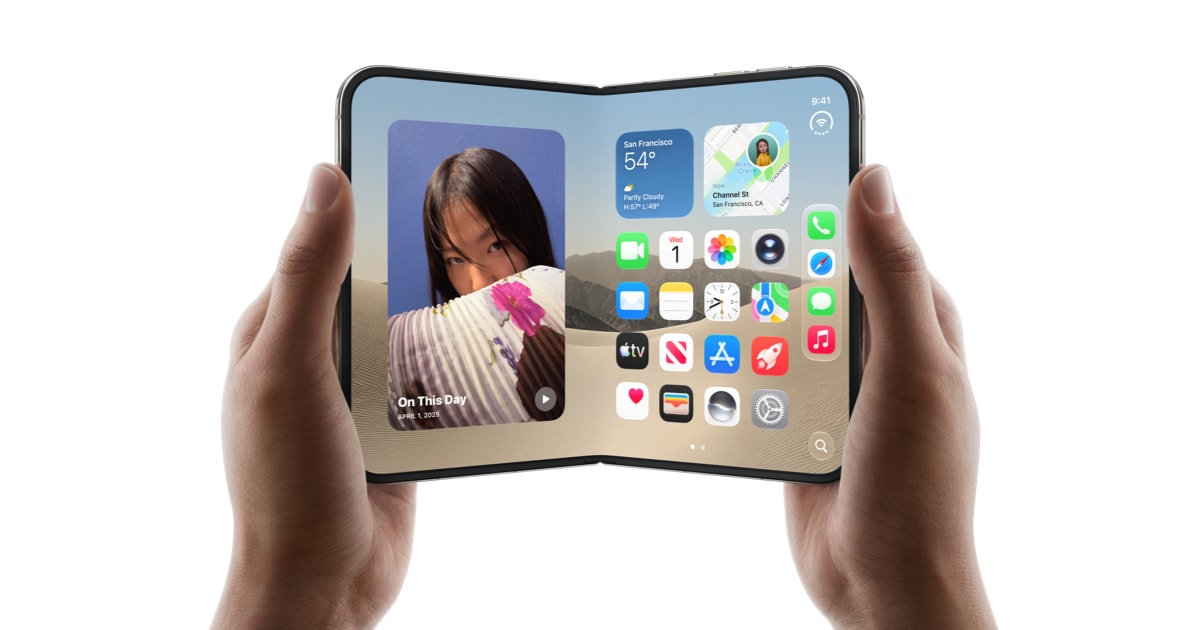
Apple did not hand John Ternus the CEO job so he could keep the iPhone conveyor belt humming. It handed him the job, then put a $1,999 folding phone in his hands eight days later and said: righto, prove you can make people care again.
On September 9, Apple unveiled the iPhone Duo, its first foldable iPhone, at Ternus’s first major product event as CEO. Pre-orders start October 16 and the phone reaches customers October 23. It starts at $1,999 in the United States. ([apple.com](https://www.apple.com/newsroom/2026/09/apple-unveils-iphone-duo/?utm_source=openai))
That is not a gentle opening act. It is a board-level statement of intent.
The first test is not whether the phone folds
Ternus became Apple CEO on September 1, 2026. Tim Cook moved into the executive-chairman role, while Arthur Levinson shifted from non-executive chairman to lead independent director. Apple said the succession followed a long-term process approved unanimously by the board. That is the tidy version. The commercial reality is less tidy: a company built into a more than $4.5 trillion behemoth under Cook now needs its next source of meaningful growth in an AI-soaked consumer market. ([apple.com](https://www.apple.com/newsroom/2026/04/tim-cook-to-become-apple-executive-chairman-john-ternus-to-become-apple-ceo/?_bhlid=c142aca9c4be5677922dad55a34dd718b91e0a03&utm_source=openai))
Ternus’s answer, at least publicly, is simple: do not abandon the iPhone. Make it more useful, more powerful and more central to a person’s life.
The iPhone Duo opens into a 7.6-inch internal display and has a 5.4-inch external display. It runs Apple’s A20 Pro chip, has a new hinge, supports Apple Pencil later this year, and is designed around multitasking and Apple Intelligence features. Apple says the inner screen is 50% larger than that of the iPhone 18 Pro Max. ([apple.com](https://www.apple.com/newsroom/2026/09/apple-unveils-iphone-duo/?utm_source=openai))
Fine. Nice bit of kit. But every phone company says its hinge is lovely and its chip is faster. Nobody worth listening to buys a $1,999 device because a press release said “advanced thermal management.”
The real question is whether Apple has made a product that creates a new habit. Not a new spec sheet. A habit.
Can the Duo replace the little moments where you reach for an iPad, a laptop or a second screen? Can it become the device that lets a salesperson build a proposal between meetings, a founder review a deck in an Uber, or an investor compare a few documents without doing the ridiculous phone-screen squint? If it can, the price starts to look like a work tool. If it cannot, it is a very expensive magic trick.
That distinction matters because foldables are not new. Samsung and others have spent years proving the category exists. Apple is late, as it often is. Being late is not a problem when you arrive with a product people actually prefer. Being late with a premium copy is how you become the bloke at the barbecue explaining why yours is technically better while everyone has already walked away.
Ternus is betting on concentration, not reinvention
There is a lazy story doing the rounds whenever Apple faces a new technology cycle: the iPhone is finished, something else will replace it, and Apple needs to find its next iPhone.
That sounds clever until you remember what great operators do under pressure. They identify the asset with the deepest trust, distribution and daily usage, then extend its relevance. They do not throw it in the bin because a few analysts are bored.
At the launch, Ternus framed the iPhone as an “intelligent personal hub” for the AI era. That is a meaningful strategic choice. Apple is not pitching a separate AI gadget that asks consumers to carry another thing, charge another thing and learn another interface. It is trying to turn the device already in your pocket into the place where personal context, on-device computing and cloud access meet. ([techcrunch.com](https://techcrunch.com/2026/09/09/apple-ceo-john-ternus-says-the-best-ai-device-is-still-the-iphone/?utm_source=openai))
That is more conservative than the Silicon Valley fantasy of replacing the smartphone. It may also be smarter.
I have seen this mistake in businesses far smaller than Apple: management gets drunk on the new category and neglects the profitable engine paying for it. They call it innovation. Usually it is just poor capital allocation wearing a black turtleneck.
The better move is to use the existing engine to earn the right to build the next one. Apple has a global installed base, retail stores, carrier relationships, an app ecosystem and customers already trained to spend serious money on its hardware. The Duo is not a side bet against the iPhone. It is Apple trying to lift the ceiling on what an iPhone can be.
A $1,999 price is a filter, not merely a price tag
Most commentary will obsess over whether $1,999 is too much. Of course it is too much for plenty of people. That is the point.
A premium launch product does three things when it is done properly.
First, it protects margin while manufacturing costs are high and volumes are uncertain. Foldable screens, hinge engineering and dual-display designs are not cheap. Apple does not need to pretend otherwise by launching cheap and then quietly cutting corners.
Second, it lets early adopters fund the learning curve. The people who buy version one are not buying the finished category. They are buying entry into a category that will improve around them. They know that, even if they would rather not admit it.
Third, it creates room below. If Apple gets the product right, a cheaper Duo eventually becomes possible without making the original product look like a failure. That is how premium categories tend to move: start with the enthusiasts and professionals, make the economics work, then broaden the market.
The overlooked angle is that Apple does not need the Duo to become its biggest-volume iPhone immediately. It needs it to prove that customers will pay more for a genuinely different form factor and that developers will build for a larger, flexible screen. Those are different tests.
The more immediate financial test is whether the device strengthens the broader ecosystem. A buyer of a $1,999 iPhone is likely to be a services customer, an accessory customer and, potentially, a more deeply locked-in customer. That is where the compounding lives. The handset sale is the front door, not the whole house.
The dangerous bit: a product CEO can overvalue product
Here is the contrarian view: John Ternus being a hardware man is both the appeal and the risk.
Ternus joined Apple’s product-design team in 2001, became a hardware-engineering vice president in 2013 and later ran hardware engineering across key product lines. That background gives him credibility for a moment built around a difficult physical product. He can look at a hinge, a thermal problem or a manufacturing compromise and understand what the team is really telling him. ([apple.com](https://www.apple.com/newsroom/2026/04/tim-cook-to-become-apple-executive-chairman-john-ternus-to-become-apple-ceo/?_bhlid=c142aca9c4be5677922dad55a34dd718b91e0a03&utm_source=openai))
But chief executives do not get paid to love the product most. They get paid to make the few hard trade-offs that let the whole company win.
The Duo will need software that makes the bigger canvas useful, developers who build more than stretched phone apps, retail teams that can demonstrate why it matters in 30 seconds, and operations teams that can deliver it without turning the launch into a supply-chain headache. It will need AI features that solve actual user problems rather than merely make keynote demos look shiny.
And it will need the management maturity to kill, delay or change things when the evidence says so.
That is the test for Ternus. Not whether he can launch a beautiful device. Apple has plenty of people who can do that. The test is whether he can align design, software, operations, services and commercial discipline behind one clear answer to the customer question: why should I care?
Cook’s great achievement was not pretending to be Steve Jobs. Reuters noted that he inherited Apple at roughly $350 billion in value and passed it on above $4.5 trillion. He made execution a strategic weapon. ([investing.com](https://www.investing.com/news/stock-market-news/cook-hands-apple-to-ternus-bigger-and-richer-but-catching-up-in-ai-race-4883733?utm_source=openai))
Ternus should not try to become Cook with better product slides. His job is to retain that operating discipline while making Apple feel hungry again.
What this means for you
If you run a business, do not copy Apple’s product. Copy the sequence.
1. Put your biggest strategic bet through a customer-usefulness test. Before asking whether people will pay, ask what behaviour changes. What does the customer do faster, better or with less hassle the day after buying? If the answer is vague, your product is still a feature.
2. Do not confuse premium with greedy. Charge properly when the product solves an expensive problem, carries real differentiation or funds a difficult build. But make the value obvious. A high price without a sharp reason is not premium; it is wishful thinking.
3. Use the asset you already own. Apple is not tossing aside the iPhone to chase an AI hallucination. Look at your own business: your customer base, data, distribution, team capability or brand trust may be the platform for the next move. Most operators spend too much time hunting for novelty and not enough extracting value from what is already working.
4. Treat a leadership transition as a strategy signal. A new CEO’s first visible decision tells the organisation what will be rewarded. Ternus’s first big public act was a hardware-heavy, high-price bet tied to AI and productivity. Your first 90 days should be equally legible. Staff should not need a decoder ring to understand where you are taking the business.
5. Demand a whole-company plan for every “big idea.” Product is never just product. It is sales, service, operations, finance, marketing and customer support. If one department owns the idea and the others hear about it in a town hall, you do not have a strategy. You have a future post-mortem.
Apple’s iPhone Duo may become a hit, a niche product or an expensive first draft. We will not know until customers get hold of it after October 23. But the management lesson is already clear: when you inherit a giant, your job is not to preserve the museum. It is to make the core business dangerous again.