Apple’s 200 Job Cuts Put Vision Pro’s $3,499 Bet on Notice
Apple cut more than 200 roles. I’ll say it plainly: a $3,499 headset is not a platform until people repeatedly use it.
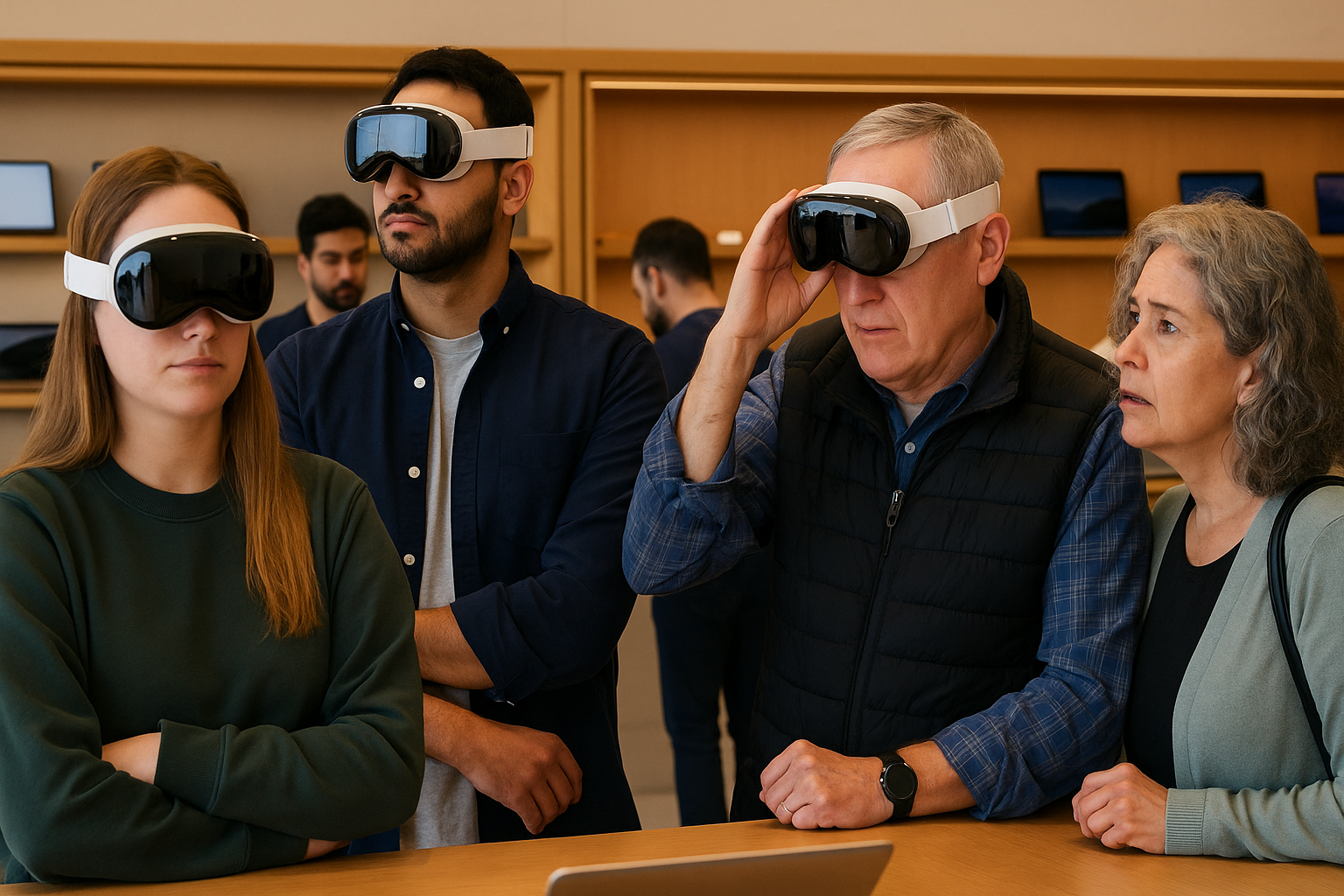
Apple cut more than 200 jobs across Vision Pro, Siri and related software teams. I’ll say it plainly: a $3,499 headset is not a platform simply because Apple built it.
On August 21, [Bloomberg](https://www.bloomberg.com/news/articles/2026-08-21/apple-cuts-jobs-in-siri-vision-pro-immersive-video-and-gaming-teams), [TechCrunch](https://techcrunch.com/2026/08/21/apple-is-reportedly-cutting-hundreds-of-jobs-from-siri-vision-pro-teams/), [9to5Mac](https://9to5mac.com/2026/08/21/apple-lays-off-200-people-across-vision-pro-and-siri-teams/) and the [San Francisco Chronicle](https://www.sfchronicle.com/tech/article/apple-layoffs-vision-pro-22399481.php) reported that Apple eliminated more than 200 roles across Vision Pro, Siri and related software teams. About 100 came from the Vision Pro organisation; roughly another 100 came from Siri and software groups, including the Intelligent Systems Experience team working on some Apple AI features. Apple confirmed the restructuring, while saying it would also create new roles.
That is not a routine tidy-up. It is a hard signal that Apple is reallocating resources because the original mix of teams and investment no longer fits where the company wants to go.
The Vision Pro dream has met the accounting department
The reports say Apple is largely shutting down the Vision Pro team focused on gaming and reducing the team producing immersive video in-house. That matters because gaming and immersive media were not side quests. They were meant to be two of the obvious reasons normal people would strap a computer to their face.
Instead, Apple is pulling back on the expensive bits.
That is the nasty truth about hardware platforms: a beautiful product demo is not a business model. You need customers, developers, content, repeat use and a price that leaves room for all of them to make money. Miss enough of those at once and even Apple ends up deciding which teams no longer fit.
The Vision Pro starts at $3,499 in the United States. At that price, Apple did not need to sell millions on day one. But it did need to prove the device could become the centre of a profitable ecosystem: an operating system developers wanted to build for, a content surface people wanted to return to, and a category Apple could expand over time.
The cuts do not prove Vision Pro is dead. Apple has reportedly told staff that Vision Pro and visionOS are continuing. But they do show something more useful for operators: Apple is changing the bet. It appears to be spending less on making premium, first-party immersive entertainment and more on AI, new devices and whatever comes next.
In plain English: the company is no longer paying to force the use case.
Siri is getting rebuilt because AI has changed the job
The more interesting part is not even the headset. It is Siri.
Apple is also cutting roles in its Siri and software teams while reorganising around a new AI-powered Siri architecture. Reports say the reshuffle reflects a change in the expertise Apple now needs. That is a polite way of saying the old organisation was built for a different technical problem.
This is what happens when a platform shift is real.
For years, voice assistants were mostly a command-and-control layer: set a timer, send a message, play a song, turn on the lights. Generative AI has raised the expectation from “do what I say” to “understand what I mean, use context, complete the work and don’t stuff it up.”
That requires different systems, different infrastructure and different people. You cannot bolt that onto a legacy product with a few glossy ads and call it transformation.
Apple’s problem is particularly sharp because its reputation rests on integration. Its customers do not care whether a useful answer came from on-device processing, a private cloud system, a model partner or a magical bloke hiding inside the iPhone. They care whether it works quickly, reliably and without handing their private life to the internet.
The upside for Apple is enormous if it gets this right. Siri is baked into a huge installed base of iPhones, Macs, iPads, Watches, AirPods and home devices. The downside is equally obvious: a weak assistant becomes a daily reminder that the world’s most valuable consumer-tech company is behind the curve.
Here is the contrarian bit: this may be Apple behaving properly
Everyone loves a story about an expensive flop. It gives the internet something to point at and laugh. Fine. But I do not think founders should learn the wrong lesson from this.
The lesson is not “never make ambitious bets.” If you only build things with guaranteed demand, you will be competing with dozens of other timid businesses for the same thin margins.
The lesson is that ambition does not excuse denial.
Apple spent years and serious money developing spatial computing. It shipped a product that pushed hardware, displays, interaction design and computing architecture forward. The evidence now appears to be telling Apple that some of the original content and gaming investment was not earning its keep. So Apple reallocated people.
That is painful for those affected, and no executive should pretend a job cut is a clever spreadsheet trick. More than 200 people have had their working lives disrupted. But operationally, it is healthier than keeping a bloated team alive merely to protect a story told at launch.
Too many founders do exactly that. They hire for the strategy deck, then defend every headcount line long after customers have voted against it. They call it conviction. Usually it is vanity with payroll.
Apple can afford vanity better than almost anyone. Which makes this move more telling, not less.
The overlooked angle: Apple is choosing a cheaper path to learning
Producing immersive video internally is expensive. Building games for a small installed base is expensive. Both are forms of subsidising an ecosystem before you know whether the ecosystem wants to exist.
Apple appears to be pulling back from that subsidy and leaning more heavily on third parties for content. That is a sensible move if the company believes the category still has a future but is not ready to bankroll every part of the supply chain.
There is a broader AI lesson here too.
Right now, companies are spending like every AI feature must be built in-house, with their own models, their own data stack, their own agent framework, their own chips and their own grand speech about the future of work. Most of them are buying complexity because it feels strategic.
It is not strategic if customers do not care.
Apple’s restructuring suggests that even the companies with the deepest pockets are being forced to distinguish between a capability worth owning and a capability worth accessing. That distinction will separate the winners from the businesses that burn cash recreating infrastructure they never needed.
Own what makes the customer choose you. Rent, partner for or cut the rest.
The real risk is not that Apple cuts too much — it is that it moves too slowly
Apple’s usual strength is patience. It waits, watches, enters late and executes well. That worked brilliantly in several product categories.
AI is less forgiving.
The competitive issue is not whether Apple can build a competent assistant eventually. Of course it can. The issue is whether “eventually” is good enough when users are already forming habits around competing AI products every day.
Habits are sticky. Once people trust another tool to draft the email, plan the trip, summarise the meeting, write the code or search their digital life, Apple is no longer simply launching a feature. It is trying to win back behaviour.
That costs more than engineering talent. It costs distribution, product judgement and speed.
The Vision Pro cuts also underline another uncomfortable point: a company can be brilliant at devices and still struggle to create a new behaviour. People do not buy technology because it is technically impressive. They buy it because it makes an existing job, desire or frustration meaningfully better.
That sounds obvious. It is apparently not obvious enough to stop billion-dollar product programmes from forgetting it.
What this means for you
If you run a business, do this tomorrow: make a list of every project, person and expense you currently defend because it supports your narrative rather than your customer.
Then ask four blunt questions.
First: what behaviour has actually changed? Not sign-ups. Not press. Not a slide deck full of projected market size. What are customers doing differently, repeatedly, because you exist?
Second: what are we subsidising? Early investment is normal. Indefinite subsidy without proof is not. If you are paying for content, services, features or sales effort that customers will not eventually value enough to support, call it what it is: a bet. Put a deadline on it.
Third: what must we truly own? Your secret sauce might be customer trust, distribution, proprietary data, workflow design or exceptional service. It is rarely every layer of the technology stack. Stop confusing control with advantage.
Fourth: have the skills required changed? If the market has moved from simple automation to AI-enabled workflows, your old org chart may be optimised for yesterday’s product. Retrain where it makes sense. Hire where it matters. But do not pretend the job has not changed just because the title has.
Apple’s more than 200 cuts are not the biggest layoff in tech, and that is not the point. They are a useful warning from a company rich enough to ignore reality for a very long time, yet smart enough not to do it forever.
A great brand can buy you attention. It cannot buy you genuine product-market fit. And no amount of futuristic footage can save a business that has not earned a place in people’s actual lives.
Sources
- Apple Cuts Jobs in Siri, Vision Pro Immersive Video and Gaming Teams — Bloomberg
- Apple is reportedly cutting hundreds of jobs from Siri, Vision Pro teams — TechCrunch
- Apple lays off 200+ across Vision Pro and Siri teams — 9to5Mac
- Apple cuts more than 200 jobs across Vision Pro and Siri teams — San Francisco Chronicle