Apple’s $349.95 Smart Lock Is Its Real AI Bet
Apple didn’t launch a smart lock on October 13. It launched a $349.95 test of whether people will trust Siri with the front door.
Apple didn’t launch a smart lock on October 13. It launched a $349.95 test of whether people will trust Siri with the front door.
That is a far more serious proposition than another chatbot that writes emails or makes a dodgy image of your dog in a suit. Apple is pushing AI into the bit of your life where a mistake is not embarrassing; it is a burglar, a missed delivery, a broken heater, or your kids locked out after school.
The real launch was not the screen
The headlines will naturally focus on Apple HomeView: a $299, 7-inch smart-home display that recognises household members, runs Siri AI and becomes available on November 13 in the US and selected English-language markets. It can sit on a bench or mount to a wall. It is Apple’s direct answer to Amazon Echo Show and Google’s Nest hubs, only with the familiar Apple promise that personal data should not become an advertising asset. ([apple.com](https://www.apple.com/newsroom/2026/10/meet-apple-homeview-a-new-way-to-enjoy-entertainment-and-manage-the-home/))
Fine. Nice product. But the screen is not the story.
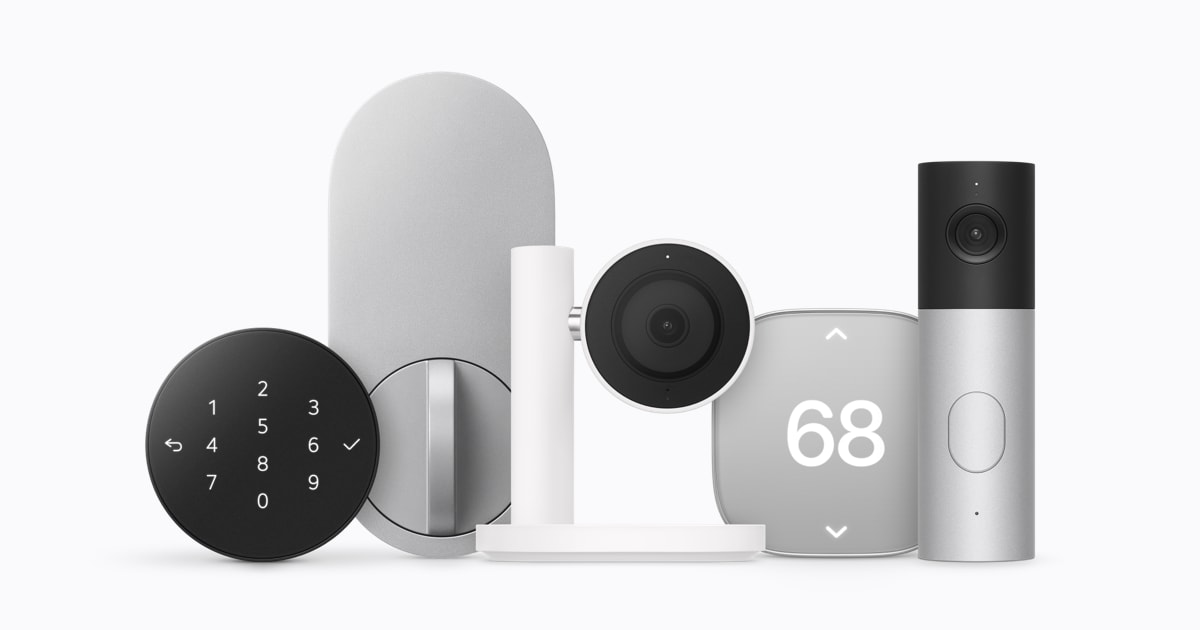
The story is Apple Home Collection: cameras, a video doorbell, temperature sensors, thermostats and a smart deadbolt, built with LG Electronics and Schneider Electric. Apple says the line will start arriving in December in the US, UK and Canada, with some accessories following in early 2027. ([apple.com](https://www.apple.com/sg/newsroom/2026/10/introducing-apple-home-collection-a-new-lineup-of-smart-home-accessories/))
That means Apple is no longer merely offering the app that controls someone else’s hardware. It is putting its name, its privacy reputation and its customer relationship on the physical infrastructure of your home.
The flagship is LG’s $349.95 Smart Deadbolt Lock. It uses Ultra Wideband to identify when an authorised person is approaching, and can detect whether the door has been opened, shut or tampered with. There is also a $249.95 wired video doorbell and a $399.95 floodlight camera. ([apple.com](https://www.apple.com/sg/newsroom/2026/10/introducing-apple-home-collection-a-new-lineup-of-smart-home-accessories/))
That is not a cheap punt at selling gadgets. It is an attempt to own the highest-trust layer of the connected home.
Apple is finally selling consequences, not convenience
Most smart-home products have been sold on convenience: turn lights on from bed, ask a speaker for music, watch a parcel arrive while you are at work. Pleasant stuff. None of it changes the economics of a household or the strategic position of a platform.
A lock does.
Once a customer gives a platform control over entry, cameras, heating, alerts and household routines, that platform is no longer an app on their phone. It becomes infrastructure. And infrastructure is where the money, retention and leverage live.
Think about the chain Apple is building. HomeView is the visible household interface. The iPhone supplies personal context. Siri AI is the conversational layer. The Apple Home app is the control plane. The lock, cameras and thermostat are the real-world endpoints. Add Apple TV 4K and HomePod devices as home hubs, and suddenly Apple has a far stickier reason for a family to stay inside its ecosystem than blue message bubbles.
Apple says its cameras can recognise people, familiar faces, pets, vehicles and packages, with footage stored through a supported iCloud+ plan rather than a separate camera subscription. Its Home Collection devices are managed through the Apple Home app, with no standalone account required. ([apple.com](https://www.apple.com/sg/newsroom/2026/10/introducing-apple-home-collection-a-new-lineup-of-smart-home-accessories/))
That last bit matters. Nobody wakes up hoping to create another password for a doorbell. The company that removes accounts, setup pain and app-hopping wins a lot of consumer goodwill before its rivals have even started their pitch deck about AI.
The question, of course, is whether Apple can make the system reliable enough that people will trust it. A smart lock that works 99.9% of the time sounds excellent until it fails on the only night you have landed at midnight with a sleeping child on your shoulder.
This is why hardware AI is different. The tolerance for nonsense is dramatically lower when atoms are involved.
The privacy angle is not fluffy marketing this time
Apple’s core differentiator is obvious: it wants the smart home to be useful without becoming a surveillance business.
Reuters reported that HomeView uses a personal search index stored on the user’s iPhone for personalised responses. Apple says private data is not stored on HomeView itself, the iPhone must be on the same home network for private-data access, and the information is not used for marketing. HomeView can recognise up to six voices and faces, which is precisely the sort of shared-household problem most AI demos conveniently ignore. ([investing.com](https://www.investing.com/news/stock-market-news/apples-homeview-brings-personalized-siri-to-smart-home-takes-on-amazon-and-google-4947587))
Apple also says Home app data is encrypted end-to-end, and that LG, Schneider Electric and Apple cannot read it. For its cameras, the company says footage and personal Home data are encrypted; processing happens locally on the customer’s home hub or through Private Cloud Compute, with supported iCloud+ users able to store encrypted footage for 10 days. ([apple.com](https://www.apple.com/sg/newsroom/2026/10/introducing-apple-home-collection-a-new-lineup-of-smart-home-accessories/))
Now, I am not asking anyone to salute a privacy press release. Businesses should earn trust with product behaviour, not adjectives. But Apple has identified the proper battlefield.
Amazon and Google have a gigantic installed base in smart-home hardware. Apple’s job is not to out-cheap them. It is to convince the household with an iPhone, a decent income and a low tolerance for digital clutter that a more private, cleaner and more integrated home is worth paying for.
That customer exists in huge numbers. And unlike bargain hunters, they tend to buy several devices, not just one.
The overlooked move: Apple did not try to build every bloody thing itself
Here is the more interesting business lesson.
Apple partnered with LG Electronics and Schneider Electric. That is unusually sensible. The company is famous for vertical integration, but it has not pretended it woke up one morning knowing more about deadbolts, outdoor cameras and HVAC systems than companies that have spent decades making them.
Instead, Apple is contributing what it is best at: software, identity, privacy architecture, industrial design standards, retail distribution and an installed base of iPhones. LG and Schneider bring category knowledge and physical-world competence.
That is not weakness. It is adult strategy.
Too many founders hear “platform” and decide they need to manufacture every component, employ every specialist and own every margin. Then they burn a fortune learning why boring industries are hard. Apple’s move says: own the customer experience and the control layer; partner where the operational scars belong to somebody else.
There is a catch. Partnerships create dependency. If installation is poor, customers do not blame the subcontractor; they blame the logo on the box. Apple is also offering third-party ADT installation at its US retail stores for an additional charge, which tells you the company understands that a thermostat and a lock cannot be treated like AirPods. ([apple.com](https://www.apple.com/sg/newsroom/2026/10/introducing-apple-home-collection-a-new-lineup-of-smart-home-accessories/))
The physical world has installers, wiring, old homes, dodgy Wi-Fi and customers who do not read instructions. Welcome to the party.
The contrarian view: the $299 HomeView may be the least important purchase
Most commentary will ask whether consumers want a $299 screen in the kitchen. Fair question. Screens are everywhere already. Your phone, iPad, television and laptop are all begging for attention.
But HomeView does not need to be a standalone smash hit to matter.
It can be a Trojan horse for higher-value hardware and recurring services. A screen that makes a home’s cameras, locks and automations easier to see and use strengthens the whole bundle. The value is not necessarily in selling one more display. It is in making the customer more likely to buy four cameras, a doorbell, a lock, iCloud+ storage and the next iPhone that improves the experience.
That is how great platform businesses work. The obvious product is rarely the entire business model.
There is another wrinkle: Apple says HomeView will not be sold in the European Union because Siri AI is currently unavailable there. ([apple.com](https://www.apple.com/newsroom/2026/10/meet-apple-homeview-a-new-way-to-enjoy-entertainment-and-manage-the-home/))
That is a commercial handicap, not a footnote. AI ambitions sound global until regulation, language support and local product availability turn them into a patchwork quilt. Operators should pay attention: distribution constraints can matter more than technical capability. A product unavailable in a major market is not “nearly global.” It is unavailable.
What this means for you
If you are a founder, operator or product leader, do not copy Apple’s devices. Copy the sequencing.
First, pick a problem where trust is expensive. Apple is not trying to win because Siri can chat longer. It is trying to win because people need a dependable system for access, security and household coordination. Find the high-consequence workflow in your market. That is where customers pay attention and stick around.
Second, own the experience, not every screw. Apple has tied together iPhone, Siri, Home, hardware partners and retail installation. Your business should identify the layer customers actually value, then partner ruthlessly for the rest. Vertical integration is brilliant when it creates an advantage. It is vanity when it just creates a larger payroll.
Third, make privacy and reliability part of the product, not legal copy. If your AI needs sensitive customer data, explain where that data lives, who can access it and what happens when the system gets it wrong. Vague assurances are dead. Customers are getting sharper.
Finally, sell the bundle, not the feature. A $349.95 lock is a hard sell in isolation. A safer, simpler, integrated home for a family already using iPhone, Apple TV and HomePod is a much easier decision. Your product should become more valuable as customers adopt more of your ecosystem. That is how you escape the monthly scramble for attention.
Apple’s smart-home bet may fail. The company is entering categories full of messy installation, entrenched competitors and no room for AI hallucinations. But the direction is right: AI gets interesting when it stops performing tricks on a screen and starts taking responsibility for real life.
That is where the money will be made. And where the mistakes will become very expensive.