Austal’s $1.35B U.S. Bid War: Why a Loss-Making Shipyard Is Gold
Austal USA lost A$202.8 million in EBIT last year. Now two serious buyers want to pay up to US$1.35 billion for it — because the real asset is not this year’s profit.
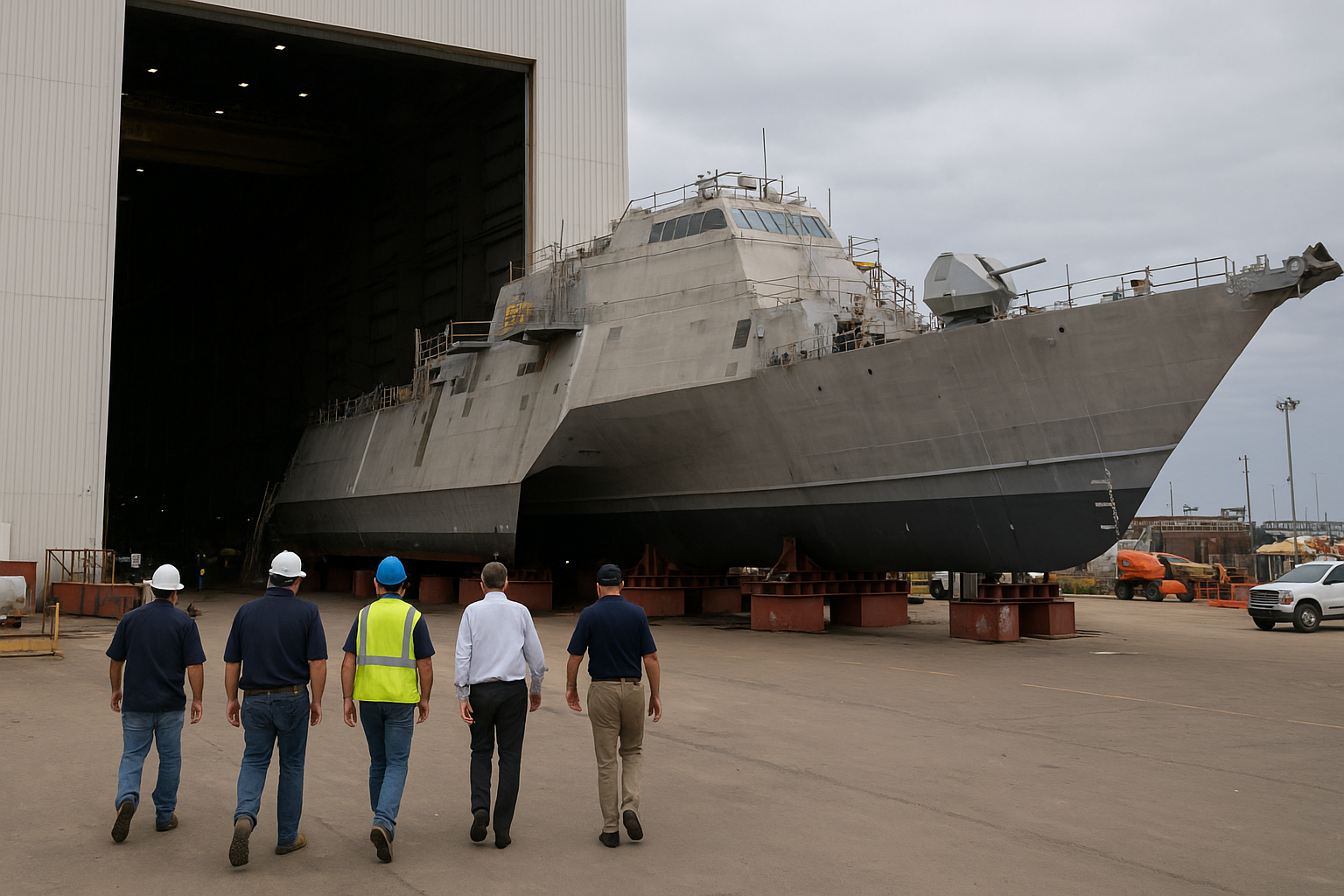
Austal USA lost A$202.8 million in EBIT in FY2026. That is not usually the sort of performance that gets buyers queueing at the door with US$1.35 billion.
Yet here we are.
On September 9, Wildcat Infrastructure put forward a non-binding indication that values Austal’s U.S. business at US$1.25 billion to US$1.35 billion, cash-free and debt-free. It tops Hanwha’s August proposal of US$1.05 billion to US$1.20 billion.
That is not a turnaround story. Not yet. It is a reminder that when an asset sits in the right bottleneck, a bad year can be less important than the next ten.
The core story: two buyers want the same hard thing
Austal is the Australian shipbuilder with major operations in the United States, including its shipyard in Mobile, Alabama. Its U.S. business builds and supports vessels for the U.S. Navy and Coast Guard, and it has become involved in the submarine industrial base through module production for Virginia-class and Columbia-class submarines.
Wildcat’s proposal is not a signed deal. That distinction matters. It is non-binding and depends on four weeks of due diligence. Austal’s board is considering it, and there is no certainty it becomes a definitive agreement.
But the offer is real enough to matter because it is higher than Hanwha’s earlier approach.
Hanwha, the South Korean industrial group, made its initial proposal in August. Its range topped out at US$1.20 billion. Wildcat has now put a maximum value US$150 million higher on the table.
The market got the message. Austal shares rose as much as 9% to A$4.74 after the Wildcat proposal emerged.
Investors are not celebrating because Austal suddenly became a beautifully run, high-margin U.S. business. They are celebrating because competition is the only valuation consultant that matters. One bidder gives you a reference point. Two bidders give you leverage.
And for Austal shareholders, that is the game now: can the board turn a preliminary interest into a properly priced, executable deal?
Why anyone would pay up for a business losing A$202.8 million
This is where most investors get it wrong. They see the A$202.8 million EBIT loss and reach for the nearest red pen.
The loss matters. Of course it does. Cost overruns, difficult legacy contracts and execution problems are not some minor accounting inconvenience. They are precisely the things that can turn a supposedly strategic acquisition into a very expensive headache.
But the buyers are looking at a different ledger.
Austal USA is not merely a factory that spits out boats. It is one of the scarce industrial platforms already operating inside the American defence-manufacturing ecosystem. It has shipyard infrastructure, a trained workforce, security credentials, Navy and Coast Guard relationships, active programs, and a position in submarine-module production.
You cannot build that from scratch because you woke up one morning with a billion dollars and a PowerPoint deck.
In particular, Austal USA has been producing critical modules for Virginia-class and Columbia-class submarines since 2022. Its Manufacturing Module Facility 3 is designed to expand that capacity, with roughly 390,000 square feet of indoor manufacturing space planned to support the U.S. Navy’s production ambitions.
That is the asset. Not a heroic spreadsheet forecast. Not a consultant’s synergy slide. Access to scarce industrial capacity in a market where the customer has strategic urgency and very few credible suppliers.
A buyer looking at Austal USA can reasonably believe the recent losses are fixable while the strategic position is irreplaceable. That does not mean they are right. It means they are buying an option on fixing the operations without having to spend a decade building the platform first.
The background: shipbuilding is suddenly a geopolitical business
For years, plenty of investors treated shipbuilding as an old-economy slog: capital-heavy, labour-heavy, cyclical, difficult and not particularly glamorous.
All true.
But geopolitical reality has a funny way of making dull industries sexy again. America needs more naval capacity. It needs greater submarine output. It needs suppliers that can manufacture, repair and sustain complex vessels. Governments can announce all the defence spending they want, but money does not weld steel, train shipbuilders or create qualified production capacity overnight.
That makes existing yards and industrial know-how more valuable than they look in a backward-looking earnings multiple.
Hanwha understands this. It bought Philly Shipyard in 2024 and has made no secret of its ambition to expand in U.S. defence manufacturing. Its bid for Austal USA was part of that push.
Wildcat’s arrival changes the temperature. Its indication says it wants Austal USA to remain a standalone platform, preserving the Austal name and U.S. operations. That sounds reassuring, but don’t confuse stated intent with a completed operating plan. Every bidder says the right things before diligence. The important question is whether its capital, management bench and appetite for operational pain match the job.
Because this job has pain.
Austal’s FY2026 U.S. loss was largely tied to a non-cash provision on onerous contracts, alongside the practical challenges that come when a shipbuilder moves from established production work into earlier-stage design, rectification and commissioning activities. In plain English: building sophisticated defence vessels is hard, and fixed-price or poorly structured contracts can bite your face off.
The overlooked angle: the US$150 million gap is not the point
Everyone will focus on the higher price. Fair enough. US$1.35 billion is more than US$1.20 billion.
But the difference between the top ends of the two ranges is only US$150 million, or 12.5%. That is not enough on its own to decide a deal of this complexity.
The winner will need to clear a far more brutal checklist:
- Can it finance the purchase on acceptable terms? - Can it satisfy U.S. national-security and defence-contracting requirements? - Can it retain the people who actually know how to run the yard? - Can it deal with troublesome legacy programs without torching the economics? - Can it invest enough capital to grow submarine and naval capacity while fixing today’s mess?
That last point is where inexperienced dealmakers get themselves into trouble. They buy the asset, congratulate themselves on the acquisition, then discover they have purchased a hungry machine that needs more capital, more talent and more management attention than the investment committee ever admitted.
The acquisition price is just the ticket at the gate. The real cost starts after you walk in.
That is why Wildcat’s standalone promise is worth watching. If it means patient capital, operational autonomy and serious investment in the yard, it could be a sensible structure. If it means financial engineering dressed up as patriotism, Austal’s problems will simply get a new shareholder register.
Hanwha has a stronger obvious industrial story. It already operates in shipbuilding and defence, and it has been building a U.S. footprint. But that strategic fit may also attract more scrutiny. Defence assets are not ordinary widgets. When foreign ownership, sensitive programs and military supply chains collide, politics can become the deciding shareholder.
What this means for you
Whether you are a founder, operator or investor, there are five useful lessons here.
First, buy bottlenecks, not narratives. Austal USA is valuable because qualified defence manufacturing capacity is hard to reproduce. In your own business, identify what customers cannot quickly replace: distribution, regulated permissions, trusted data, trained teams, supplier relationships or physical capacity.
Second, separate a bad year from a broken business. A$202.8 million of lost EBIT is ugly. But ugly financials do not automatically mean worthless assets. Ask what caused the loss, whether it is contained, and whether the underlying strategic position has strengthened or weakened.
Third, competition is a strategy. Austal did not need to manufacture drama. Once multiple credible buyers emerged, the asset became more valuable. Founders should remember this when raising capital or considering a sale: build genuine alternatives before you need them. Desperation gets priced into every term sheet.
Fourth, do not mistake headline price for deal quality. US$1.35 billion sounds better than US$1.20 billion. It may be better. But certainty of funding, regulatory risk, liabilities, employee retention and post-deal investment can easily outweigh US$150 million.
Finally, the best opportunities often look operationally annoying. Everybody wants clean software margins and a simple story. Real wealth is often made where the work is difficult, the asset is scarce and the crowd cannot be bothered understanding the details.
Austal USA may or may not sell. Wildcat may or may not beat Hanwha. But the signal is already clear: in a world short of industrial capacity, the companies that can actually make strategically important things are becoming far more valuable than their latest profit number suggests.
That is worth remembering before you dismiss a business just because its current year looks ugly.