BioNTech’s €17.2B Test: Guido Oelkers Replaces Uğur Şahin
€17.2 billion in cash will not save BioNTech if it cannot turn science into products. Replacing founder Uğur Şahin with Guido Oelkers is a commercial gut-check.
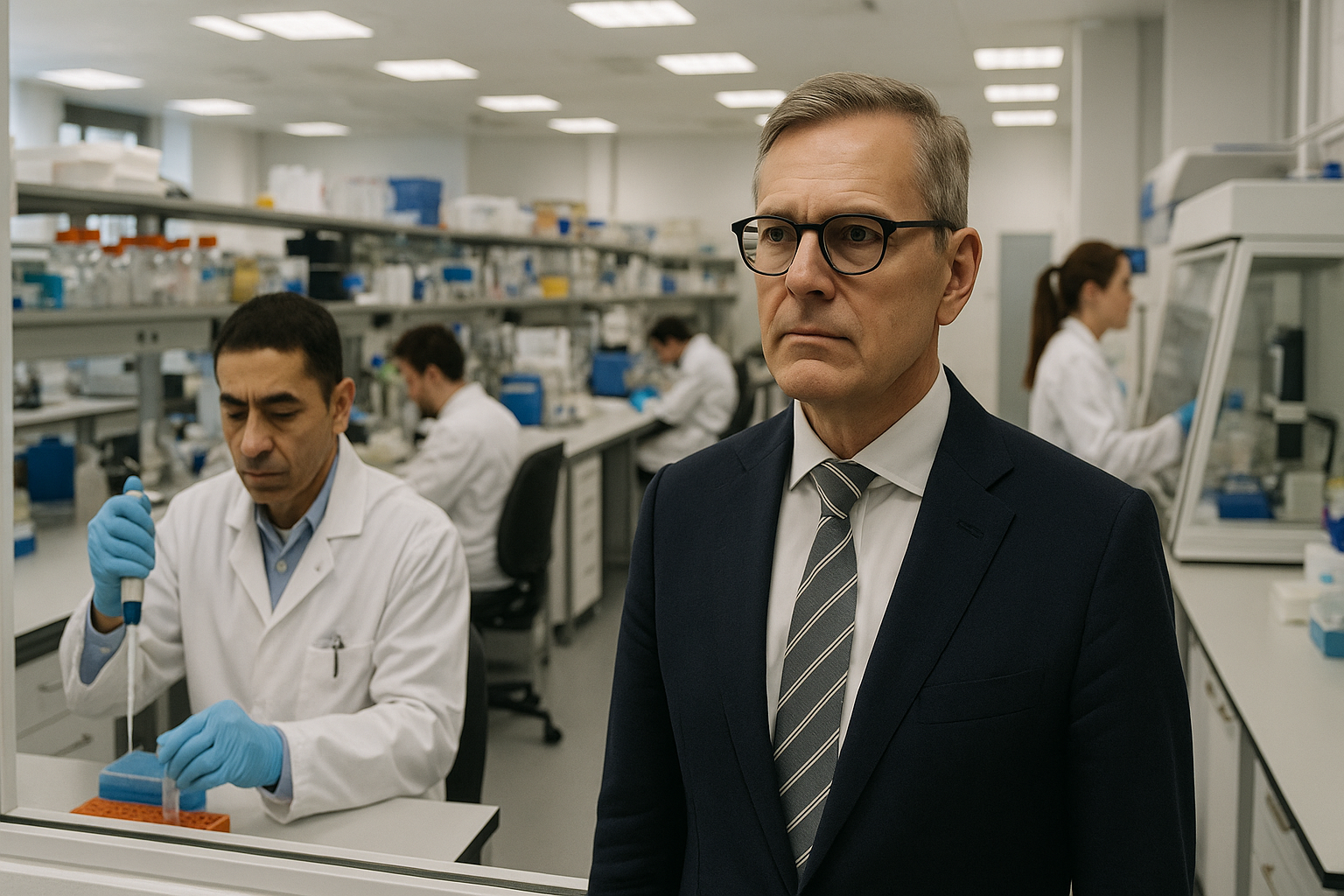
€17.2 billion in cash will not save BioNTech if it cannot turn science into products. Its two defining founders are walking out the door, and that is not a succession plan — it is a test of whether a miracle company can survive contact with the real world.
On August 3, BioNTech named Guido Oelkers as its next chief executive, replacing co-founder Uğur Şahin no later than February 1, 2027. Şahin and BioNTech co-founder and Chief Medical Officer Özlem Türeci had already said in March they would leave by the end of 2026 to start a new venture.
Let’s call it plainly: this is one of the biggest leadership handovers in European biotech. Not because another executive got a fancy title, but because BioNTech must now prove it is more than the company that made a fortune during COVID.
The founder era is ending — with €17.2 billion on the table
BioNTech’s COVID-19 vaccine partnership with Pfizer created one of the great business windfalls of the pandemic. But windfalls expire. The company reported €2.9 billion in 2025 revenue, a €1.1 billion net loss and €17.2 billion in cash, cash equivalents and security investments at year-end.
That last number is the headline. A cash pile of €17.2 billion gives management room to make mistakes, fund trials, acquire assets and wait for data. It does not give them the right to be vague, slow or sentimental.
BioNTech expects 2026 revenue of €2.0 billion to €2.3 billion, while forecasting adjusted research and development spending of €2.2 billion to €2.5 billion. In other words, this is no longer a vaccine cash machine. It is a capital-allocation machine with a massive scientific engine attached.
That is why the board’s choice matters.
Şahin was not simply a CEO. He was a founder-scientist whose identity became wrapped up with the company’s mRNA breakthrough. Türeci was not merely the chief medical officer. Together, they were the intellectual centre of gravity. Every founder-led business eventually faces the same uncomfortable question: are we building an institution, or are we just renting the founders’ brilliance?
BioNTech is about to find out.
Guido Oelkers is not being hired to be inspirational
Oelkers comes from Swedish Orphan Biovitrum, better known as Sobi, where he has been CEO since 2017. BioNTech says he brings more than 30 years of experience in biotech and pharmaceuticals, with a record in scaling organisations, prioritising portfolios, capital allocation and commercial operations. During his time at Sobi, the company says revenue increased more than fourfold.
That background tells you what BioNTech thinks it needs next: not another scientist to explain the science, but an operator who can turn a sprawling set of scientific bets into actual medicines, actual launches and actual returns.
Good. That is overdue.
Founders often build companies by refusing to listen to people who say something is impossible. That is exactly what you want at the start. It is less useful when the business becomes large, complicated and flush with cash. At that point, you need someone who can kill projects, set priorities, hire adults and make a commercial call without turning every meeting into a seminar.
BioNTech has said 2026 should bring six late-stage data readouts across immunomodulators, antibody-drug conjugates and mRNA cancer immunotherapies. It also expects eight global Phase 3 trials involving its PD-L1/VEGF-A bispecific immunomodulator pumitamig to be ongoing by year-end with Bristol Myers Squibb.
That is not a cute innovation portfolio. It is an operating challenge. Clinical data, regulatory work, manufacturing, pricing, reimbursement, physician adoption, partnerships and sales infrastructure all need to line up. Missing any one of those can turn a brilliant drug into an expensive science project.
Oelkers has been hired to make that machinery work.
The real job: spend less like a lab, think more like an owner
Here is the trap facing BioNTech: having lots of money can make smart people behave stupidly.
When a company has €17.2 billion sitting there, every project can look fundable. Every acquisition can be described as strategic. Every executive can argue for another team, another platform and another two years. Before long, you have 40 priorities, which is the corporate version of having none.
I have seen this in businesses far smaller than BioNTech. Cash does not create discipline. It exposes whether you had any in the first place.
The new CEO’s most important decision may not be what BioNTech buys. It may be what he refuses to buy, fund or prolong. Investors love to talk about pipeline breadth, but portfolio breadth is often camouflage for a lack of conviction.
A proper commercial operator should ask brutally simple questions:
- Which programs can plausibly become products with meaningful demand? - Where does BioNTech have a genuine edge rather than a slide deck full of hope? - What will it cost to win, not merely to get approved? - Which projects should be partnered, sold or shut down? - Who owns the commercial outcome when the product leaves the lab?
Those are not anti-science questions. They are how science survives long enough to help patients and shareholders.
The overlooked risk is not Oelkers — it is founder withdrawal
Everyone will watch Oelkers. Fair enough. But the more interesting question is what happens to the organisation after Şahin and Türeci leave.
Founder transitions fail when the departing people take the informal operating system with them. They know who can make decisions. They know which research programme is genuinely promising and which one is politically protected. They know where the bodies are buried, figuratively speaking. A new CEO can read every board paper in the world and still miss that knowledge.
BioNTech has given itself time: Oelkers is due to take over by February 1, 2027, while the founders plan to leave by the end of 2026. That is sensible. But an overlap period only works if it is designed properly.
The founders need to transfer decisions, relationships and accountability — not merely hand over a calendar and pose for photos. Oelkers needs clear authority before day one, particularly over capital allocation, senior talent and commercial build-out. If people spend six months wondering whether the old regime might overrule the new one, the transition becomes theatre.
Boards get this wrong all the time. They announce a successor, praise continuity, then create a vague half-life in which nobody knows who is really in charge. That is how good people leave and mediocre people wait it out.
The contrarian angle: BioNTech should become less romantic
The market will naturally ask whether Oelkers can preserve BioNTech’s innovative spirit. I think that is the wrong fear.
BioNTech does not need to become more romantic about innovation. It needs to become more ruthless about converting innovation into outcomes.
The company’s scientific identity is already strong. Its problem is the brutal gap between proving something can work and building a repeatable commercial business around it. The most dangerous sentence in biotech is: “The data is promising.” Promising for whom? In which indication? Against what standard of care? At what price? With what manufacturing complexity? Sold by whom?
A founder-led company can sometimes survive on belief. A mature public company cannot. It needs a scoreboard.
That does not mean Oelkers should march in and turn BioNTech into a spreadsheet factory. That would be equally dumb. The best version of this succession is simple: protect the scientific ambition, but impose commercial consequence. Keep funding the big swings. Stop pretending every swing deserves the same money and time.
What this means for you
Whether you run a startup, lead a division or invest your own money, BioNTech’s handover is a useful lesson: succession is not about replacing a person. It is about replacing the capabilities that person concentrated in themselves.
Do this tomorrow.
First, write down the three decisions only you make. Not the tasks you do — the decisions nobody else can make without you. If you cannot name them, you are probably not leading clearly. If you can name 15, you have built a bottleneck, not a business.
Second, separate discovery from delivery. Your best creative people should be allowed to explore. But somebody with authority must decide which ideas receive serious resources, which get a small experiment and which get killed. Hope is not a budget.
Third, make your successor testable before you need one. Give them a real commercial decision, a real hiring decision and a real crisis to manage while you are still around. A handover after the founder quits, gets sick or burns out is not succession. It is panic with a press release.
Finally, if you are an investor, stop being hypnotised by big cash balances. Cash is not the asset. The judgement applied to it is the asset. BioNTech has plenty of ammunition. Guido Oelkers now has to prove he can aim it.
That is the whole game: founders create the miracle. Operators make sure it does not become a museum piece.