Blackstone’s $448M South Korea Logistics Bet
A $448 million South Korean warehouse project in a market carrying 15.5% vacancy sounds like a textbook way to lose money. Blackstone just bought control anyway.
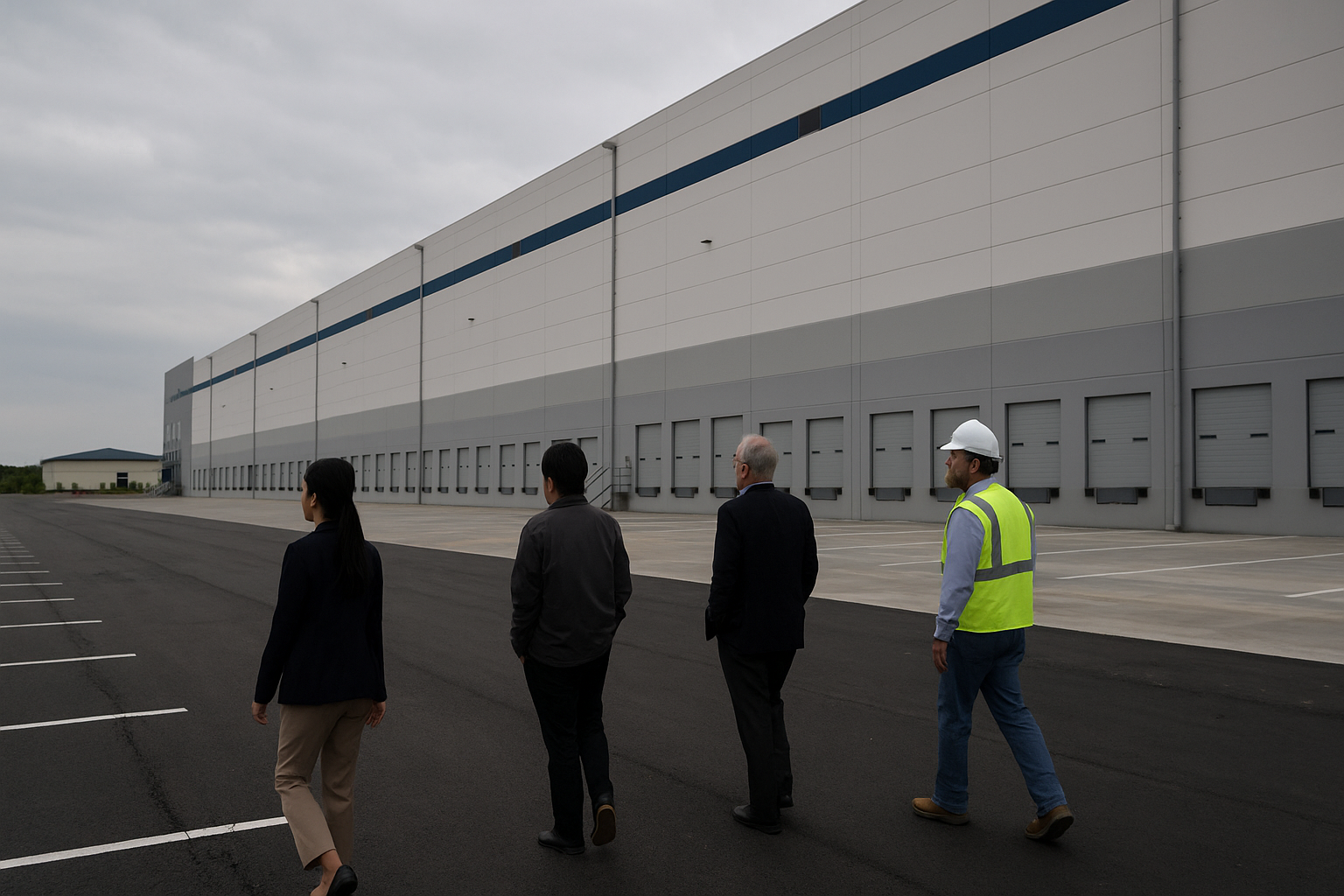
A $448 million South Korean warehouse project in a market carrying 15.5% vacancy sounds like a textbook way to lose money.
Blackstone has just taken a majority stake in it anyway. That is either a very expensive bout of optimism or a useful lesson in how serious property investors actually think.
Blackstone is buying the warehouse, not the headline
On September 10, Blackstone and Singapore-based real-asset manager ESR announced that funds managed by Blackstone Real Estate Partners had acquired a majority interest in Sanha Logistics Park II through a primary share issuance. ESR remains invested and, importantly, keeps the jobs that matter day to day: development manager and asset manager through its Korean platform, ESR Kendall Square.
Sanha is a dry-storage logistics development in South Korea’s Seoul Metropolitan Area. It is under construction, spans 334,000 square metres and is expected to finish in 2028. ESR told Reuters that total development cost is about KRW 600 billion, or US$448.3 million.
Read that carefully: US$448.3 million is the project’s total development cost, not the disclosed price Blackstone paid. Blackstone did not disclose the value of its majority stake. Anyone confidently calculating its return from the press release is doing property analysis with a blindfold on.
The site sits along the Gyeongbu Expressway, the major corridor linking Seoul and Busan, inside an established distribution and manufacturing hub. It is being built with substantial power capacity and designed for warehouse automation, with intended customers including third-party logistics providers, e-commerce platforms and retailers.
That last bit is the whole game. Blackstone is not buying a big empty shed because “logistics” looks sexy in a PowerPoint. It is backing a specific operating premise: modern supply chains will pay more for locations, power and layouts that let them move goods faster and with fewer people.
That premise may prove right. But it is not risk-free, and pretending otherwise is how investors end up calling a bad asset “long-term strategic” for seven years.
The market has improved. It has not become easy.
The lazy take is that e-commerce makes every warehouse valuable. Rubbish.
Greater Seoul’s logistics market has been working through an oversupply hangover. JLL reported that vacancy in the Seoul Capital Area was 15.5% in the second quarter of 2026, unchanged from the prior quarter. That is not a scarcity market. It means tenants have options, landlords have competition, and a mediocre building can sit there earning excuses rather than rent.
But conditions are getting less bad in ways that matter. JLL said new supply delivered to the market in the second quarter was 68,800 pyeong, while 2026 supply is forecast at roughly 47% of 2025 levels and only about 15% of 2024 levels. It also expects ongoing demand from 3PL, e-commerce and manufacturing occupiers to push net absorption above completions.
Cushman & Wakefield describes 2025 as a structural turning point for Greater Seoul logistics: new supply fell 73% year on year, demand became more selective, and foreign capital represented 74% of total transaction volume.
That is the bit most punters miss. A recovery in property is rarely announced by a brass band. It begins when supply stops flooding in, weaker assets become visibly weaker, and capital starts paying up for the small pool of buildings that actually work.
Sanha will not open until 2028. So Blackstone is not wagering on today’s vacancy rate alone. It is wagering that by completion, less new competing stock will be arriving and the tenants that matter will care more about operational productivity than simply the cheapest square metre.
That is a far more sophisticated bet than “warehouses good.”
Why Blackstone kept ESR in the driver’s seat
This is also a nice little masterclass in not confusing capital with capability.
Blackstone brings scale, global real-estate expertise and the ability to write a big cheque without organising a bake sale. ESR brings local development and operating knowledge, including its ESR Kendall Square platform. Neither side is pretending it can do the other’s job better.
Too many investors, especially successful founders who have made their first serious pile, make the opposite mistake in property. They believe buying the asset means they understand the asset. Then they discover that permits, power capacity, tenant specifications, construction sequencing, lease-up and local relationships are not minor administrative details. They are the investment.
The primary-share-issuance structure matters as well. It signals new equity going into the project, not simply Blackstone paying ESR to cash out. ESR stays exposed. In my book, that is better alignment than a seller who takes the money, waves goodbye and leaves you holding a beautifully rendered problem.
Blackstone said this is its third logistics investment and fifth investment announcement across businesses in South Korea in the past 14 months. It had already acquired two Grade A last-mile logistics centres in the Seoul area in July 2025, covering 1.3 million square feet in Gimpo and Namyangju.
That does not make Sanha automatically brilliant. It does tell you this is not a tourist taking one speculative punt in a foreign market. It is a deliberate build-out of a theme, with local partners, following prior transactions.
The contrarian angle: vacancy can be your friend
Here is the uncomfortable truth: investors love buying buildings with low vacancy because it feels safe. Usually, by the time an asset looks unquestionably safe, it is priced like a winning lottery ticket.
A 15.5% market vacancy rate is ugly. But it can create opportunity if three things happen: new supply falls, demand concentrates in better facilities, and you can survive long enough for the market to distinguish quality from quantity.
Sanha is deliberately aimed at that distinction. Its location is connected to key distribution routes. Its power capacity supports automation. Its planned customer base is made up of users for whom throughput, labour efficiency and network design matter. That does not guarantee tenants. It gives the project a reason to exist beyond being another concrete box with a loading dock.
The risk is equally clear. Higher-spec buildings cost more. Automation-ready facilities need tenants willing and able to use the capability. Borrowing costs are not cooperating either: JLL notes that the Bank of Korea raised its base rate to 2.75% in July, which could raise financing costs and dampen deal activity in the second half of 2026.
So this is not a call to rush out and buy every vacant industrial unit within driving distance of an airport. The trade is more selective than that. The winners are likely to be assets that save customers time, labour or transport cost—not merely ones labelled “logistics.”
What Blackstone is really buying: future bargaining power
Property investors talk endlessly about cap rates. Operators should talk more about bargaining power.
If Sanha opens into a tighter development pipeline with demand from major 3PL, e-commerce and retail users, the landlord has a better chance of commanding rent because the building solves real operational problems. If it opens into another glut, the tenant has the upper hand and the fancy power capacity becomes an expensive brochure feature.
This is why the timing matters more than the building’s sheer size. Blackstone and ESR are trying to deliver into the gap after the supply binge, not during it.
There is a broader lesson here for anyone watching commercial property from Australia, the US or anywhere else. Do not invest by asset-class label. “Industrial,” “office,” “retail” and “data centre” are categories for spreadsheets. The money is made in the submarket, the tenant profile, the supply pipeline, the cost of capital and the operator’s ability to execute.
A great warehouse in the wrong location is still a bad investment. A well-located warehouse with no power for the tenant’s machinery can be just as bad. And a theoretically perfect asset bought at a stupid price remains stupid.
What this means for you
If you are a founder, investor or property operator, steal the useful parts of this deal rather than admiring the size of Blackstone’s cheque.
First, separate headline risk from asset-level reality. A 15.5% vacancy rate is a warning, not a conclusion. Ask where vacancy sits, which buildings are empty, what new supply is coming, and whether your target asset offers something tenants will pay for.
Second, buy capability with the asset. If you do not have local operating expertise, retain or partner with someone who does—and make sure they still have economic skin in the game. Capital without execution is just a more expensive way to learn.
Third, underwrite the exit from day one. Sanha is due to complete in 2028, so the underwriting has to survive construction, leasing and interest-rate risk before the asset produces mature income. Your own deal should have the same honesty. Model delays, vacancy, incentives, refinancing and the ugly case—not only the one that makes you feel clever.
Finally, hunt for functional scarcity. The best investments are not always scarce because there are few of them. They are scarce because few of them do the job properly. That can mean power, access, approvals, automation, tenant fit or a team that knows how to operate the thing.
Blackstone has not bought a warehouse because warehouses are fashionable. It has bought control of a 2028 delivery into a changing market, alongside the local operator that has to make it work.
That is the sort of boring, precise thinking that gets you rich. The logo on the hard hat is irrelevant.