Boston Dynamics’ 30,000-Robot Bet Hires Amazon’s Rohit Prasad to Deliver
Thirty thousand robots a year by 2028 is not a robotics demo. It is a manufacturing promise — and Boston Dynamics has hired Amazon’s Rohit Prasad because promises this expensive need an operator, not another bloke doing backflips on stage.
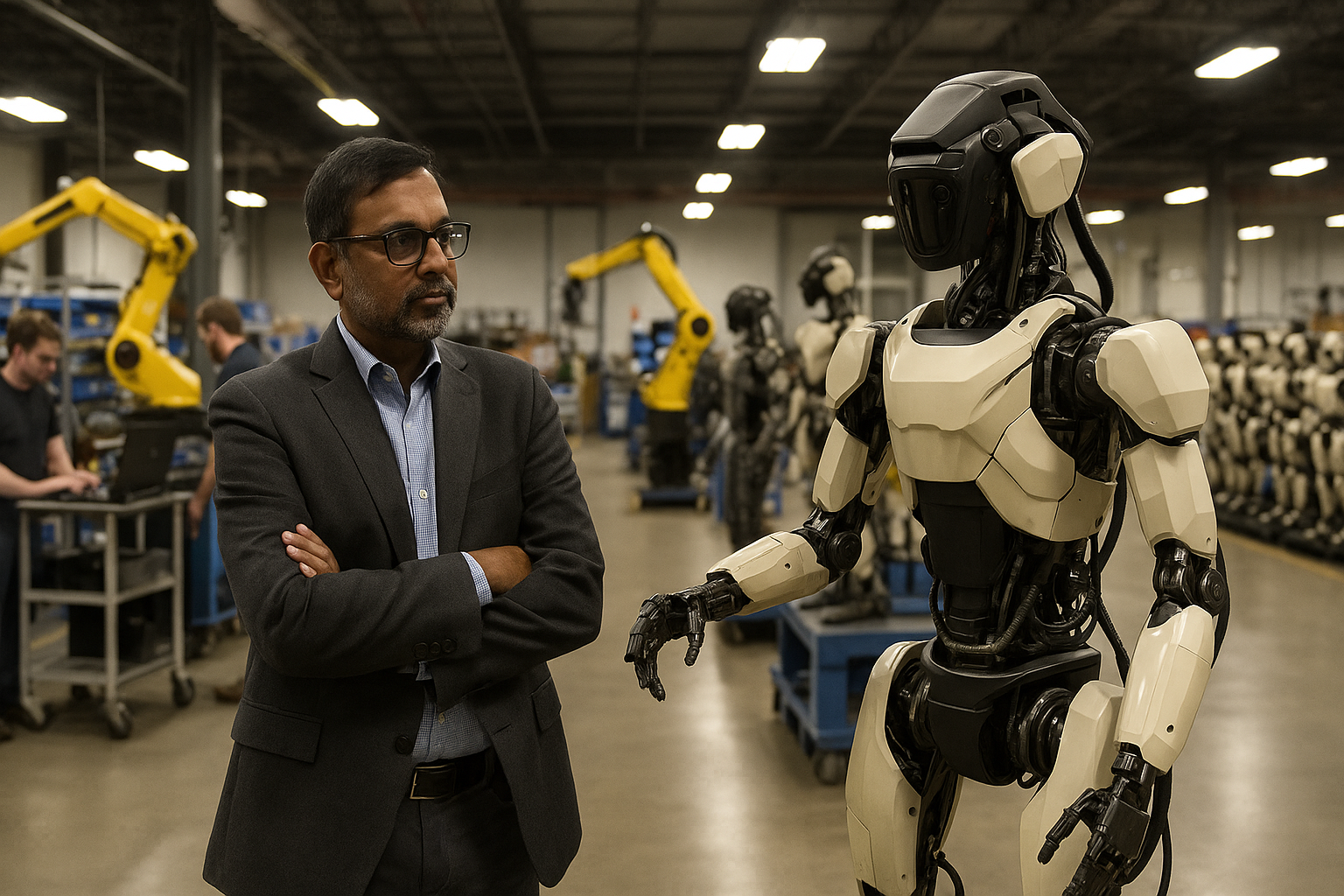
Thirty thousand robots a year by 2028 is not a robotics demo. It is a manufacturing promise — and Boston Dynamics has hired Amazon’s Rohit Prasad because promises this expensive need an operator, not another bloke doing backflips on stage.
Boston Dynamics named Prasad chief executive effective October 7, replacing Robert Playter, who stepped down in February. Prasad spent 12 years at Amazon, most recently as senior vice president and head scientist for Alexa and Amazon’s artificial-general-intelligence work. That is the headline. The actual story is harsher: Hyundai has turned Boston Dynamics from a very clever robotics company into a commercial deadline with an enormous number attached. ([bostondynamics.com](https://bostondynamics.com/news/boston-dynamics-appoints-rohit-prasad-as-chief-executive-officer/?utm_source=openai))
Boston Dynamics Has Moved From Theatre to Targets
For years, Boston Dynamics was the internet’s favourite robotics company because its machines looked uncanny. Spot trotted around. Atlas jumped, danced and made everyone alternately excited and mildly nervous about the future.
But viral clips don’t build a serious business. They build awareness. There is a bloody big difference.
Hyundai Motor Group’s plan is to create annual production capacity for 30,000 robot units by 2028, with Atlas beginning work at Hyundai Motor Group Metaplant America in Georgia in 2028 on parts-sequencing tasks. The company says deployment would then expand to component assembly by 2030. Atlas has 56 degrees of freedom and a stated lifting capacity of up to 110 pounds. Those are not consumer-toy specifications; they are factory-worker specifications. ([hyundaimotorgroup.com](https://www.hyundaimotorgroup.com/en/news/hyundai-motor-group-announces-ai-robotics-strategy--to-lead-human-centered-robotics-era-at-ces-2026?utm_source=openai))
That makes Prasad’s appointment more consequential than the usual press-release fluff about a new CEO “leading the next chapter.” His job is not to make robots more entertaining. His job is to make them reliable enough, cheap enough, safe enough and useful enough that operations managers will reorder them.
This is where the romance dies and the business starts.
A robot that can do something once under controlled conditions is a science project. A robot that can do it every shift, around people, with changing materials, imperfect data, maintenance requirements and a finance director asking about payback is a product. Most founders learn that distinction eventually. Robotics founders learn it with more zeros involved.
Why Rohit Prasad Makes Sense — and Why the Hire Is Risky
Prasad is not being hired because Alexa was universally adored. Let’s be honest: plenty of people have yelled at a smart speaker that misunderstood a dead-simple request. That is exactly why this appointment is interesting.
Amazon had to wrestle with the ugly bits of artificial intelligence at consumer scale: speech recognition, messy human behaviour, failed interactions, privacy expectations, product integration, developer ecosystems and the relentless cost of serving millions of users. Boston Dynamics needs a leader who understands that AI is not valuable because it can be demonstrated. It is valuable when it works repeatedly for customers who do not have time to babysit it.
Boston Dynamics says Prasad helped build and scale Alexa and created the Amazon Nova family of foundation models. It has explicitly framed his brief as accelerating the combination of advanced AI and robotics, then commercialising physical-AI applications across industries. ([bostondynamics.com](https://bostondynamics.com/news/boston-dynamics-appoints-rohit-prasad-as-chief-executive-officer/?utm_source=openai))
That is the sensible case for him.
The risk is equally obvious. Voice assistants and humanoid robots are not the same animal. When Alexa gets your playlist wrong, you swear at a speaker. When a robot moving parts in a factory gets something wrong, production stops, someone could get hurt, and the customer will not care about your lovely AI roadmap.
Physical AI has to survive physics, not merely impress an algorithm benchmark. Batteries degrade. Sensors get dirty. Floors are uneven. Components vary. Networks drop out. Humans do unpredictable things because humans are, quite frankly, a menace to any neat operating plan.
Prasad’s real test is whether he can build an organisation that treats those problems as the product, not as annoying exceptions to the product.
Hyundai Is Building Its Own First Customer
Here is the underrated part of this story: Hyundai is not merely backing a robotics company and hoping somebody else figures out demand. It is creating the proving ground itself.
Hyundai has said it wants Boston Dynamics embedded in its wider AI-robotics strategy, using its manufacturing network as a place to train, test and scale robotic systems. Its partnership structure includes Boston Dynamics, Hyundai Mobis on high-performance actuators, and collaboration with AI leaders including Google DeepMind. ([bostondynamics.com](https://bostondynamics.com/news/hyundai-motor-group-announces-ai-robotics-strategy-to-lead-human-centered-robotics-era-at-ces-2026/?utm_source=openai))
That is a serious advantage. Startups trying to sell industrial technology often hit the same brick wall: customers say they love innovation right up until innovation threatens this quarter’s output. Then the pilot gets delayed, the committee multiplies and everyone goes back to spreadsheets.
Boston Dynamics has a parent company that can put the machines into real factories. It can collect evidence on uptime, workflows, safety, training and economics before asking external customers to take a leap. In business terms, Hyundai can be both laboratory and launch customer.
That does not guarantee success. Internal customers can be too patient with mediocre economics because the group wants the strategy to work. It is one thing to deploy Atlas in a Hyundai plant; it is another to convince a hard-nosed manufacturer with no emotional attachment to Boston Dynamics to spend real money at scale.
Still, I would rather own the factory where the product gets bloodied than run a robotics company that learns from PowerPoint decks.
The Contrarian View: The Robot Is Not the Product Yet
Everyone is fixated on the humanoid form. Two arms, two legs, vaguely person-shaped — terrific. It makes for excellent videos and gets people talking about robot workers.
But the humanoid body is not the commercial breakthrough. The operating system around it is.
The winner will be the company that makes deployment boring. That means installation measured in days rather than months; operators trained without a PhD; software that integrates with factory systems; remote monitoring; predictable maintenance; spare parts; clear liability; and a return-on-investment calculation a plant manager can explain to the board without using the phrase “transformational potential.”
This is where Prasad’s background matters most. Amazon is a machine for building platforms and operational systems around technology. Boston Dynamics does not need to become Amazon. It does need to borrow that muscle: product discipline, customer obsession, repeatable deployment and a ruthless view of where the machine fails.
The company’s 30,000-unit target also creates a healthy pressure test. If that number is real, every decision changes. You cannot hand-build 30,000 robots a year. You cannot support them with a handful of heroic engineers. You cannot sell them through demos alone. You need supply chains, manufacturing yield, service infrastructure, financing options, software updates and customers with a reason to buy a second unit after the first.
That is not robotics glamour. That is management.
What This Means for You
Whether you build robots or run a normal business, Boston Dynamics offers a useful reminder: when strategy becomes expensive, leadership has to become operational.
First, separate a capability from a product. Ask yourself: can our customer use this without our best people standing beside them? If the answer is no, you have a bespoke service disguised as a scalable business.
Second, build a real test environment. Hyundai has its factories. You need your equivalent: a customer, business unit or market where you can test the ugly realities before you announce grand plans. A controlled pilot is not cowardice. It is how you avoid discovering your business model is fantasy after you have hired 100 people.
Third, hire for the bottleneck you actually have. Boston Dynamics did not need another person who could say “AI” confidently on a panel. It needed someone with experience turning advanced technology into global products. Look at your own company honestly. If sales are weak, stop hiring more strategy people. If delivery is breaking, stop hiring brand specialists. Find the constraint and recruit directly against it.
Finally, put a number on the ambition. Hyundai’s 30,000-unit target may prove too aggressive, too conservative or exactly right. But it forces a real conversation. Targets expose whether the people in the room understand what must be true for the plan to work.
That is the value of Prasad’s new job. Boston Dynamics is no longer being judged on whether its robots look like the future. It is being judged on whether they can earn their keep in it.