Campbell’s $3.49 Soup and Trump’s 25% Steel Tariff
A Campbell’s chicken-noodle soup can that cost $1.99 in 2018 now costs $3.49. No, tariffs didn’t cause every cent — but anyone saying a 25% steel tariff is “nothing” is selling you a fairy tale.
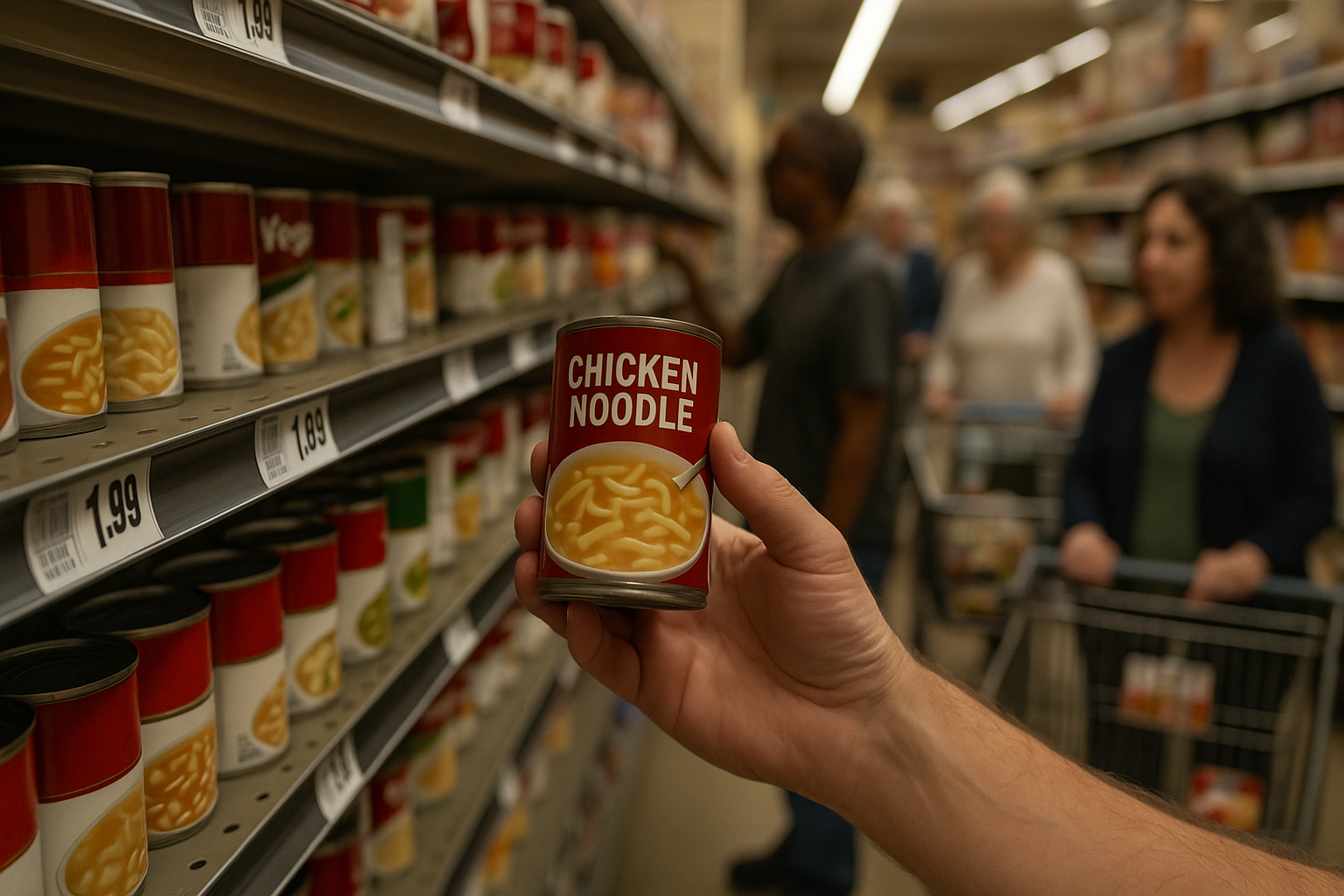
A Campbell’s chicken-noodle soup can that cost $1.99 in 2018 now costs $3.49.
No, tariffs didn’t cause every cent of that $1.50 increase. That would be a stupid claim. But anyone still pretending a 25% steel tariff is too small to matter because it adds only fractions of a cent to one can is selling a fairy tale with a flag wrapped around it.
That is the real story behind America’s tin-can mess: politicians talk in pennies, while operators have to survive in millions.
The $3.49 can is the point
Back in March 2018, then-Commerce Secretary Wilbur Ross held up a can of Campbell’s soup to defend President Donald Trump’s steel tariffs. His argument was neat, memorable and wildly incomplete: the steel in a can was such a small part of its final price that a 25% tariff would add roughly six-tenths of one cent.
That is exactly how people who have never run a supply chain like to think. Isolate one input. Do school maths. Declare victory.
The Bloomberg reporting revisiting that moment is useful because it follows the chain rather than the press conference. Eight years into the tariff experiment, the same type of Campbell’s chicken-noodle soup can bought for $1.99 in 2018 was priced at $3.49 at a 7-Eleven. That price rise reflects far more than metal: labour, freight, ingredients, energy, retail margins and plain old inflation all get a seat at the table.
But steel tariffs are not innocent bystanders. Campbell’s itself has told investors that tariffs have increased costs for ingredients, packaging — including tinplate steel used in cans — distribution materials and imported finished goods. The company also flagged more meaningful cost pressure in 2026, primarily from tariff effects.
That is what matters. Tariffs do not arrive at a factory with a little sticker saying, “Please add $0.006 to soup.” They force a business to renegotiate supply, carry more inventory, reprice contracts, change sourcing, absorb margin hits, fight with retailers and make investment decisions with worse information.
A tax on an input does not stay an input problem for long.
A tariff is a tax on complexity
I have built businesses. The expensive bit is rarely the line item you see first.
If packaging costs rise by a few cents, the obvious response is to push the price up. But that is not how it works in the real world. Your biggest retailer might refuse the increase. Your supplier may demand payment faster. Your customer may trade down to a cheaper private-label product. Your factory might need a different can specification. Your finance team might have to hold more working capital because no one trusts the next trade-policy announcement.
Then the supposedly tiny cost becomes a management tax.
That is particularly brutal in low-margin industries. Canned food is not software. You cannot write one line of code and sell it another million times at near-zero marginal cost. You buy tomatoes, soup ingredients, cans, cartons, freight and labour every day. If you get squeezed, there is nowhere clever to hide.
The can makers are caught in the middle. So are food processors. So are growers. So are households that buy canned goods because they are cheap, shelf-stable and reliable.
And before anyone gets carried away, this is not an argument that tariffs are always bad or that domestic industry never deserves support. Countries are allowed to care about strategic capacity. The problem is pretending that protection has no bill, or worse, that the bill is paid by someone else.
It is paid by importers first. Then suppliers, workers, shareholders and customers argue over who gets stuck holding it.
Usually, the customer wins the privilege.
The protectionist promise breaks on the factory floor
The sales pitch for steel tariffs is simple: make imported steel more expensive, and American steelmakers will invest, hire and produce more.
Simple stories are brilliant politics. They are often rubbish operating strategy.
The US canned-food industry needs tinplate steel — steel made for food cans — and Bloomberg’s reporting shows why this is a rotten place to apply a blunt instrument. American food producers depend on a material that is specialised, globally traded and difficult to replace overnight. A tariff does not magically create the precise domestic capacity, quality, logistics and commercial terms those producers require.
It just makes their current options more expensive while they hunt for new ones.
That distinction matters. A country can protect a producer without strengthening a whole supply chain. In fact, it can protect the upstream producer while weakening every downstream business that turns the material into something people actually buy.
That is the overlooked economic question: not “Did steel mills benefit?” but “Did the whole value chain become more competitive?”
If a domestic canner pays more for tinplate while an overseas competitor exports finished canned food without carrying the same burden, you have not built industrial strength. You have shifted the disadvantage from one part of the chain to another.
That is not strategy. That is moving the deckchairs and calling it productivity.
Canada shows why tariff uncertainty is worse than the tariff
The fresh angle here is not merely that tariffs cost money. Everyone with a calculator already knew that.
The bigger issue is that trade policy has become wildly unstable. Reuters reported that US and Canadian negotiators were working against an August 2026 deadline after Trump threatened a new 50% tariff on about $20 billion of Canadian goods. The talks included major issues around autos, steel and aluminium. Canada and the US are not distant adversaries with no commercial ties; they are deeply intertwined neighbours whose manufacturers have spent decades building cross-border supply chains.
That uncertainty is poison for investment.
A 25% tariff is painful, but a predictable 25% tariff can at least be modelled. You can price it, hedge it, source around it, or decide the market is no longer worth serving.
A tariff that may become 50%, vanish after a phone call, shift categories, be paused for three days, or be replaced by some new legal mechanism is much worse. It turns ordinary planning into gambling.
Founders love talking about optionality. Governments should learn the difference between optionality and chaos. Optionality is having several good choices. Chaos is forcing every business in the country to make permanent decisions around your temporary mood.
The market charges for that. It shows up in lower capital spending, fatter inventory buffers, slower hiring, more expensive financing and less appetite for long-term bets.
None of those costs appear neatly on a can of soup. They are still real.
The contrarian view: the can price is not the scandal
Here is the contrarian bit: I do not think the real scandal is that soup got dearer.
Prices move. Businesses pass on costs. Inflation happens. A $3.49 soup can is annoying, but it is not civilisation-ending.
The scandal is the intellectual dishonesty around the policy. Tariff advocates claim credit for every factory job that appears and deny responsibility for every downstream cost. Tariff critics often make the opposite mistake, acting as though every grocery-price rise is proof of policy failure.
Both camps are playing politics with a spreadsheet.
The adult answer is harder: tariffs can create winners, losers and second-order effects simultaneously. The right test is whether the gains justify the total economic cost — including the cost of uncertainty — and whether the government has a disciplined plan for the industries it is trying to rebuild.
If the plan is just “make foreign stuff dearer and hope,” it is not a plan. It is a press release.
A serious industrial policy would identify where domestic capacity is genuinely strategic, set clear time limits, invest in the bottlenecks that prevent production from scaling, and measure outcomes honestly. It would also stop punishing downstream manufacturers for buying inputs that domestic producers cannot supply competitively.
That may sound less dramatic than waving a can of soup on television. It is also how adults run businesses.
What this means for you
If you are an operator, stop treating tariffs as a political-news category. Put them on your operating dashboard beside payroll, cash flow and customer concentration.
First, map every imported input and every supplier’s imported input. Do not accept “locally sourced” as an answer. Ask where the components, packaging, machinery and raw materials actually come from.
Second, calculate your exposure in dollars, not percentages. A 5% hit to a low-margin product can wipe out the profit entirely. Gross-margin arithmetic is more useful than flag-waving.
Third, build at least two sourcing options for critical materials, even if the second one is more expensive today. The cheapest supplier in a stable market can become the most expensive supplier when policy changes overnight.
Fourth, protect your pricing power before you need it. Better products, trusted brands, direct customer relationships and clear differentiation give you choices when costs rise. Commodity businesses with one customer and no pricing power get flogged.
And if you are an investor or saver, look past the headline beneficiary. A steel tariff may sound good for steel. The better question is which companies consume steel, lack pricing power and have thin margins. The second-order losers are often hiding in plain sight.
The $3.49 Campbell’s can is not really about soup. It is a reminder that every grand economic policy eventually lands in somebody’s warehouse, somebody’s P&L and somebody’s shopping basket.
That is where the truth lives. Not at the podium.