ChatGPT Ads Are Here—and Most Brands Will Stuff Them Up
Most brands will treat ChatGPT like another Google Ads account. That’s how they’ll burn money in a place where customers are asking for advice, not scrolling past rubbish.
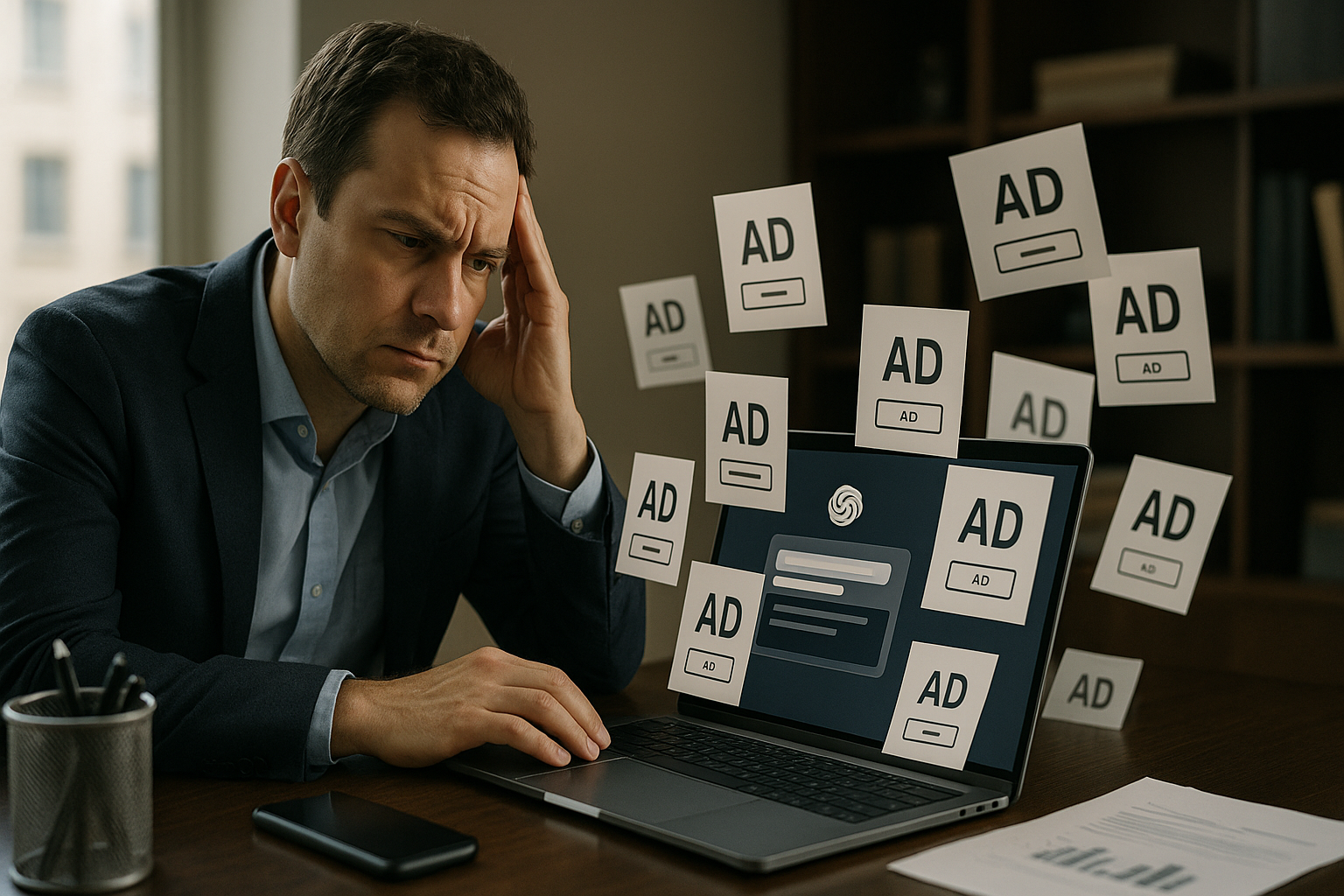
Most brands will treat ChatGPT like another Google Ads account. That’s how they’ll burn money in a place where customers are asking for advice, not scrolling past rubbish.
The big marketing story right now is not that OpenAI has put ads in ChatGPT. It has. The bigger story is that it has built the plumbing to make ChatGPT a serious buying channel: self-serve campaigns, CPM and CPC bidding, conversion measurement, agency access and a relevance-weighted auction. The machine is switched on. Now comes the predictable stampede from marketers carrying mediocre creative and an Excel sheet.
That is good news if you run a business properly. New channels reward clear operators before they get clogged with committee-approved beige.
ChatGPT is becoming a shopfront, not just a chatbot
OpenAI began rolling out a beta self-serve Ads Manager in May. Businesses can set budgets, bids and pacing, upload creative, launch campaigns and view performance directly. It has also added cost-per-click buying alongside the original CPM model, plus conversion measurement through a pixel and Conversions API.
That might sound like ordinary ad-tech jargon. It is not ordinary in this context.
Google Search began with people typing short, blunt queries: “best tequila”, “tax accountant Sydney”, “cheap flights.” Social advertising got good at interrupting people while they were watching mates argue about politics or dogs wearing sunglasses.
ChatGPT sits somewhere else. A person can ask it to compare three options, explain trade-offs, build a shortlist, then tell them what to do next. That is closer to speaking with a switched-on salesperson than entering keywords into a search box.
OpenAI itself says ads are served as users explore, compare and decide. The format sits below a response and includes the advertiser name, logo, headline, copy, landing page and image. Ads are not currently embedded inside the answer itself. That separation matters enormously. If users conclude the answer has been bought, the whole thing goes up in smoke.
The commercial ambition is not modest. Axios reported in May that OpenAI is aiming for $2.5 billion in advertising revenue in 2026 and $100 billion by 2030. It also reported that the minimum $50,000 test budget from the early pilot was being removed. That is the moment this stops being a club for giant brands and becomes a legitimate experiment for smaller businesses with a clue.
OpenAI is not trying to do this alone. Its buying and services ecosystem includes Dentsu, Omnicom, Publicis and WPP, with technology partners including Adobe, Criteo, Kargo, Pacvue and StackAdapt. When the holding companies turn up, it means the industry has smelled a pool of money.
The numbers are less important than the moment of intent
Here is where marketers get this wrong: they become obsessed with whether ChatGPT can beat Google’s cost per click by Thursday.
OpenAI’s own advertiser guidance recommends a starting maximum CPC bid of US$3 to US$5. It also says reporting now covers impressions, clicks, spend, click-through rate, average CPC, average CPM and conversions. Fine. Those are useful dashboard numbers. They are not the business.
The business is this: what is the quality of a customer who has spent ten minutes explaining their problem to an AI before they see your offer?
That customer may be worth far more than a cheap click from someone who typed two words into a search bar while waiting for the kettle to boil. Or they may not. We do not know yet. Anyone claiming certainty is selling a course or trying to impress someone at a conference.
But we do know the environment is built around active consideration. That creates a different job for the advertiser. Your ad cannot merely yell that you exist. It needs to help a buyer finish a decision.
If you sell accounting software, “Australia’s fastest-growing platform” is a lazy claim. A better proposition might tackle the actual friction: “See which overdue invoices are worth chasing before you pay another staff member to chase them.”
If you sell a premium consumer product, do not lead with a pretty lifestyle image and three empty adjectives. Answer the buyer’s unstated concern: why is this worth the money, who is it actually for, what is the downside, and why should I trust you?
That is not a copywriting trick. It is product positioning. And positioning has always mattered more than the media plan, even when agencies would prefer you not notice.
The privacy promise is the product’s biggest strength—and its constraint
OpenAI says advertisers do not receive users’ conversations, chat history, memories or personal details. They receive aggregated, non-identifying campaign reporting. The company says ads can use current-chat context and basic context such as general location or language; if a user enables personalisation, select signals from broader ChatGPT use, including past chats and memory, may inform relevance.
Users can turn off ad personalisation, clear advertising data and see why an ad was shown. Ads are not meant to appear near sensitive or regulated conversations such as personal health, mental health or politics. OpenAI also says accounts identified as belonging to under-18s will not receive ads, and Plus, Pro, Business, Enterprise and Edu accounts are ad-free.
That is a far tighter public promise than the digital ad industry is used to making. It is sensible. A chat interface is intimate by design. People tell it things they would never type into a conventional search field. The company cannot afford to look like it is reading over their shoulder and selling the result to the highest bidder.
But there is a trade-off. The more restrictive the data use and the more limited the targeting, the less marketers can rely on their old habits: building tiny audiences, following people around the internet, and pretending a spreadsheet full of segments is strategy.
Good. That game was getting a bit embarrassing anyway.
A study published this week by researchers at Northeastern University and the University of Washington gives the first independent snapshot of what this early market looks like. The researchers collected more than 3,000 ads from 186 advertisers across 335 realistic prompts. They found ads were heavily skewed toward consumer goods, usually pointed to a specific advertiser rather than a specific product, and were clearly separated from ChatGPT’s response.
The uncomfortable finding was that lower-income simulated accounts were more likely to receive ads, regardless of the racial signals used in the audit. It is early research, not final judgement, but it is exactly why brands should care about where their ads appear and platforms should welcome outside scrutiny. “The algorithm did it” is not a defence. It is what a lazy executive says when they did not govern the system they bought.
The overlooked angle: your brand will be interrogated before it is purchased
This is the part I find most interesting.
In a normal ad environment, your creative gets a few seconds before the user moves on. In ChatGPT, a buyer can click an ad and then ask: “Is this brand any good?” “Compare it with the cheaper alternative.” “What are the bad reviews saying?” “Is this claim believable?”
OpenAI says ChatGPT cannot see an ad by default. But if a user chooses the “Ask ChatGPT” option, it can answer questions about that particular ad. OpenAI also says advertisers do not influence those answers.
Think about what that means. The old gap between advertising and reality gets smaller.
For years, mediocre businesses got away with beautiful brand campaigns, a manipulated review strategy and a sales funnel designed to keep awkward questions out of sight. An AI-assisted buyer can bring the awkward questions into the buying moment.
That is not a threat to great businesses. It is a gift.
If your product is genuinely differentiated, your service is reliable, your pricing is coherent and your customer feedback holds up, a more inquisitive buyer is exactly who you want. If the business depends on confusion, artificial urgency or vague claims, ChatGPT ads may expose you faster than they scale you.
While building Agave Finder, I see this plainly in spirits. A person looking for a bottle is not just asking, “What is premium?” They want to know how it tastes, where it is made, whether the price is fair, whether it suits a Paloma or deserves to be sipped, and whether the brand’s story is genuine or marketing perfume. That is the future across nearly every category: better-informed customers asking more specific questions.
Why the first winners will not be the biggest spenders
New ad channels have a predictable life cycle. First, curious operators test them. Then big brands arrive with budgets. Then agencies package it into a complicated service. Eventually, everyone complains it is expensive and crowded.
We are in the first part.
That does not mean you should lob your whole acquisition budget into ChatGPT. Absolutely not. OpenAI is still early in building the platform, and it is still testing formats, objectives and measurement. AI-search advertising remains small relative to conventional search; Axios cited eMarketer expectations that US AI-search ad spend will rise from 0.7% of total search ad revenue to 13.6% in 2029. There is opportunity here, but not a licence to abandon common sense.
The winners will be businesses with a sharp enough offer to test quickly, a landing page that makes a decision easier, and proper conversion tracking from click to profit. Not click. Profit.
The other winners will be brands that understand that conversation changes the creative brief. In an intent-rich setting, generic awareness copy is dead weight. You need useful claims, proof, clarity and a genuine reason to choose you.
What this means for you
Do these five things before the market gets noisier:
1. Write down the five questions customers ask immediately before buying. Not demographic nonsense. Actual questions. Price, risk, comparison, setup, quality, return policy, compatibility. Build ads and landing pages that answer them.
2. Test one narrow, high-intent offer. Pick a product or service where you know the economics. Do not run a vague “brand awareness” campaign and pretend it is innovation.
3. Track the full path to margin. Set up the pixel or Conversions API, use clean UTM tagging, and measure lead quality, sales, refunds and repeat purchase. A cheap CPC can be a very expensive customer.
4. Audit the truth behind every claim. Assume a prospective customer will ask an AI to scrutinise your promises. If the answer makes you nervous, fix the business or fix the claim.
5. Keep a hard test budget and a kill rule. Decide in advance what a qualified lead, sale or payback period must look like. If the channel does not meet it after enough data, stop. Do not fund a platform’s learning curve with money you should be using to improve your own operation.
ChatGPT advertising is not magic. It is a new shelf in a shop where the customer arrives with a very specific problem and an adviser sitting beside them.
If your brand cannot survive that conversation, more media spend will not save you. If it can, get in early and make the conversation useful.