Chris Olave’s $132M Saints Deal Is a $90M Bet on One Receiver
The New Orleans Saints just put $90 million of guaranteed money behind Chris Olave. That is not paying for last season. It is paying to avoid being irrelevant for the next four years.
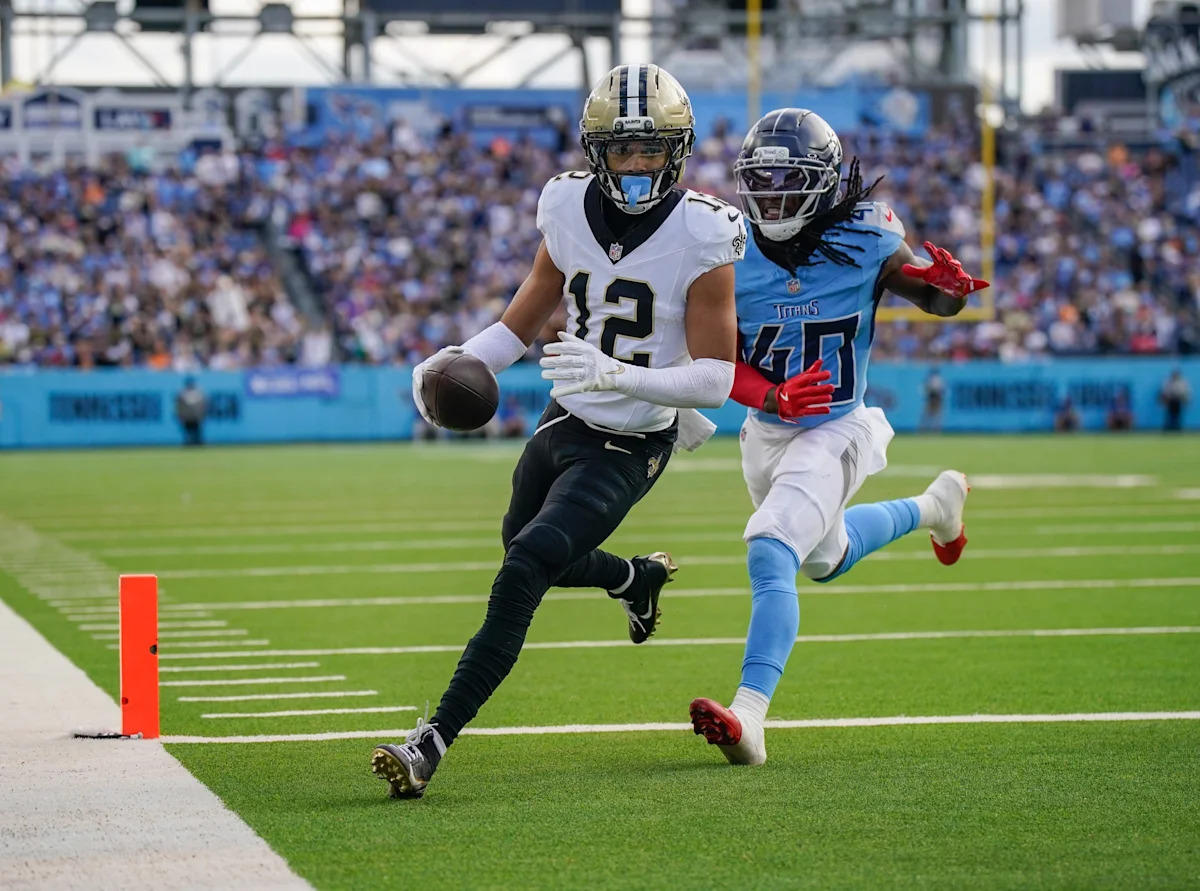
The New Orleans Saints just put $90 million guaranteed behind Chris Olave.
That is not paying him for 100 catches last year. It is paying to avoid being irrelevant for the next four years.
The $132 million headline is not the real story
On July 30, the Saints agreed to a four-year extension with Olave worth up to $132 million, with $90 million guaranteed. On the surface, it is simple: a good young receiver gets paid after a career year.
That is the fan version.
The business version is harsher. New Orleans has decided that, even after years of middling results and roster churn, the cost of not having a genuine No. 1 receiver is worse than the risk of paying one like a superstar.
Olave is 26. He was the No. 11 pick in the 2022 NFL Draft. Last season he caught 100 passes for 1,163 yards and nine touchdowns — all career highs — and earned second-team All-Pro recognition. He has now logged three 1,000-yard seasons in four NFL years.
That is a proper player. Not a social-media star with a highlights reel and a merch shop. A proper player.
But the Saints are not paying for proper. They are paying for certainty.
At an average of $33 million a year, Olave’s extension puts him alongside the league’s most expensive receivers. The number is tied with Pittsburgh Steelers wideout DK Metcalf for sixth among NFL receivers by average annual value, according to USA Today’s analysis of the deal.
The key figure is not $132 million, though. It is $90 million.
Roughly 68% of the maximum deal is guaranteed. That means the Saints have not merely made a public statement that Olave matters. They have made a very expensive private commitment that he will be central to their offence even if the next few years get messy.
And, mate, NFL teams are very good at making speeches about commitment. Guarantees are where they stop bluffing.
New Orleans is buying stability before it buys a championship
The Saints already exercised Olave’s fifth-year option. That means this extension starts in 2027 and is set to keep him in New Orleans through the 2030 season.
That timing matters.
The club did not need to do this deal now in the narrow legal sense. Olave was already under team control for 2026. It could have waited, watched another season unfold, and taken the usual football approach: praise the player publicly, squeeze him privately, then argue over risk next summer.
Instead, the Saints got it done before the season.
Why? Because the alternative was ugly.
A talented receiver heading into a contract year is not just a football problem. He is a management distraction waiting to happen. Every target becomes a negotiation point. Every missed practice becomes a headline. Every strong performance makes the eventual bill bigger.
Olave had reported to training camp, but he initially did not participate in drills while his new deal was being worked out. That is not a scandal. It is simply what happens when a player has delivered and knows the market is watching.
The Saints chose to remove the noise.
They also chose to make a call on their quarterback situation without pretending that the question has already been answered. Olave produced his career-best numbers in 2025 with rookie quarterback Tyler Shough. New Orleans then used the eighth overall selection in the 2026 draft on wide receiver Jordyn Tyson.
That is a useful clue about what the front office thinks it is building.
It is not waiting for the perfect quarterback before investing in elite pass-catchers. It is building the receiving room first and betting that a young quarterback is more likely to become viable when he has high-end options rather than a collection of “good effort” blokes on cheap contracts.
That sounds obvious. Plenty of clubs still get it wrong.
They tell themselves they will sort the quarterback out first, then add weapons later. By the time “later” arrives, the quarterback has spent three years throwing into tight windows to receivers who would be a third option on a serious team. Then the organisation wonders why development stalled.
Chris Olave is expensive because replacement is even more expensive
There is a lazy line in sport that teams should never pay wide receivers this much because “someone else can catch passes.”
That line is usually delivered by people who have never had to replace one.
A genuine top receiver does several jobs at once. He creates separation. He changes defensive coverage. He gives a young quarterback an obvious answer before the snap. He lets coordinators call plays that would be reckless with a lesser player. And he gives the club a bankable face for ticket sales, sponsors, fantasy relevance and national attention.
None of that shows up neatly in a box score.
What does show up is the market. Olave’s deal follows extensions for other 2022 first-round receivers, including Garrett Wilson of the New York Jets, Jameson Williams of the Detroit Lions and Drake London of the Atlanta Falcons. The league has made its view clear: elite receiving talent is not getting cheaper.
The Saints could have tried to be clever. They could have traded Olave before paying him, collected picks, drafted another receiver and talked about “resetting the timeline.”
That sort of plan sounds brilliant on a PowerPoint slide. It is much less brilliant when you remember that draft picks are lottery tickets, rookie development is uneven, and the existing player has already proved he can win in the NFL.
I have made enough investment mistakes to know this one: founders and operators often overvalue optionality because it feels intelligent. Keeping every option open can be another way of avoiding a decision.
New Orleans made the decision.
It decided Olave is not an asset to churn. He is a foundation asset.
The overlooked risk is not the money — it is concentration
Here is the contrarian bit: I do not think the biggest risk is that Olave earns $33 million a year.
The bigger risk is that the Saints confuse one excellent decision with a complete strategy.
Paying a great receiver is easy to defend. Building an offence that makes the investment compound is much harder.
Olave can be worth every cent and the Saints can still waste him. That happens all the time in sport. A club identifies a core asset correctly, then fails to build the operating system around it.
For New Orleans, that means the offensive line has to protect. The quarterback has to develop. Tyson has to become enough of a threat that opponents cannot simply load coverage toward Olave. The coaching staff has to create touches rather than hoping talent will solve structural problems.
A $132 million deal does not fix any of that.
In fact, it raises the standard. Once you make this commitment, “we are rebuilding” stops being a useful excuse. You have told the market — fans, players, agents and sponsors — that you believe your offensive nucleus is ready to matter.
There is another point that gets missed in contract chat: the best organisations do not assess a deal only against the player’s past production. They assess it against the cost of the next decision.
If Olave maintains his level, the Saints have avoided another expensive bidding war. If he improves, they look smart. If Shough becomes a real NFL starter, the deal looks smarter still because elite receivers make quarterback growth easier. If Tyson hits, New Orleans has a young, premium receiving duo under control through the period when it needs to escape the middle of the league.
That is what the Saints bought: not just catches, but a set of better future options.
What this means for you
You are probably not negotiating a $132 million contract this week. But the logic applies whether you run a startup, a family business, a sales team or your own investment portfolio.
First: identify the assets that are costly to replace, not merely costly to keep.
Olave is expensive. Replacing proven high-end output would likely be more expensive, slower and far less certain. In business, this might be your best operator, your distribution partner, your product lead or the customer relationship that brings half the referrals. Stop treating proven contributors as interchangeable because a spreadsheet says a cheaper alternative exists.
Second: pay for certainty when the downside of delay is rising.
The Saints did not wait for another huge season, another market jump or a full-blown holdout. They made a decision before uncertainty became more expensive. If you know you want to retain someone or secure a strategic relationship, delaying purely to feel clever can cost you more than acting.
Third: never confuse buying the asset with building the system.
Olave’s contract is only good business if New Orleans builds an offence around the investment. Same goes for your hires, software, acquisitions and marketing spend. A great asset dropped into a broken system does not produce magic. It produces an expensive post-mortem.
Finally: use guarantees sparingly, but mean them when you use them.
The $90 million tells Olave exactly how serious the Saints are. In your world, guarantees might be equity, a long-term contract, a major budget allocation or public backing for a senior hire. Do not hand them out to create a nice announcement. Use them when you have done the work and are prepared to build around the bet.
The Saints have done exactly that with Chris Olave.
Now comes the difficult bit: making sure $90 million of certainty produces more than another good receiver on another forgettable team.