Danaher’s $11B Diagnostics CEO Bet: Julie Sawyer Montgomery Takes Over
Most CEO handovers are theatre. Danaher just handed its future to the executive who turned diagnostics from $6B into roughly $11B—and now she has to prove that growth wasn’t a one-off.
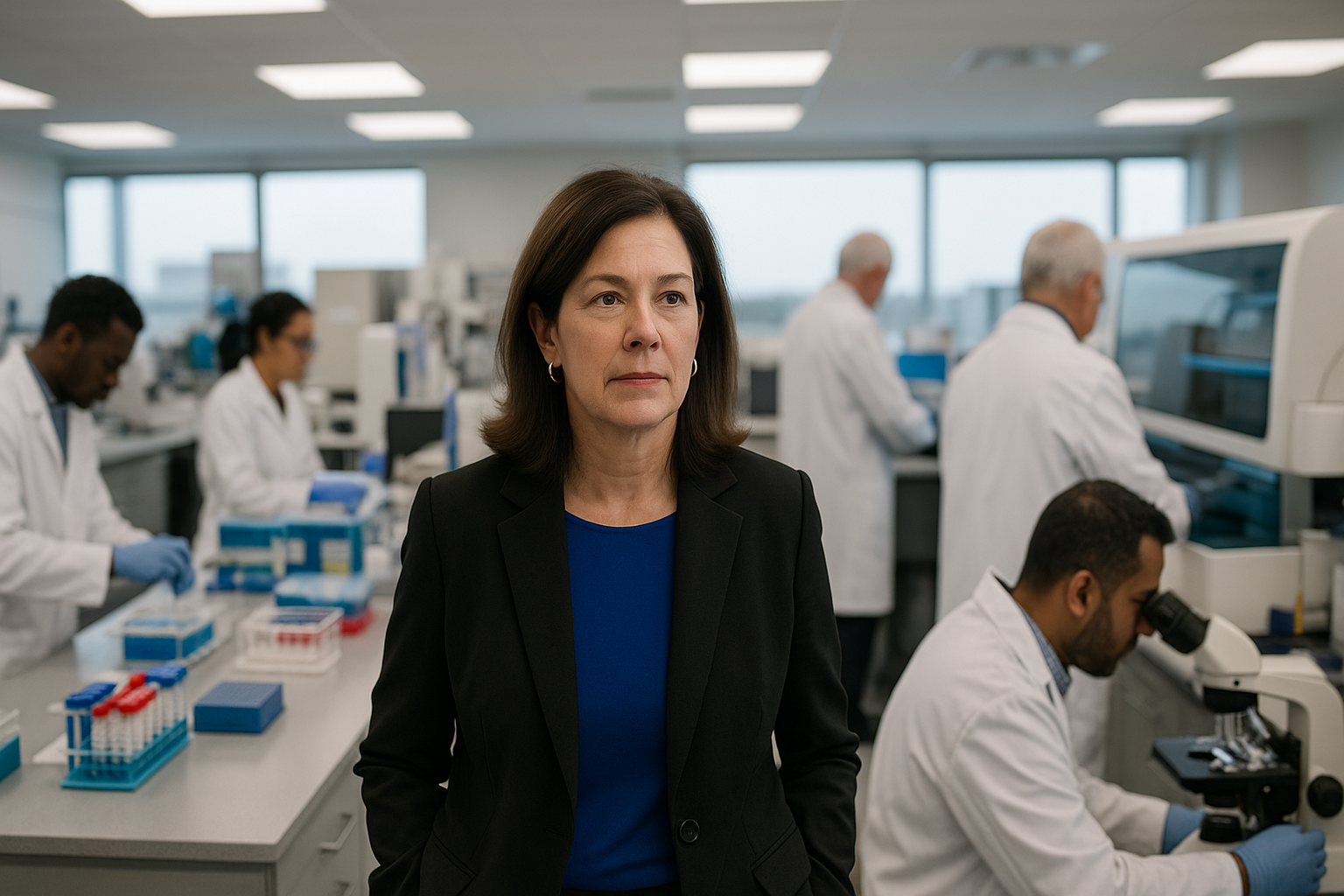
Most CEO handovers are theatre. A bloke walks out to applause, a new one says “excited for the opportunity”, and everyone pretends the board hasn’t spent 18 months quietly worrying about who can keep the machine running.
Danaher’s October 1 handover is different. Julie Sawyer Montgomery becomes president and CEO after helping grow the company’s Diagnostics platform from roughly $6 billion in revenue in 2017 to roughly $11 billion today, while approximately tripling operating profit. That is not a nice line on a LinkedIn profile. It is the whole investment case.
Rainer Blair retires as CEO today, October 1, 2026, and will stay on as a senior adviser through March 31, 2027. The clean internal succession is intentional. So is the challenge: Danaher is asking the executive who built its diagnostics engine to run the entire company while biotech demand remains uneven, respiratory-testing comparisons muddy the numbers, and recent acquisitions need to earn their keep.
That is a proper CEO job. No ceremonial ribbon-cutting nonsense.
The real story is not the new CEO. It is the $11 billion proving ground.
Montgomery joined Danaher in 2017 at Beckman Coulter Diagnostics, first leading commercial operations and research and development before becoming its president in 2020. She later became a group executive and then executive vice president responsible for Danaher’s Diagnostics platform.
The board did not pick a charismatic outsider with a 100-day PowerPoint deck. It picked the operator closest to the part of the business that has delivered a material transformation.
Danaher says Diagnostics grew from approximately $6 billion in 2017 to approximately $11 billion today under Montgomery’s leadership, with operating profit roughly tripling. She also led the recent Masimo acquisition and Danaher’s pending acquisition of StatLab. That tells you precisely what the board wants more of: disciplined growth, commercial execution, and acquisitions that plug into the Danaher Business System rather than merely inflate a press release.
For founders, this is worth underlining: boards do not promote someone because they are “strategic”. They promote people who have already made a large part of the business demonstrably better.
Montgomery is not being handed a turnaround. She is being handed an expectation. That is sometimes harder.
Danaher reported $6.3 billion in second-quarter 2026 revenue, up 5.5% year on year. Core revenue rose 3.0%, or 4.5% excluding respiratory-testing revenue. It generated $1.5 billion in operating cash flow and $1.3 billion in free cash flow for the quarter. Those are serious numbers. But the company’s own reporting makes the catch plain: the underlying picture differs by segment, and management now separates respiratory testing because flu and flu-like illness are not things executives can control.
Good management does not claim credit for the weather. It removes the weather from the scoreboard.
Rainer Blair is leaving with the hard part still on the table
There is a lazy story people tell about industrial and healthcare conglomerates: once you have scale, the business runs itself. Absolute rubbish.
A company like Danaher is a portfolio of specialised businesses selling complex tools, tests, instruments, consumables and services into laboratories, hospitals, drug development and bioprocessing. It benefits from repeatable operating disciplines, yes. But no operating system substitutes for judgment when markets change, customers pause spending, or an acquisition lands on your desk.
Danaher’s second-quarter results made that tension visible. Life Sciences drove much of the core-sales improvement. Biotechnology and Diagnostics also grew in the quarter, but Diagnostics sales were lower across the first six months of 2026, partly offsetting gains elsewhere. The company’s 2026 outlook calls for core revenue growth of 3% to 4%.
That is not catastrophe. It is also not a licence to drift.
Montgomery takes the top job at a time when the company needs to turn several moving parts into one coherent machine: strengthen the existing operating businesses, integrate Masimo, progress StatLab, keep capital allocation sensible, and make sure the business does not confuse a cyclical recovery with a permanent tailwind.
A lot of CEOs are good at one of those jobs. The exceptional ones can do all of them without turning the organisation into a meeting factory.
The overlooked angle: this is a test of whether Danaher built a system or a hero
The impressive thing about this succession is not that Danaher promoted internally. Plenty of companies say they value internal talent right before hiring a celebrity outsider.
The impressive thing is that the company had enough confidence to elevate the person responsible for a major platform while retaining Blair as an adviser for six months. That suggests a planned transition rather than a board scrambling around after someone quits.
But here is the uncomfortable bit: Montgomery’s promotion creates a hole at the centre of Diagnostics. The executive who has been accountable for that platform is now responsible for everything. If diagnostics slows, if Masimo integration becomes messy, or if the next layer of leaders cannot carry the load, the market will discover whether the performance came from one exceptional executive or from a durable operating institution.
That distinction matters far beyond Danaher.
I have watched founders build businesses where every meaningful decision goes through one person. They call it high standards. Usually it is just dependency dressed up in a polo shirt. It works while the founder has energy, health and perfect recall. Then the business reaches a size where the founder becomes the bottleneck—and everyone else learns to wait for permission.
Danaher’s leadership handover is the corporate version of that test. The company has spent years using the Danaher Business System as its operating model. The next few quarters will show whether that system reliably produces leaders, or whether it merely makes good operators look inevitable after the fact.
Why a diagnostics operator may be exactly what Danaher needs
The contrarian view is that Danaher should have picked someone from the more volatile biotechnology side because that is where investor anxiety tends to gather when funding cycles tighten and customers delay projects.
I think that misses the point.
The CEO’s job is not to personally rescue every weaker segment. It is to allocate attention, talent and capital without panicking. Diagnostics is a useful training ground for that because it combines technical products, regulatory realities, hospital and laboratory customers, recurring consumables, commercial execution, and high consequences when something fails.
Montgomery also comes with a commercial and R&D background. That combination matters. Pure finance operators can become addicted to spreadsheet improvements. Pure product leaders can confuse a clever product with a profitable business. Someone who has worked across customers, science and operations is more likely to understand that a business only wins when all three line up.
The Masimo acquisition raises the stakes. Buying a respected business is the easy part; making it more valuable inside a larger organisation without suffocating the thing that made it good is where executives earn their money. Every acquirer says it will preserve innovation. Far fewer can preserve speed, retain the right people and still extract operational benefits.
Montgomery’s record means she gets the benefit of the doubt. It does not give her a free pass.
What this means for you
If you run a business, do not copy the press release language. Copy the mechanics.
First, identify the executive—or potential executive—who has already created measurable value in a meaningful part of your business. Not the best presenter. Not the safest pair of hands. The person who improved revenue quality, margins, customer retention, speed, product performance or talent density in a way you can prove.
Second, build succession before you need it. Danaher announced Montgomery’s appointment on August 3, nearly two months before she took the job on October 1. Blair remains available through March 31, 2027. That gives employees, customers and investors clarity. Surprise is not a strategy.
Third, separate noise from operating reality. Danaher now reports core growth excluding respiratory testing because respiratory demand can swing with illness severity. Your business has its own version of that: one large customer, foreign exchange, a temporary price rise, a viral campaign, a founder’s personal relationships. Put those variables on a separate line. Do not build your plans around luck and call it momentum.
Finally, ask yourself the brutal question: if you got hit by a bus—or simply took a proper holiday for six weeks—would your company get sharper, stay flat, or fall apart?
If it falls apart, you have not built a company. You have built a well-paid job with a logo.
Julie Sawyer Montgomery’s first task as Danaher CEO is to prove the company is bigger than any one operator, including her. That is the standard every serious founder and CEO should be building toward. Not because you want to leave, but because the business should be strong enough that you can.