Databricks $5B Funding at $190B: Your AI Moat Is Data
Databricks wanted $1B. Investors wanted roughly $15B. The reason should scare founders: AI value is moving from the chatbot to the data, context and spend around it.
Databricks wanted $1 billion. Investors wanted roughly $15 billion — because the real AI prize is not the chatbot; it is owning the data, context and spend around it.
It settled on $5 billion at a $190 billion valuation. If your AI plan begins with picking a model, you’re already behind.
That is the bit plenty of founders, investors and corporate AI committees still don’t get. They are arguing over which model is smartest while the companies that control the pipes, permissions, databases and bills are quietly becoming the landlords.
Databricks just put a $190 billion price tag on enterprise AI plumbing
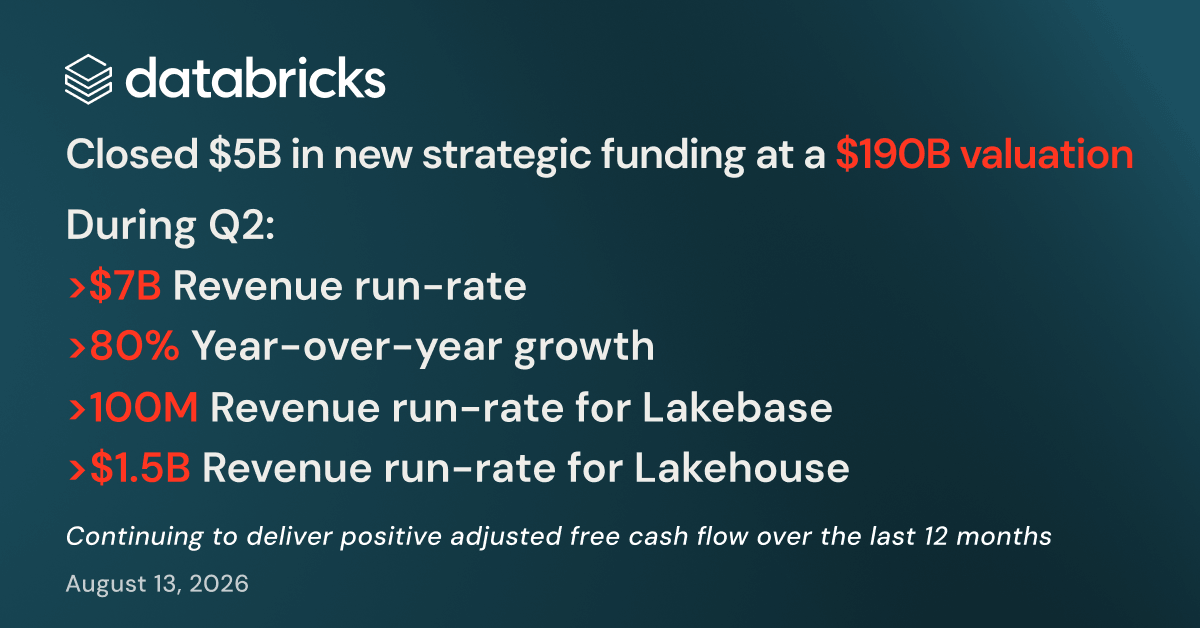
On August 13, Databricks said it had closed a $5 billion strategic funding round led by Coatue, with Blackstone, MGX, T. Rowe Price and Sixth Street Growth among the investors. The company also said it had passed a $7 billion annualised revenue run-rate, was growing at more than 80% year over year, and remained positive on adjusted free cash flow over the prior 12 months.
That is not a nice deck with a few AI screenshots. That is a big, functioning business being priced as critical infrastructure.
The valuation moved from $134 billion in February 2026 to $190 billion in August — a $56 billion jump in about six months. Databricks had also raised $1 billion at a valuation above $100 billion in September 2025, following a $10 billion round at a $62 billion valuation in late 2024.
This latest round was apparently oversubscribed to a silly degree. CEO Ali Ghodsi told TechCrunch Databricks originally wanted to raise $1 billion but saw roughly $15 billion in investor interest, then ultimately sold more equity than planned.
That is not normal. It is also not entirely irrational.
At $190 billion, Databricks is worth roughly 27 times its stated $7 billion revenue run-rate. That is a rich price by any adult standard. But investors are not paying for last quarter’s data-warehouse revenue. They are paying for the possibility that Databricks becomes the operating layer enterprises use to turn their private data into useful AI.
That is a much bigger game.
The old product was analytics. The new product is control.
Databricks was built in the big-data era. Its core appeal was straightforward: help large companies store, process and analyse vast volumes of information without making everyone’s life miserable.
AI changed the pitch.
An enterprise does not get much value from a clever model if the model cannot access the right internal information, cannot distinguish a current customer contract from an expired one, cannot follow permission rules, cannot be audited and burns cash every time someone asks it a question.
That is where Databricks is aiming its latest products.
Its Lakebase product is a serverless Postgres database designed for AI agents. Databricks says Lakebase has already exceeded a $100 million revenue run-rate. Its Genie product is pitched as an AI coworker that turns business data into answers and actions. Then there is Unity AI Gateway, which is designed to govern use of multiple AI models and help control costs.
Put less politely: Databricks wants to be the grown-up in the room after everyone has finished playing with AI demos.
It wants to own the place where an agent gets the company context, checks what it is allowed to see, calls a model, records what happened and makes sure the finance team does not find a horrifying token bill at month-end.
That is valuable because every serious company will eventually need it. Not just banks and insurers. Retailers, logistics operators, manufacturers, media businesses and small companies with a messy CRM and too many spreadsheets will need some version of the same thing.
Why investors are piling in now
The lazy take is that this is just another AI bubble valuation. There is obviously some heat in the room — when a business can raise $5 billion privately after already raising enormous sums, nobody should pretend capital discipline is the main attraction.
But calling it all froth misses the more interesting point.
Databricks has real scale. The company says more than 20,000 organisations use its platform, including 70% of the Fortune 500. It also says more than 1,000 customers are consuming at over $1 million in annualised revenue, while more than 100 customers are above $10 million.
Those numbers matter because enterprise AI is not won by whoever gets the most people generating cartoon headshots. It is won by whoever can get embedded in a company’s most valuable workflows without creating a compliance, security or cost disaster.
Databricks also has a useful advantage over a pure model maker: it can benefit whether an enterprise uses OpenAI, Anthropic, Google, an open-weight model or a mix of the lot. That is what makes the governance and routing layer so attractive. If customers use several models — and they will — someone needs to manage the traffic.
This is the same reason the best businesses in a gold rush are often the ones selling the picks, maps and logistics. Except in AI, the best business may be the bloke who controls access to the mine.
The overlooked angle: the model may become the least defensible part
Founders love talking about their model choice as though they have discovered fire.
“We use the best model” is not strategy. It is a procurement decision.
Models are improving fast, competitors are proliferating, and prices are under pressure. Even Databricks has been promoting the use of lower-cost open-weight models for certain coding work, alongside the idea that the software harness around a model can materially affect cost and performance.
That should make every operator sit up.
If model quality keeps converging, then the durable advantage shifts elsewhere: proprietary data, workflow ownership, distribution, trust, integration depth and cost control. In other words, boring stuff — the stuff that actually makes money.
Databricks is betting that AI agents will become a new class of worker inside companies. Whether that exact vision lands or not, the underlying observation is right: AI needs context to be useful, and context lives in business systems that are fragmented, sensitive and expensive to wrangle.
The company is also clearly buying its way into adjacent territory. It announced the acquisition of Electric, maker of lightweight Postgres database PGlite, this month. In June it announced a deal to buy AI cybersecurity company Panther. That tells you the strategy is not to merely provide a data platform; it is to assemble more of the enterprise AI stack before someone else does.
There is still a catch — and it matters
A $190 billion valuation is not a trophy. It is a promise with a very expensive interest rate.
Databricks now has to keep growing fast, keep customers spending, make its AI products genuinely indispensable and avoid getting squeezed by hyperscalers such as Amazon, Microsoft and Google — companies that are both partners and formidable competitors.
It also has to show that products like Lakebase and Unity AI Gateway become meaningful businesses, not just clever extensions that help maintain the AI narrative.
Private-market enthusiasm can hide a lot because there is no public share price judging the company every morning. That does not mean the economic reality disappears. Eventually, every valuation meets revenue, margins and competition.
But I would not bet against the data layer.
The market is telling you that the next great AI fortunes may not belong only to the labs building the cleverest models. They may belong to the businesses that make those models safe, useful, affordable and deeply embedded in the organisations that pay the bills.
What this means for you
If you are a founder, stop leading your AI story with the name of the model you use. Customers can copy that by Friday. Lead with the workflow you own, the data you can responsibly connect, the decision you can improve and the measurable dollars or hours you save.
If you run a business, do not let every department buy its own AI tool and create a Frankenstein monster of data leaks and duplicate subscriptions. Pick a small number of high-value workflows, define what data the tool can access, set budget controls and measure outcomes before rolling it across the company.
If you are an investor, look past the chatbot demo. Ask four questions: Who owns the data? Who owns distribution? Who controls the AI spend? And what gets harder to replace as usage grows?
That is the Databricks lesson. The flashy model gets attention. The layer that turns it into trusted work gets paid.
Sources
- Databricks wanted to raise $1B, investors wanted $15B. It settled on $5B at a $190B valuation.
- Databricks Grows >80% YoY, Surpasses $7B Revenue Run-Rate, Scales Lakebase, Genie, and Unity AI Gateway
- Databricks hits $188B valuation, extending its run as AI’s favorite second act
- Coatue Leads Databricks Funding Round at $188 Billion Valuation