Domino’s 22,531-Store CEO Test: Joe Jordan Takes Over
Most boards wait until CEO succession becomes a blood sport. Domino’s has chosen the riskier move: three powerful men handing over a 22,531-store machine while growth is slowing.
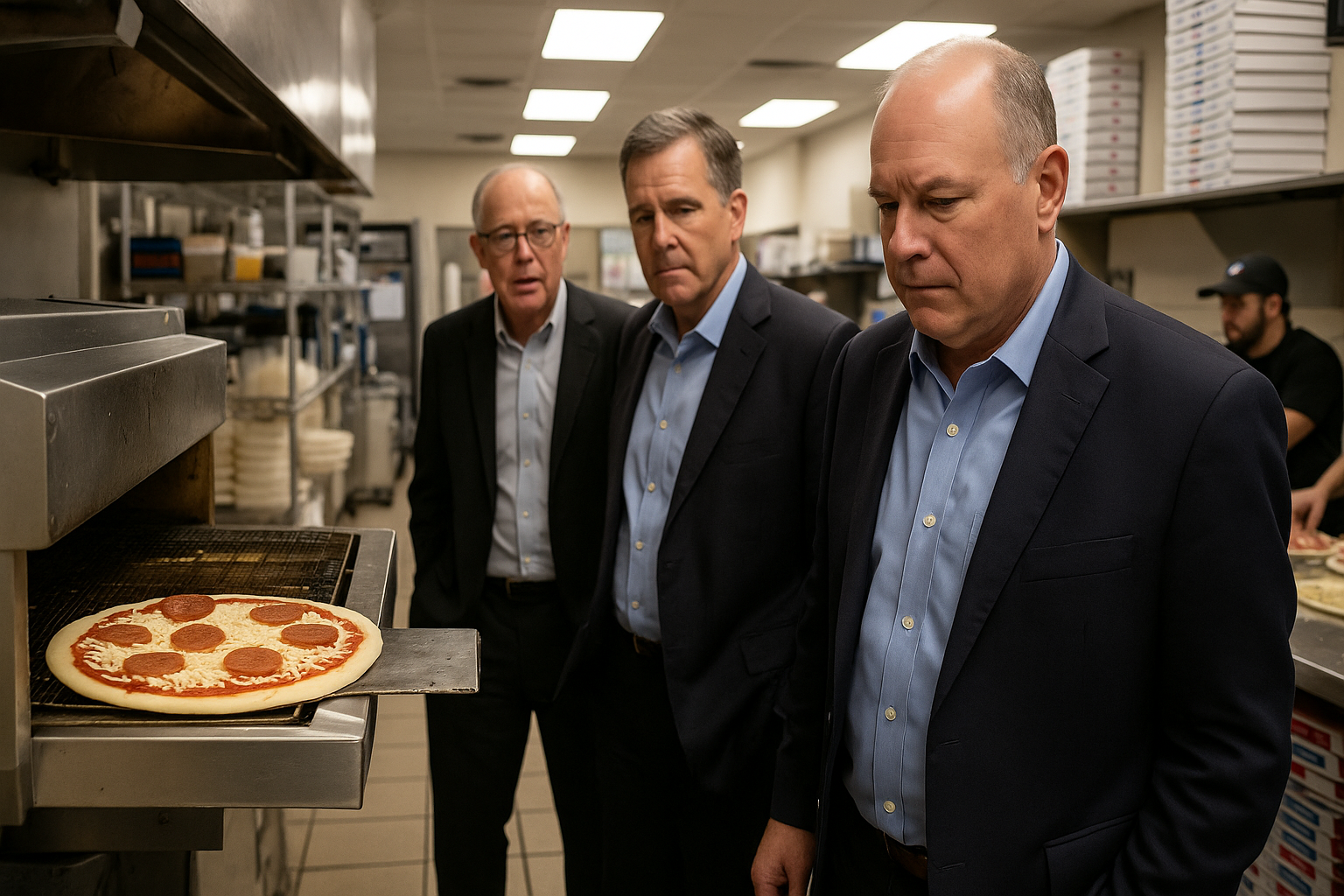
Most boards wait until CEO succession becomes a blood sport. Domino’s has chosen the riskier move: three powerful men handing over a 22,531-store machine while growth is slowing.
On October 1, 2026, Joe Jordan becomes chief executive of Domino’s Pizza. He replaces Russell Weiner, who moves into the awkwardly named role of executive chairman designate before becoming executive chairman after the 2027 annual meeting. Meanwhile, current Executive Chairman David Brandon is due to leave the board in 2027 after 28 years with the business. That is not a changing of the guard. It is a guard change conducted in full view of the old guard.
Jordan has earned the job. The question is whether Domino’s has designed a succession that gives him enough room to actually do it.
Joe Jordan inherits a very good business at exactly the wrong time for excuses
Let’s start with the obvious: Domino’s is not handing Jordan a flaming bin.
In the second quarter of 2026, the company reported $4.85 billion in global retail sales, up 3.0% excluding currency movements. It added 209 net stores in the quarter, reaching 22,531 worldwide as of June 14. Revenue rose 4.3% to $1.19 billion, operating income rose 3.1% to $232 million, and diluted earnings per share climbed 6.8% to $4.07. That is a serious operating machine, not a turnaround story. ([dominos.gcs-web.com](https://dominos.gcs-web.com/news-releases/news-release-details/dominos-pizza-announces-second-quarter-2026-financial-results))
But good businesses can still drift. The warning light is sitting right on the dashboard: U.S. same-store sales rose just 0.1% in the second quarter, while international same-store sales slipped 0.1% in constant currency. Domino’s is still opening stores and getting more orders, but the easy headline growth is not there. ([dominos.gcs-web.com](https://dominos.gcs-web.com/news-releases/news-release-details/dominos-pizza-announces-second-quarter-2026-financial-results))
That makes Jordan’s first job brutally clear. He does not need to invent a new pizza company. He needs to get more productive growth from a gigantic, mostly franchised system without ruining the unit economics that make franchisees want to keep backing the brand.
That is a harder job than it sounds. A CEO can juice short-term sales by discounting. He can juice store growth by making expansion look cheap. He can make investors happy for a quarter by buying back stock. None of that proves the underlying machine is improving.
The real test is whether stores make more money, customers order more often, digital acquisition costs stay sensible, and franchisees still believe the next store is worth opening.
Domino’s picked an insider because this is an operating job, not a branding exercise
Jordan is not a parachuted-in celebrity CEO with a 90-day listening tour and a PowerPoint full of words like “reimagine.” Thank Christ.
He joined Domino’s in 2011 as vice president of innovation, later ran marketing, international operations and the U.S. business, and became chief operating officer and president of Domino’s U.S. in March 2025. His remit then included domestic operations, marketing, global services and technology. Before Domino’s, he worked in marketing roles at Pepsi-Cola North America, Philips and Unilever, plus consulting at Accenture. ([ir.dominos.com](https://ir.dominos.com/node/23471/pdf))
That CV matters because Domino’s is not really a pizza company in the old-fashioned sense. It is a franchise system, logistics network, software business, marketing engine and property-light retailer that happens to sell a mountain of pizza.
A bloke running this business must understand the ugly connective tissue: whether a promotion works for stores as well as head office; whether a product launch slows kitchens down; whether the app improves customer frequency without making franchisees subsidise discounts; whether a store-opening target produces returns or merely dots on a map.
Jordan’s record suggests he has seen those gears from more than one seat. Domino’s says he helped lead its international business through a period in which it opened more than 3,000 stores, and that he has overseen the loyalty and e-commerce relaunches plus global digital marketplace partnerships. ([sec.gov](https://www.sec.gov/Archives/edgar/data/1286681/000119312526277510/d50178dex991.htm?utm_source=openai))
That is why the internal appointment is sensible. Continuity is not cowardice when the business model works.
The awkward bit: Russell Weiner is not really leaving
Here is where I become less relaxed about it.
Weiner will cease being CEO on October 1, but he remains in the business as executive chairman designate until the 2027 annual meeting, when he becomes executive chairman. Brandon remains executive chairman until then, before retiring from the board. Domino’s has mapped this out carefully. It calls the process multi-year succession planning. ([ir.dominos.com](https://ir.dominos.com/news-releases/news-release-details/dominos-announces-ceo-succession-plan?utm_source=openai))
Fine. Planned successions are better than emergency ones. But every founder, chief executive and board chair should understand the danger: transition support can turn into shadow management very quickly.
Jordan will have a former CEO with 18 years at Domino’s sitting beside him, and a long-serving outgoing chairman in the same orbit until 2027. Both have deep relationships with franchisees, directors and senior executives. Both know the business cold. Both, I expect, want the company to win.
None of that changes the structural issue. When people do not know whose call it is, they shop around for the answer they prefer. A difficult franchisee rings the old boss. A nervous executive asks the chairman for a quiet steer. A decision that should take 24 hours takes three weeks because everyone wants to preserve harmony.
That is how capable businesses become slow businesses.
The board needs a plain-English rule: Jordan owns operations, capital allocation, people decisions and strategy from day one. Weiner can advise, challenge and represent the company where useful. He cannot become the back-channel appeals court for managers who dislike the new CEO’s answer.
There is no such thing as a clean handover if the old CEO retains the authority to overrule the new one informally.
The overlooked angle is franchisee trust, not Wall Street applause
Investors will rightly watch sales, margins and earnings. I would be watching franchisee behaviour just as closely.
Domino’s had more than 21,300 stores across more than 90 markets at the end of 2024, and independent franchise owners operated 99% of its stores. More than 85% of U.S. retail sales came through digital channels that year. ([ir.dominos.com](https://ir.dominos.com/node/23471/pdf))
That means Jordan inherits a business where the central office can create value at enormous scale — but only if operators at the coalface keep believing the system is making them richer too.
The second-quarter numbers show why this matters. Domino’s opened 26 net stores in the U.S. and 183 internationally, but same-store sales were almost flat. Expansion is useful, but it cannot become camouflage for weak productivity in mature markets. ([dominos.gcs-web.com](https://dominos.gcs-web.com/news-releases/news-release-details/dominos-pizza-announces-second-quarter-2026-financial-results))
The contrarian view is that Jordan should not arrive with a dramatic “new era” strategy. That sort of theatre is catnip for analysts and poison for a franchise system if it leads to operational churn.
His best move may be boring: make the digital funnel convert better, keep delivery and carryout convenient, protect franchisee margins, and be ruthless about which initiatives create orders rather than merely headlines.
Boring, done well, compounds. I have made more money backing businesses that execute the obvious for a decade than businesses constantly trying to look clever for a quarter.
Growth has to be paid for, not just announced
There is another number Jordan cannot ignore: leverage.
At the end of the second quarter, Domino’s reported a 4.3-times leverage ratio and $4.77 billion of fixed-rate notes. It also spent $156.2 million repurchasing shares in the quarter and had $1.23 billion remaining under its buyback authorization. ([dominos.gcs-web.com](https://dominos.gcs-web.com/news-releases/news-release-details/dominos-pizza-announces-second-quarter-2026-financial-results))
That does not mean the balance sheet is broken. Domino’s has historically operated with leverage between four and six times, and it produces real cash. But a leveraged franchise business needs operating discipline more than motivational posters.
Jordan’s job is to make sure the company’s capital allocation is serving the machine, not flattering the share price. If sales are soft, stores are under pressure or technology investment is required, the business must earn the right to keep buying back stock. That is the adult order of operations.
What this means for you
If you are a founder, operator or investor, take three lessons from Domino’s today.
First, build successors through real operating exposure. Jordan did not get handed a leadership-development badge and a mentor coffee. He moved through innovation, marketing, international, U.S. operations and technology. If your supposed successor has only run one function, you do not have a successor. You have a specialist with a fancy title.
Second, succession needs written decision rights. Do this tomorrow: write down who makes the final call on hiring, budgets, customer strategy, capital spending and executive appointments after the handover. Then tell the leadership team. Vague authority is where politics breeds.
Third, judge growth by the economics of the people doing the work. Domino’s can add hundreds of stores, but the durable signal is whether franchisees, staff and customers are all better off because the system got sharper. Your equivalent might be sales reps, suppliers, channel partners or frontline managers. If they are not winning, your “growth” is likely expensive noise.
Joe Jordan has inherited one of the world’s most formidable retail systems. The board has given him experience around him, which is sensible. Now it has to give him something harder to hand over: actual authority.
That is the whole game.