Freddie Mac’s 6.71% Mortgage Rate Tests the “Wait for Cuts” Plan
At 6.71%, a $400,000 mortgage costs roughly $2,584 a month before taxes, insurance or repairs. Underwrite the rate you can get, not cuts you hope for.
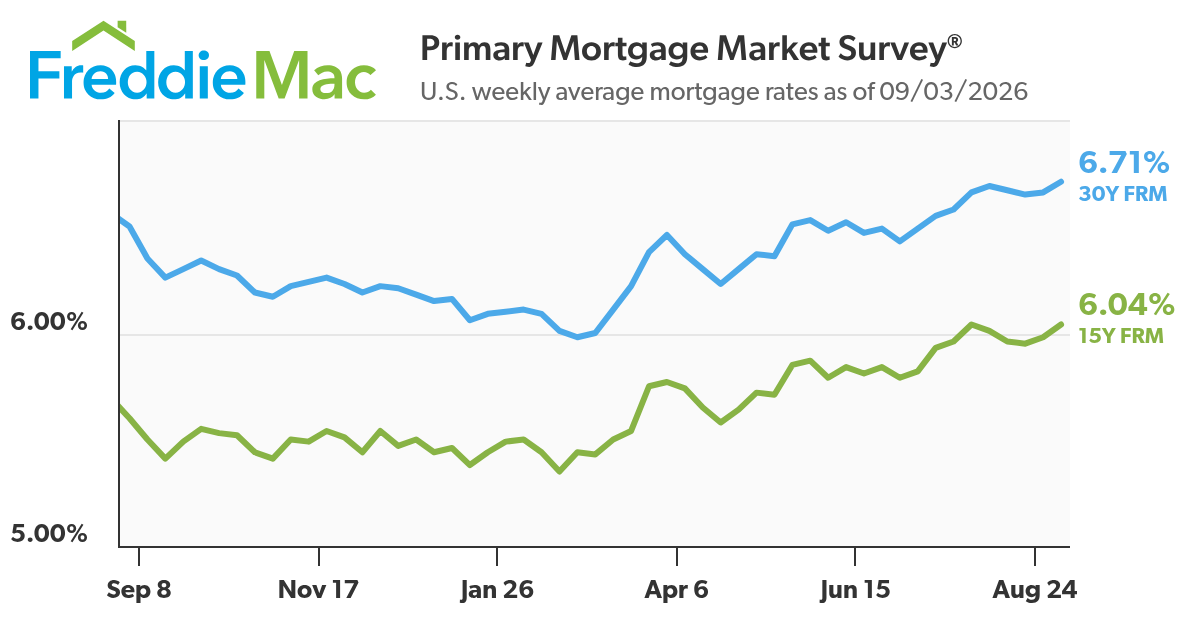
A $400,000 mortgage at 6.71% costs roughly $2,584 a month before taxes, insurance or repairs. If your property plan needs rate cuts to save it, it is not a plan.
The U.S. housing market has spent years telling itself a comforting lie: just wait for lower rates and everything will go back to normal.
On September 3, Freddie Mac put a number on how badly that theory is ageing. The average 30-year fixed mortgage rate rose to 6.71%—its highest level since July 2025. If your property plan requires rates to bail you out, you do not have a plan. You have a prayer with a spreadsheet attached.
Freddie Mac’s 6.71% number is the story
Freddie Mac’s latest Primary Mortgage Market Survey showed the average 30-year fixed rate rising from 6.66% a week earlier and 6.50% a year earlier. The 15-year fixed rate rose to 6.04%, from 5.98% the prior week and 5.60% a year ago.
That sounds like small change. It is not.
A rate is a lever applied to a very large number for a very long time. On a $400,000, 30-year loan, 6.71% works out to roughly $2,584 a month in principal and interest. Over 30 years, that is about $530,000 in interest before you add property taxes, insurance, maintenance, repairs, HOA fees or the inevitable kitchen that suddenly needs doing.
This is why people feel broke even when prices have stopped racing away from them. The sticker price is only the front door. The debt service is the bloke standing behind it with a bat.
And remember what Freddie Mac’s survey represents: conventional, conforming purchase loans for borrowers putting 20% down with excellent credit. That is not the marginal buyer. It is the cleanest file in the pile. Plenty of real borrowers will see a worse rate or have to put down less money, which makes the monthly pain sharper again.
Purchase demand has remained relatively steady, according to Freddie Mac. I do not read that as proof buyers are fine. I read it as proof that life does not pause for a bond market. People still get married, divorced, relocated, have kids, inherit houses and need somewhere to live. “Demand is holding” is not the same as “housing is affordable.”
The Fed does not set your mortgage rate—and that matters
Here is another expensive belief: the Federal Reserve cuts or holds rates, and your mortgage follows obediently behind.
Nope.
Mortgage rates are heavily influenced by the bond market, especially the 10-year U.S. Treasury yield. On September 3, the 10-year yield was about 4.74%, up from 4.67% a week earlier and well above the 3.97% level seen in late February, according to the Associated Press.
Why? Markets are pricing inflation risk, government borrowing, growth expectations and uncertainty. In the current cycle, higher crude prices connected to the U.S.-Iran conflict have also fed inflation concerns. Add worries over U.S. government debt and suddenly investors demand more yield to lend for longer.
That yield pressure runs through the system. Treasury yields rise, mortgage-backed securities get repriced, lenders protect their margins, and the family trying to buy a modest house pays for it.
That is the chain. Not sexy. Very real.
The practical takeaway is brutal but useful: do not make a property decision based on a prediction about the next central-bank meeting. The Fed can influence the broad cost of money. It cannot promise you a cheap 30-year mortgage on the day you need to settle.
This is not merely a buyer problem
Higher rates hit buyers first because the monthly payment is sitting right there in black and white. But the second-order effects matter more for investors and operators.
First, sellers are stuck too. A homeowner sitting on a cheap legacy mortgage has a powerful reason not to move. Selling means giving up their old loan and buying into a 6%-plus market. That creates the lock-in effect: fewer listings, fewer transactions and less price discovery.
Second, transaction businesses cop it. Agents, lenders, title businesses, renovators, furniture retailers and developers do not get paid because people admire Zillow listings. They get paid when homes change hands and projects get funded. A market can have plenty of household formation and still be commercially miserable if transactions remain weak.
Third, developers cannot wish away their capital stack. Higher long-term rates push up the hurdle rate for new projects and can make marginal developments uneconomic. That matters because today’s cancelled or delayed project is tomorrow’s missing supply. Everyone loves yelling that housing needs more homes. Far fewer people enjoy financing them when debt is expensive and the exit price is uncertain.
Fourth, commercial real estate does not get a free pass because it is called commercial. Office, retail, apartments, industrial and hospitality all live or die on the spread between property income, financing cost and the price investors are prepared to pay for a stream of rent. When long-term yields reset higher, valuations have to work harder to justify themselves.
That does not mean every property is doomed. It means lazy underwriting is.
The overlooked opportunity is not “buy the dip”
Every noisy market creates a tribe of people yelling “now is the time to buy.” Usually, they own something they would like you to buy.
I think the better contrarian view is simpler: this is the time to become extremely selective.
A frozen market is miserable for anyone who needs liquidity. It is useful for anyone with liquidity, patience and the ability to say no.
The best opportunities will not necessarily be the homes with the biggest advertised price cut. They will be situations where the seller has a deadline and the buyer pool has shrunk: an estate sale, a relocation, a developer with an awkward unit mix, an owner facing a refinance, or a business property where the operations are decent but the capital structure is not.
But do not confuse a discount with value. A $1 million building cut to $900,000 is still overpriced if the rents cannot carry debt, expenses, vacancies and a sensible return on your equity.
I have watched plenty of investors lose money because they were obsessed with buying below a previous valuation. The old valuation does not pay the interest bill. Cash flow does.
In this environment, the premium asset is not property. It is optionality.
Cash gives you optionality. A strong balance sheet gives you optionality. Pre-approved finance gives you optionality. A clean understanding of your downside gives you optionality. Being able to walk away from a mediocre deal is the most underrated investing skill on earth.
What this means for property investors
If you own property already, stress-test it at rates higher than today’s. Not because I know rates will rise, but because you should be able to survive being wrong. Run your numbers at 7.5% or 8%. Include vacancy. Include repairs. Include the fact that insurance and operating costs do not politely stand still while you wait for rent increases.
If the investment only works at the interest rate you hope to receive on refinance, it does not work.
If you are buying, underwrite the deal using the actual rate available to you today—not a broker’s cheerful forecast. Work from monthly cash flow backwards. What is the maximum payment you can make without starving your savings rate, emergency buffer or business capital? Then determine the purchase price and loan size that fit inside it.
That is the reverse of how most people do it. Most people fall in love with a property, then contort their finances until the bank says yes. That is how you become house-rich, cash-poor and permanently anxious.
For listed-property investors, be equally careful. A REIT is not a magic exemption from interest rates. Look at debt maturities, fixed-versus-floating exposure, interest coverage, occupancy and the gap between asset values on paper and what buyers are actually paying for comparable properties. A juicy distribution is not income if it is being funded by a balance sheet that needs rescuing.
What this means for you
Here is the use-it-tomorrow version.
1. Stop waiting for a forecast to make your decision. Price the loan you can get now. If it works now and gets better later, terrific. If it only works after a hypothetical cut, walk.
2. Calculate your all-in holding cost. Mortgage, taxes, insurance, maintenance, vacancy, strata or HOA fees, management and repairs. If you have not included the boring costs, your return is fiction.
3. Keep more cash than your ego likes. In a tight market, liquidity is not dead money. It is negotiating power and survival capital.
4. Ask every seller one question: why now? The answer tells you more than a glossy listing ever will. Urgency creates opportunity; pretty photos do not.
5. Buy income, not stories. A property should stand on its own cash flow and conservative assumptions. Do not pay today for a future rate cut, a heroic rent increase or a resale buyer who may not exist.
The headline rate is 6.71%. The real story is that property has become a business again. Debt costs money. Timing matters. Bad assumptions get punished.
Good. Markets are supposed to do that.