Gatik’s $200M Raise: PepsiCo Proves Driverless Freight Is Real
The autonomous-trucking gold rush was mostly expensive theatre. Gatik’s $200 million round matters because PepsiCo is already using the trucks to move real products, every day.
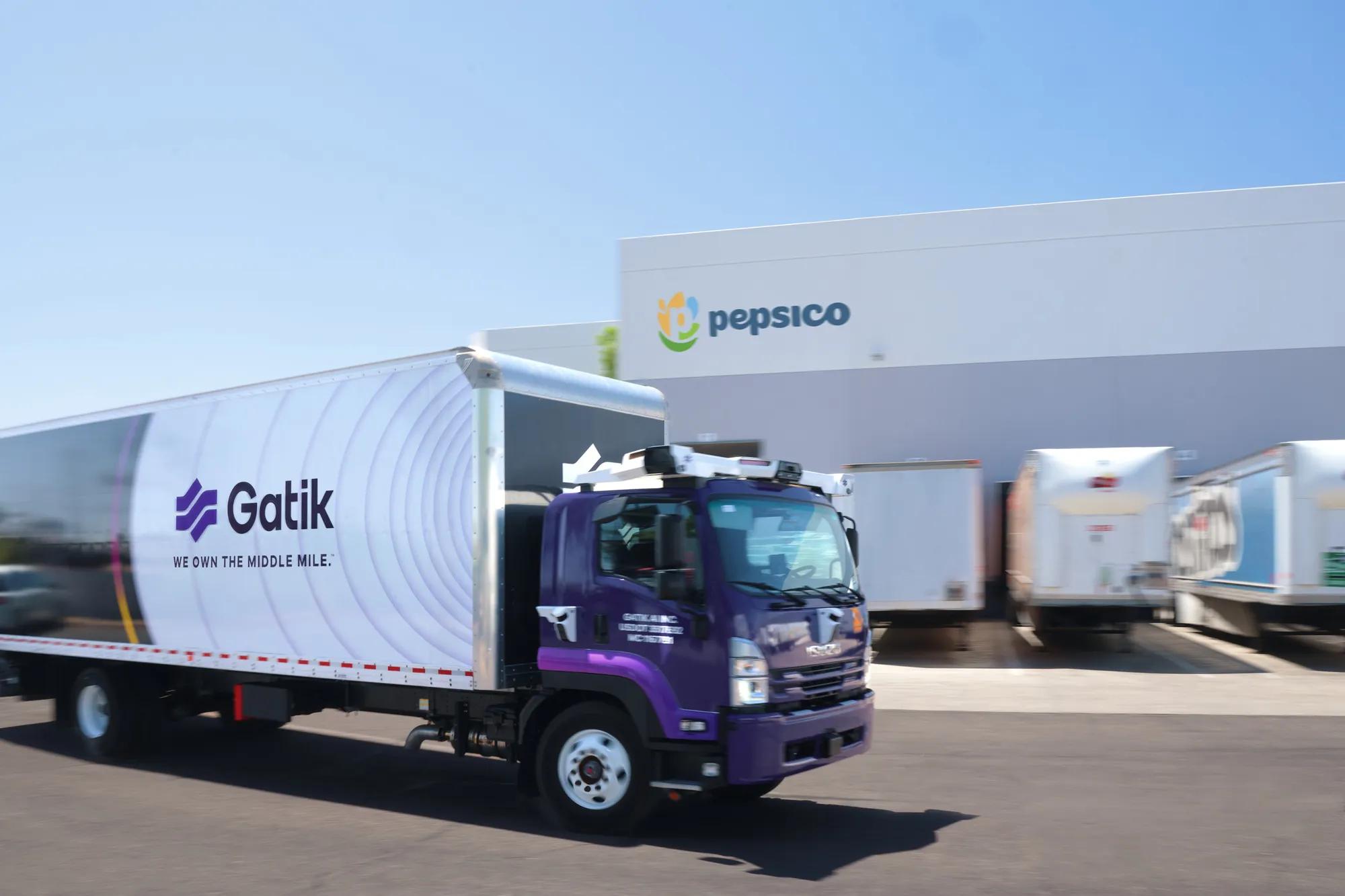
Most autonomous-trucking startups spent years selling a future that never arrived. Gatik has just raised $200 million because it is doing the boring bit everyone else avoided: moving actual freight for actual customers without a driver in the cab.
That is the whole game. Not demos. Not glossy launch videos. Not another billionaire-funded science project that needs one more breakthrough before it earns a dollar.
Gatik’s Series D was co-led by Qatar Investment Authority and Koch Disruptive Technologies, with ARK Invest, Millennium Management, Intact Private Capital and Arca Continental also participating. The company did not disclose a valuation, but it says the money will help it meet growing demand from large retailers, grocers and consumer-goods businesses. ([qia.qa](https://qia.qa/en/Newsroom/Pages/QIA-Co-Leads-Gatiks-%24200-Million-Series-D-Financing-to-Support-the-Expansion-of-Driverless-Commercial-Freight.aspx?utm_source=openai))
The $200 million is not the headline. The customer is.
The money is substantial, but the more important number is 41.
That is the number of driverless Gatik box trucks operating in PepsiCo’s network, moving Frito-Lay products including Cheetos and Doritos between distribution centres and stores in Dallas, Phoenix and Northwest Arkansas. PepsiCo and Gatik announced their multiyear deal on June 8, 2026; the companies say the operation is already live across Texas, Arizona and Arkansas. ([techcrunch.com](https://techcrunch.com/2026/08/25/self-driving-truck-startup-gatik-raises-200m-following-pepsico-deal/))
This is why the raise matters. Venture investors are not simply placing a bet on autonomous vehicles as a category. They are putting capital behind a company that has found a specific job where autonomy has commercial teeth: regional, repetitive “middle-mile” freight runs.
That phrase sounds dull because it is dull. It means shifting goods from a distribution centre to stores or another facility. The routes are frequent, time-sensitive and operationally repetitive. That makes them a far better starting point for driverless technology than trying to solve every chaotic road, every bizarre edge case and every drunk bloke wandering into traffic at 2 a.m.
Gatik started with routes under 10 miles and has expanded to dynamic routes with many pickup and drop-off points spanning as much as 400 miles, according to TechCrunch. It has commercial relationships with names including Walmart, Kroger, Loblaw and Tyson Foods. The company says it has about $600 million in contracted revenue and has raised roughly $500 million since emerging from stealth in 2019. ([techcrunch.com](https://techcrunch.com/2026/08/25/self-driving-truck-startup-gatik-raises-200m-following-pepsico-deal/))
That is a much healthier startup story than “we have amazing technology and a huge total addressable market.” Every founder on earth can say that. Contracted revenue is where the fantasy gets punched in the face by reality.
Gatik picked the unsexy wedge — and that was the smart move
The first lesson here is brutally simple: a narrow market can be worth more than a huge market if you can actually win it.
Autonomy has attracted absurd amounts of capital because the theoretical prize is enormous. Long-haul trucking, robotaxis, delivery bots, mining vehicles, construction machinery — everyone sees labour costs and imagines a giant cheque. The problem is that a giant market does not make a giant business. It often makes a giant burn rate.
Gatik did not start by promising to replace every truck driver in America. It focused on medium-duty box trucks, defined routes and customers whose commercial pain is obvious: shelves need stock, distribution centres need flow, and missed deliveries cost money immediately.
PepsiCo describes the partnership as a way to improve consistency, add capacity and strengthen customer service in high-volume regional transportation networks. The company says Gatik’s system lets it adapt routes as demand shifts, including adding or removing stops. PepsiCo also says Gatik had achieved more than 98% on-time delivery across its operations as of the June announcement. That is a company-reported figure, of course, but it is the right commercial metric to watch. ([pepsico.com](https://www.pepsico.com/en/newsroom/press-releases/2026/pepsico-and-gatik-announce-multi-year-agreement-to-deploy-autonomous-freight-in-north-america?utm_source=openai))
Notice what is missing from that pitch: techno poetry.
No one buying freight capacity cares whether the truck is “reimagining mobility.” They care whether their product arrives on time, whether costs are predictable, and whether the service holds up when the network gets messy. The best technology companies understand that customers do not buy technology. They buy a result.
I am building Agave Finder in the spirits industry, and the same rule applies there. Nobody wakes up wanting another app. They want to find the right bottle, make a better decision or run a sharper business. If your product needs a TED Talk to explain why it matters, you have probably built a feature looking for a problem.
The real shift: capital is moving from possibility to proof
For years, the autonomous-vehicle sector was funded on a hope-and-hype model. Big rounds went to companies with smart people, spectacular technical ambitions and a plausible story about the future. Fair enough. That is how frontier technology starts.
But the market has become less patient. Investors now want to see a path from research to repeatable deployment. Not a pilot that exists to impress journalists. Not a memorandum of understanding dressed up as revenue. A paid operating system inside a customer’s daily workflow.
Gatik’s raise fits that change. Qatar Investment Authority and Koch Disruptive Technologies are not lightweight tourists in a seed round. Their involvement signals that the financing is about scaling an operating footprint, not merely keeping a lab alive. Gatik says it runs fully driverless trucks in customer networks across Texas, Arizona, Arkansas and Ontario, and that the funding will support demand from Fortune 50 customers. ([qia.qa](https://qia.qa/en/Newsroom/Pages/QIA-Co-Leads-Gatiks-%24200-Million-Series-D-Financing-to-Support-the-Expansion-of-Driverless-Commercial-Freight.aspx?utm_source=openai))
There is also a practical reason this segment is moving first. Regional freight networks are more controllable than the open-ended mess of consumer transport. Companies can map routes, design operating procedures, build maintenance routines, plan loading docks and measure service levels. The problem is still difficult, but it is a business problem with boundaries.
That matters because the best startups do not win by solving the biggest imaginable problem first. They win by solving a painful, constrained problem so well that customers drag them into adjacent ones.
The overlooked angle: this is a capacity story before it is a labour story
The lazy take on driverless trucking is always the same: “It will replace drivers.” Maybe, in some jobs and over time. But that is not the commercial case PepsiCo is making right now.
PepsiCo says the partnership is aimed at adding capacity in high-demand regional networks that are hard to staff, while investing in workforce planning and helping employees develop alongside the changing operation. ([pepsico.com](https://www.pepsico.com/en/newsroom/press-releases/2026/pepsico-and-gatik-announce-multi-year-agreement-to-deploy-autonomous-freight-in-north-america?utm_source=openai))
You do not have to swallow every corporate reassurance whole to see the point. A logistics network has one job: keep goods moving. If a business cannot get enough reliable capacity on certain routes, it does not need a philosophical debate. It needs trucks.
That is the contrarian bit. The near-term winner in automation may not be the company that promises the biggest headcount reduction. It may be the one that gives customers dependable capacity where they are constrained today.
Founders should pay attention. Cost-cutting is an easy pitch, but revenue protection is often a stronger one. If you can help a customer avoid stockouts, missed sales, downtime or lost service levels, you are attached directly to their heartbeat. That is where budgets become remarkably available.
Gatik’s 350-person workforce is also a reminder that “autonomous” does not mean “staff-free.” The company plans to add engineering and operational employees as it expands. Technology that removes one category of labour can create demand for different, higher-leverage operational capability. ([techcrunch.com](https://techcrunch.com/2026/08/25/self-driving-truck-startup-gatik-raises-200m-following-pepsico-deal/))
What could still go wrong
Let’s not get carried away after one funding round.
Gatik has not disclosed its valuation, precise fleet size or every customer. Scaling a driverless freight operation is not just a software problem. It involves vehicles, maintenance, insurance, regulation, weather, customer integration, depot operations and proving safety over a far larger number of miles.
The company’s current advantage is focus. Its risk is that expansion dilutes that focus. It is one thing to dominate repeatable regional routes with box trucks. It is another to add markets, customers and use cases without turning the operation into a dog’s breakfast.
There is a financing risk as well. Two hundred million dollars is a war chest, not immortality. Hardware-heavy businesses eat cash for breakfast. Gatik will need to turn its contracted revenue into durable gross margins and reliable operating economics. Revenue is good. Profitable, repeatable revenue is the bit that lets you sleep at night.
Still, this is a far more credible position than most autonomy businesses have managed. Gatik is not asking the market to believe that commercial driverless freight will happen someday. It is showing the market that commercial customers are already using it.
What this means for you
If you are a founder, steal Gatik’s strategy — not its technology.
First, find the narrowest painful use case. Do not start with “transforming an industry.” Start with a job that happens frequently, costs real money and has a measurable outcome. Gatik did not begin with all trucking. It attacked regional freight routes where repetition made deployment possible.
Second, sell an operating result, not an innovation story. Build your pitch around on-time delivery, capacity, revenue recovered, hours saved, errors eliminated or churn reduced. If you cannot name the before-and-after number, your customer will struggle to justify buying from you.
Third, earn the right to expand. A customer that uses your product daily is worth more than ten press releases about future partnerships. Nail one workflow. Get embedded. Then move sideways into the next workflow with proof in hand.
Fourth, separate contracted revenue from real economics. Contracts are brilliant. But ask the hard questions: What does delivery cost? What breaks at scale? How much human support is still required? When does gross margin improve? I have seen plenty of businesses raise money on momentum and discover later that momentum is expensive.
And if you are an investor or operator, stop confusing scale of ambition with quality of business. The most valuable company in a category may not be the one shouting loudest about changing the world. It may be the one quietly doing a job every day that a major customer cannot afford to have done badly.
That is what Gatik’s $200 million says. The driverless-truck race is becoming less about who has the sexiest demo — and more about who has already become part of the supply chain.