Gatik’s $200M Raise Proves PepsiCo Is Already Buying Robot Freight
The robot-truck revolution isn’t coming. PepsiCo already has 41 driverless Gatik trucks moving Doritos and Cheetos—and Gatik just raised $200 million to do more of it.
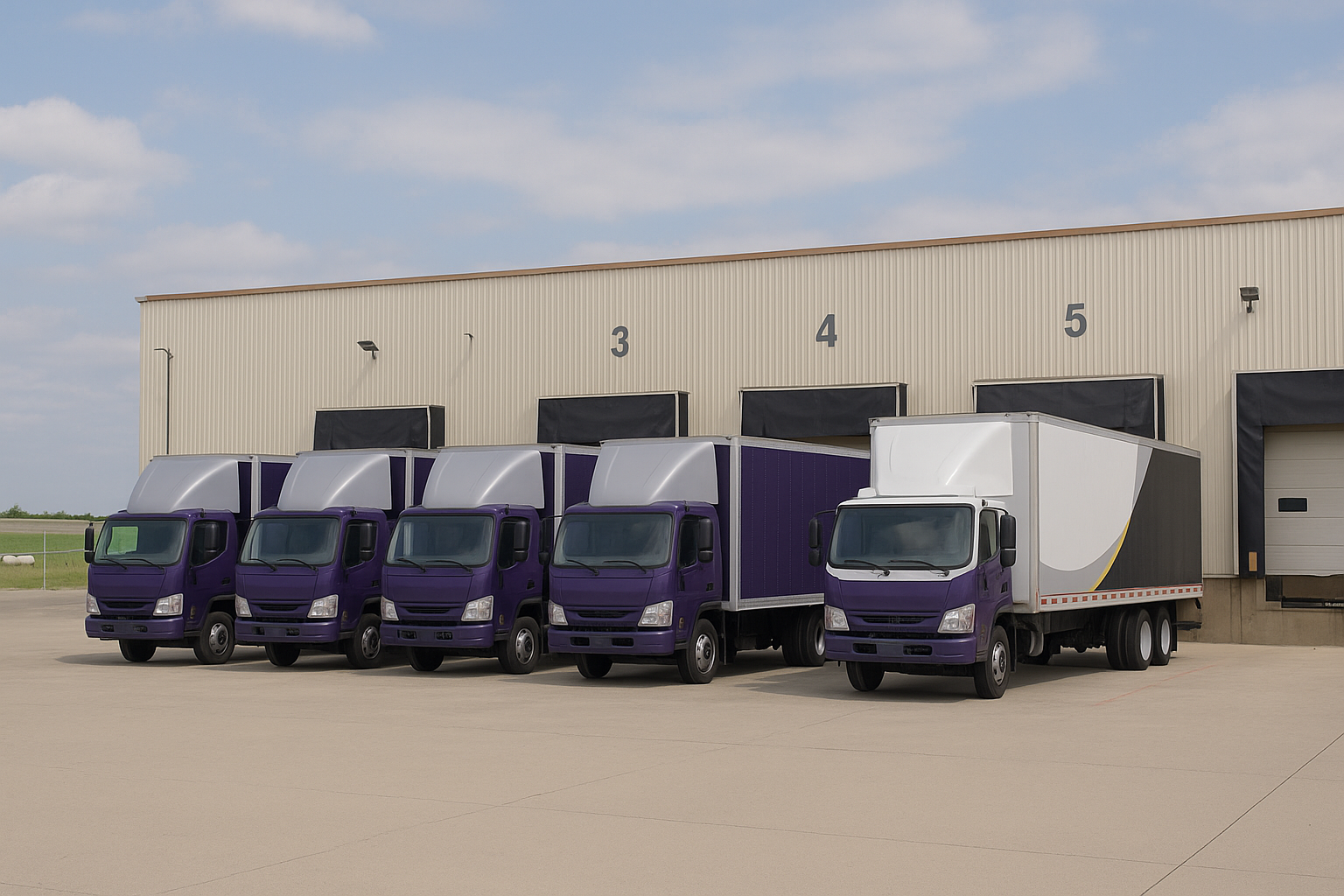
PepsiCo has put 41 driverless trucks on public roads, hauling Doritos and Cheetos between distribution centres and stores. If you still think autonomous freight is a flashy demo waiting for a real customer, you’re already behind.
Gatik, the autonomous middle-mile freight company, has raised a $200 million Series D led by Qatar Investment Authority and Koch Disruptive Technologies. The company says it has now raised roughly $500 million since emerging from stealth in 2019, with more than $600 million in contracted revenue. ([techcrunch.com](https://techcrunch.com/2026/08/25/self-driving-truck-startup-gatik-raises-200m-following-pepsico-deal/))
That’s not a robotaxi story. It’s better than a robotaxi story.
Robotaxis get headlines because people can imagine themselves sitting in one. But moving cartons of snacks from a PepsiCo distribution centre to a Walmart or Dollar General is where the money is. It is repetitive, high-frequency, operationally dull—and therefore exactly the sort of problem technology should attack first.
Gatik picked the boring bit of trucking. That was the smart move.
For years, autonomous-vehicle founders sold the grand vision: driverless cars everywhere, then driverless long-haul semis crossing America. It sounded massive because it was massive. It was also a bloody hard place to start.
Long-haul trucking means high speeds, changing weather, unfamiliar roads, endless edge cases, refuelling, loading docks, state-by-state rules and enormous consequences when something goes wrong. Plenty of companies raised mountains of money chasing it. Several disappeared or stumbled badly.
Gatik went after the middle mile instead: the regular movement of goods between warehouses, distribution facilities and retail sites. Its box trucks began on fixed routes under 10 miles and have expanded to dynamic routes covering as much as 400 miles with multiple pickup and drop-off points. The company says its third-generation trucks operate around the clock on surface streets and highways, including in light rain and snow. ([techcrunch.com](https://techcrunch.com/2026/08/25/self-driving-truck-startup-gatik-raises-200m-following-pepsico-deal/))
That is what good founders do. They do not start with the biggest market on a pitch deck. They start with the smallest version of a painful problem that someone will pay to solve now.
PepsiCo is the commercial proof. Its multiyear agreement with Gatik puts driverless freight into its North American food and beverage supply chain across Texas, Arizona and Arkansas. The partnership centres on regional networks where goods move every day and delays turn into empty shelves. ([news.gatik.ai](https://news.gatik.ai/news/coverage/pepsico-and-gatik-announce-multi-year-agreement-to-deploy-autonomous-freight-in-north-america/))
The Wall Street Journal reported that a 26,000-pound Gatik truck can leave a Phoenix-area distribution centre and drive roughly four miles to a Walmart store without anyone behind the wheel. This is not a simulation. It is not a press-event lap around a sunny business park. It is product moving through a major consumer-goods supply chain. ([wsj.com](https://www.wsj.com/business/logistics/driverless-trucks-are-hereand-theyre-delivering-bags-of-doritos-ee4495f0))
The $200 million matters less than the customer
Founders often get this backwards. They announce a funding round as if the financing itself is the achievement.
It isn’t.
Cash is fuel. Customers are proof.
Gatik’s $200 million round matters because it follows a commercial relationship with PepsiCo and sits alongside customers including Walmart, Kroger, Tyson Foods and Loblaw. It was led by deep-pocketed investors that can fund an ugly, capital-intensive job: turning a technically working fleet into a properly scaled operating business. ([techcrunch.com](https://techcrunch.com/2026/08/25/self-driving-truck-startup-gatik-raises-200m-following-pepsico-deal/))
That distinction is crucial. Building autonomy software is expensive. Operating autonomous freight is more expensive still. You need vehicles, maintenance, remote support, insurance, safety systems, mapping, simulations, customer integrations and people on the ground when things get weird—as things inevitably do.
The worst possible outcome for a company like Gatik would be a beautiful technical demo with no commercial rhythm. The second-worst would be a pile of purchase orders it cannot fulfil. This raise is meant to close the gap between those two problems: more trucks, more markets, more engineers and more operational staff beyond its roughly 350-person workforce. ([techcrunch.com](https://techcrunch.com/2026/08/25/self-driving-truck-startup-gatik-raises-200m-following-pepsico-deal/))
I like that more than a startup announcing it has invented “agentic logistics intelligence” or some other PowerPoint crime against the English language. Gatik has vehicles running and freight to move. The work is obvious.
The real product is not the truck. It is reliability.
This is the bit most investors miss when they get hypnotised by the autonomy.
Nobody at PepsiCo wakes up hoping to own clever robotics. They want snacks on shelves when retailers expect them. They want a system that can add capacity on routes that are difficult to staff. They want fewer surprises.
Gatik’s pitch is not merely that a truck can drive itself. The operational pitch is that PepsiCo can alter stops as demand changes, add or remove pickups, and respond to activity across distribution centres without rebuilding its network around the technology. ([news.gatik.ai](https://news.gatik.ai/news/coverage/pepsico-and-gatik-announce-multi-year-agreement-to-deploy-autonomous-freight-in-north-america/))
That is a far more valuable capability than “look mum, no driver.”
When I’m building Agave Finder, I see the same principle. The interesting technology is rarely the thing customers actually buy. They buy a result: faster discovery, better information, fewer bad decisions, more confidence in what they are spending money on. The tech earns its keep only when it removes friction from a real job.
For PepsiCo, the job is keeping an enormous physical network dependable. Food and beverage supply chains do not get points for being innovative. They get judged when stock does not arrive.
Here is the overlooked angle: this is a capacity story before it is a labour story
The lazy take is that driverless freight is simply about replacing truck drivers. That may eventually be part of the economics, but it is too simplistic to be useful.
PepsiCo has framed the Gatik arrangement around adding capacity and reliability in high-demand regional networks that are hard to staff, while continuing to invest in its workforce. ([news.gatik.ai](https://news.gatik.ai/news/coverage/pepsico-and-gatik-announce-multi-year-agreement-to-deploy-autonomous-freight-in-north-america/))
That matters because a technology adopted to relieve a bottleneck has a much clearer path than one adopted purely to slash headcount. Businesses will tolerate disruption when a new system helps them serve customers. They become more cautious when the only promise is a spreadsheet saving and a public-relations headache.
There is another reason the middle mile is attractive: utilisation. A dedicated regional route can be repeated, tested, observed and improved. The business can learn its geography, loading patterns, traffic pinch points and failure modes. It does not need to solve every road in North America on day one.
That is the contrarian lesson. Constraints are not always a weakness. In the early years of a hard technology, constraints are often the moat.
A company that says, “We only work in these conditions, on these routes, for these customers,” can look less ambitious than a company promising universal autonomy. But it may be the one quietly accumulating commercial data, customer trust and operating discipline while the louder rival is still selling the dream.
Forbes reported in January that Gatik planned to grow from fewer than a dozen fully driverless, revenue-generating trucks to hundreds by the end of 2026. Its current funding gives it more ammunition to pursue that goal, but the difference between dozens and hundreds is where execution gets brutally real. ([forbes.com](https://www.forbes.com/sites/alanohnsman/2026/01/28/hundreds-of-gatik-robot-delivery-trucks-headed-for-us-roads/))
Don’t confuse contracted revenue with victory
Now for the cold shower.
Gatik says it has locked in $600 million in contracted revenue. Good. That is a serious commercial signal. But contracted revenue is not the same thing as cash in the bank, recognised revenue or profit.
A contract can still require years of deployment, vehicles, route approvals, customer integration and flawless operations before it produces the returns investors imagine. And Gatik did not disclose its valuation in the new round. ([techcrunch.com](https://techcrunch.com/2026/08/25/self-driving-truck-startup-gatik-raises-200m-following-pepsico-deal/))
This is where sensible operators separate themselves from hype merchants.
The $600 million tells me customers are willing to commit. The $200 million tells me sophisticated investors think the company has a credible shot at scaling. Neither number tells me the business has won.
It has not won until the fleet expands without safety failures, unit economics improve as volumes rise, customers renew, and the company can deliver service across more cities without turning every new route into a custom science project.
That is not cynicism. It is respect for the difficulty of the job.
What this means for you
If you are a founder, stop worshipping massive markets and start hunting repeatable pain. Gatik did not begin by trying to make every vehicle autonomous. It focused on a specific freight leg, with repeated routes and buyers who could measure the benefit. Find your version of that.
If you are an operator, ask every technology vendor one question: what operational metric gets better in the next 90 days? Not “what can your AI do?” Ask whether it improves fulfilment, error rates, margin, response time, capacity or customer retention. If they cannot answer plainly, keep your wallet shut.
If you are an investor, pay closer attention to the sequence: customer proof first, capital second, scale third. Money raised before demand is a story. Money raised after a major customer has put the product into daily operations is a different beast.
And if you run a physical-goods business, quit assuming AI is only a software-industry story. The bigger prize is often in the unsexy machinery underneath commerce: warehousing, routing, replenishment, claims, procurement and distribution.
Gatik’s $200 million round is not proof that autonomous trucking has conquered the world. It is proof of something more useful: the winners may be the companies that made the problem small enough to solve, then commercial enough to matter.