Gatik’s $200M Series D: Why 41 PepsiCo Trucks Matter
Forty-one driverless trucks moving Doritos are more valuable than another robotaxi promise. Gatik’s $200M raise is what venture capital looks like when the product actually works.
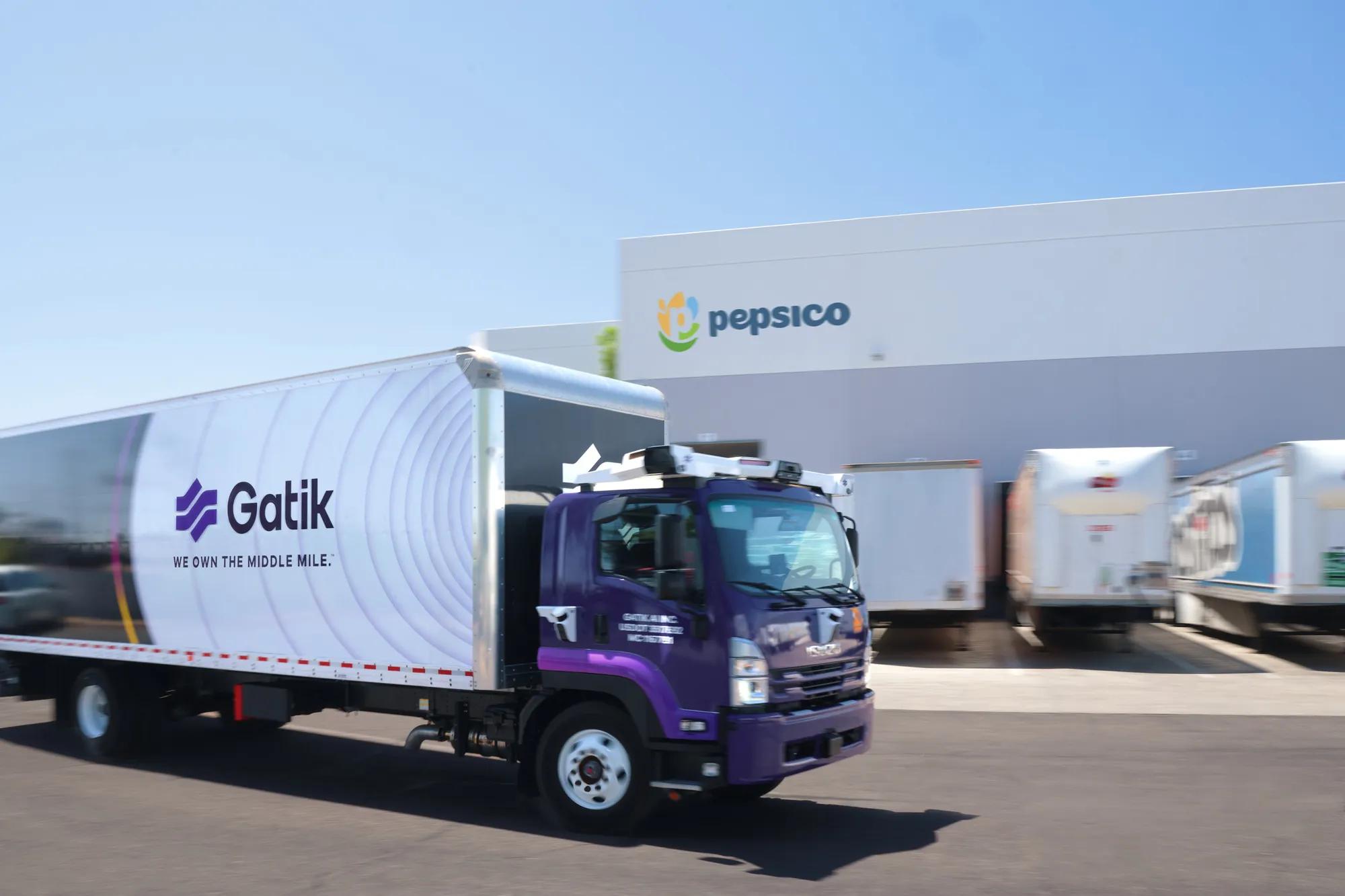
Forty-one driverless trucks moving PepsiCo products around Texas, Arizona and Arkansas are doing more for autonomous vehicles than a decade of flashy robotaxi videos.
That is the real story behind Gatik’s $200 million Series D this week. Not the funding round. Not the obligatory AI-and-autonomy chest-beating. The fact that a startup has found the bit of the transport market where the technology can earn its keep before everyone gets bored, regulators get nervous, or the cash runs dry.
Gatik has raised the money from Qatar Investment Authority and Koch Disruptive Technologies, with investors including ARK Invest, Millennium Management, Intact Private Capital and Arca Continental also participating. It has now raised roughly $500 million since emerging from stealth in 2019.
More importantly, it has a proper commercial partner: PepsiCo. Its 41 driverless box trucks are carrying Frito-Lay products between distribution centres and stores in Dallas, Phoenix and Northwest Arkansas. Gatik says it has more than $600 million in contracted revenue and has completed more than 100,000 fully driverless orders.
That is not a science project. That is a business with tyres.
The $200 million is not the point
Founders love funding headlines because they make everybody feel successful for a day. Investors love them because they create the impression that someone else has done the homework. Both can be a bit of a con.
A large round means one thing for certain: the company has more money. It does not mean the company has customers, pricing power, defensibility or a sensible path to returns.
Gatik is interesting because the operating proof came before the big cheque. PepsiCo and Gatik announced a multi-year agreement in June 2026, expanding autonomous freight through PepsiCo’s North American supply chain. PepsiCo says Gatik had already been operating in its network since 2022. That is the sequence you want: first earn trust inside a demanding customer’s real operation, then scale the relationship, then raise growth capital.
Too much venture capital has it backwards. Raise a monster round. Hire ahead of the problem. Issue grand forecasts. Hunt for a customer willing to be your case study. Then act surprised when the next round is difficult.
Gatik’s $200 million is still venture money, so nobody should start handing out medals. The company did not disclose its valuation. It also has a long way to go before anyone can claim victory in autonomous freight. But it has achieved something the market should respect: it has attached its technology to a customer’s daily pain.
That is the only sort of innovation that matters in the end.
Gatik chose the boring route — and that was smart
The autonomous-vehicle industry has spent years chasing the most photogenic problem: put a car in a busy city, remove the driver, and convince the world it is the future.
Great theatre. Brutal business.
Urban robotaxis must deal with pedestrians, cyclists, school zones, bizarre roadworks, terrible weather, drunk passengers, vandalism, pickup confusion and public scrutiny. Every edge case becomes a headline. The technology may be extraordinary, but the operational mess is extraordinary too.
Gatik chose middle-mile freight instead. Its box trucks move goods between fixed commercial locations: distribution centres, stores and warehouses. The routes can be short, repeatable and commercially urgent. The company began with routes under 10 miles and has progressed to dynamic networks with multiple stops spanning as much as 400 miles.
That is not merely a narrower use case. It is a better wedge.
A business does not need to conquer every road on Earth to create value. It needs to own a problem where reliability is valuable, the buyer has money, the workflow repeats, and failure is measurable. PepsiCo’s regional network ticks those boxes. A late delivery affects stock on shelves. A missed route creates labour and inventory headaches. A truck that can add capacity and run consistently solves an expensive problem.
PepsiCo has said Gatik’s operations are achieving more than 98% on-time delivery. Take that as a company-reported metric, not gospel carved into stone. Even so, it points to the commercial standard that matters: not whether the truck looks futuristic, but whether the crisps arrive when they are meant to.
I am building Agave Finder, so I see a version of this problem from the other side. The drinks industry is full of products that are romantic at the bottle level and ruthlessly operational behind the scenes. Somebody has to move cases, manage availability and get the right product in front of the right buyer. The winner is rarely the person with the slickest pitch deck. It is the person who makes the system work when things get busy.
The second-order lesson: distribution is becoming the moat
The obvious read is that Gatik is an autonomous-trucking company. Fair enough.
The better read is that it is building a position inside distribution networks that are already hard to replace.
The trucks matter. The software matters. But the real asset may be the operating relationship: route data, deployment experience, customer workflows, safety processes, service reliability and the confidence earned from doing the job day after day.
That is why the PepsiCo agreement is more valuable than a vague partnership announcement. PepsiCo runs one of the world’s largest food and beverage supply chains. A technology supplier does not get embedded in that network because its founder made a beautiful slide deck. It gets embedded because operations people believe it can help them move product without blowing up their week.
Once a startup is trusted in one network, it has a credible template for the next customer. Gatik already names customers including Walmart, Kroger, Loblaw and Tyson Foods. Its fresh capital is intended to expand its fleet, its markets and its team beyond its current workforce of about 350 people.
This is how a real scaling story should look: capital follows repeatable deployment, rather than replacing it.
There is also a lesson here for investors. The next great company might not sell a magical tool to millions of users on day one. It may own an unglamorous workflow for a small number of enormous customers. Those businesses can look slower at first because enterprise sales and physical operations are hard. They can also become much harder to dislodge once they work.
The overlooked risk: $600 million in contracts is not $600 million in cash
Now for the bit everyone prefers to skip.
Contracted revenue is not recognised revenue. It is not gross profit. And it is definitely not free cash flow.
Gatik’s reported $600 million in contracted revenue is a meaningful signal that customers want what it sells. It is not a guarantee that the company will turn that pipeline into attractive economics. Scaling an autonomous freight business requires vehicles, hardware, maintenance, insurance, permits, operations staff, customer support and relentless safety discipline. This is not an app that can add customers without touching the physical world.
The $200 million round helps, but capital intensity is precisely why the business needs commercial proof. A software founder can survive being a bit early with a modest burn rate. A company operating driverless trucks cannot afford years of costly ambiguity.
The other risk is concentration. PepsiCo is a magnificent customer, but any founder who has built around one giant enterprise knows the danger. Big customers can accelerate a company’s credibility and revenue. They can also dictate timelines, pricing, integration requirements and strategic priorities. Gatik needs PepsiCo to be a launchpad, not a set of golden handcuffs.
That is why its other customer relationships matter. The company must prove that the playbook travels across retailers, grocers and consumer-goods groups without becoming a bespoke services shop wearing an AI badge.
What this means for you
If you are a founder, stop asking whether your product is “transformative.” Ask a much more useful question: what expensive, repeated job can I do reliably enough that a serious customer changes its operating model around me?
Do not begin with the biggest possible market. Begin with the narrowest painful workflow where you can win. Gatik did not start by solving every transport problem. It focused on regional freight. That restraint is not a lack of ambition. It is how ambition survives contact with reality.
Before you raise your next round, get brutally clear on four things:
1. Your proof of value: What number does the customer care about? For Gatik, delivery reliability and capacity are far more useful measures than a flashy demo. 2. Your deployment recipe: Can you repeat the installation, onboarding and service process without the founders personally holding it together? 3. Your unit economics: Revenue contracted is lovely. Cash generated after delivering the service is lovelier. 4. Your customer concentration: One marquee logo can make your company. It can also own you. Build a repeatable second and third use case early.
If you are an investor, look past the category noise. The best question is not, “Is this AI?” or “Is this autonomous?” It is, “Has somebody with a real budget put this into production and come back for more?”
And if you run a traditional business, this is your reminder not to dismiss new technology because it arrives wearing a stupid slogan. The useful stuff rarely announces itself with fireworks. Sometimes it just turns up, moves 26,000 pounds of snacks, hits the delivery window, and quietly makes the incumbent look slow.
That is the takeaway. Do not confuse a massive market with a useful starting point, or a funding round with proof. Find the boring, expensive job. Do it reliably. Get a serious customer to depend on you. Then earn the right to scale.
That is the kind of startup I would back my time on: one that does the hard, boring thing well enough that customers cannot imagine going back.