Google’s DeepMind Reset Is a Talent-and-Strategy Test for the AI Race
Demis Hassabis is leaving the DeepMind CEO role as Jeff Dean departs with key researchers. Google’s answer is not a retreat—it is a bet that research, product and capital can be reorganized fast enough.
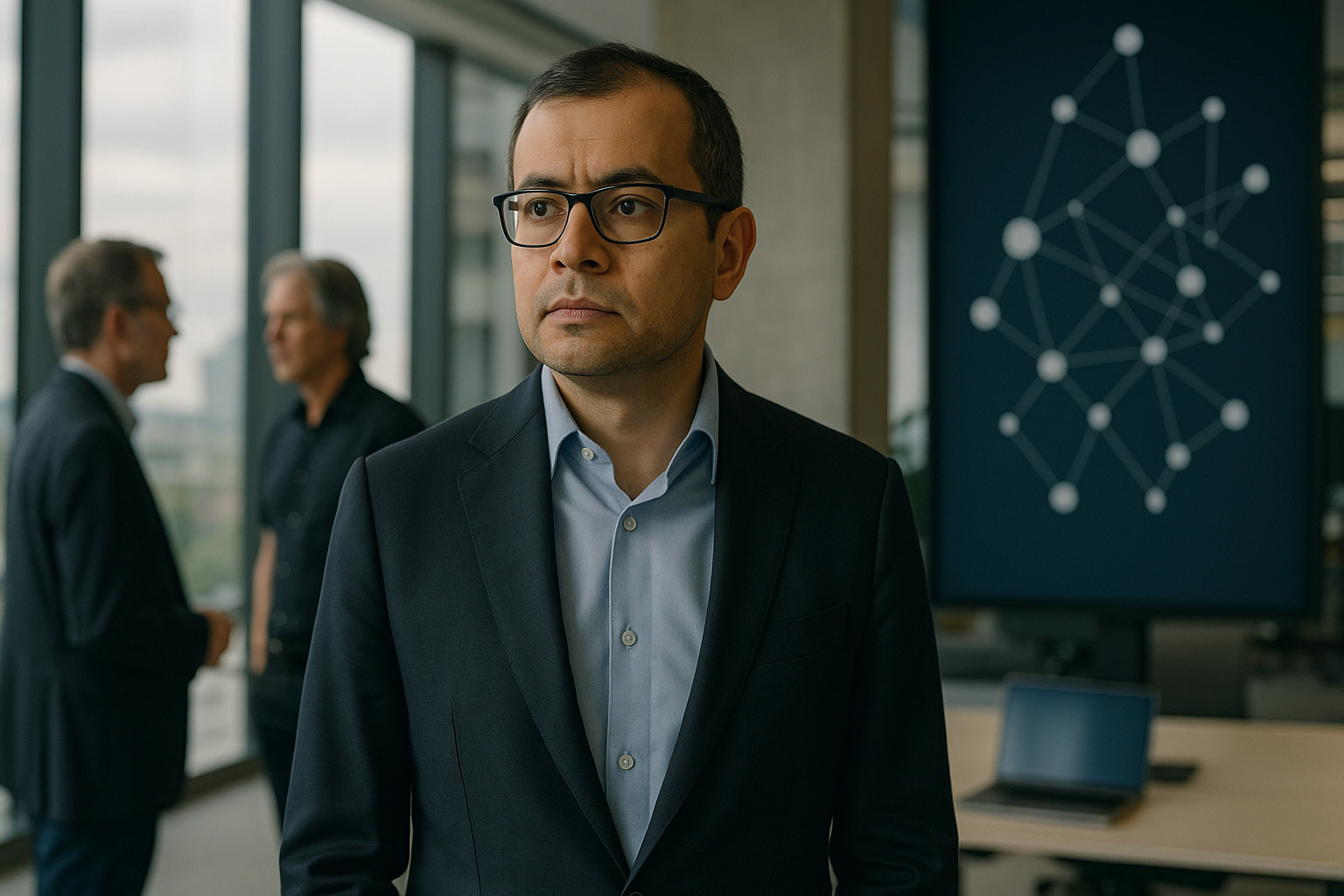
On August 5, Google made one of the most consequential AI leadership changes of the year. Demis Hassabis is stepping down from the day-to-day CEO role at Google DeepMind to become chairman of the unit and chief scientist of Alphabet. At the same time, Jeff Dean—Google’s chief scientist and a 27-year veteran—is leaving with senior researchers Sanjay Ghemawat, Oriol Vinyals and Quoc Le to form Discovery Loop, an independent public-benefit corporation backed by Google and using its cloud.
The conventional framing is that Google has lost a few big names. That is true, but it misses the point.
This is a structural test of whether an incumbent can keep its frontier-research advantage while turning AI into an operating system for a massive commercial business. Google is trying to separate scientific stewardship from execution: Hassabis gets more space to focus on AGI, science and the long horizon; Koray Kavukcuoglu, previously DeepMind’s CTO, moves into the senior operating role, reporting directly to Sundar Pichai.
That might be the right org chart. But it is arriving at precisely the moment when AI leadership is becoming less about who publishes the most impressive benchmark and more about who can keep elite talent, ship reliable agents and distribute them through products people already use.
This is bigger than one executive move
Google DeepMind was created in April 2023 by combining DeepMind and Google Brain. The logic was clear even then: Google needed one focused organization capable of moving research into products at a pace matching OpenAI’s emergence. Google’s own announcement described the combined group as a way to pool work across AlphaGo, Transformers, AlphaFold, TensorFlow, JAX and large-scale machine-learning systems.
The original arrangement was designed around complementary strengths. Hassabis, the DeepMind co-founder, was the scientific leader tasked with the company’s most capable and responsible general AI systems. Dean, one of the foundational engineers behind Google’s large-scale computing and machine-learning infrastructure, was elevated to chief scientist across Google Research and Google DeepMind.
Now both sides of that pairing are changing at once.
Hassabis is not leaving Alphabet. His new portfolio is arguably more consequential: chairman of Google DeepMind, Alphabet chief scientist, and continued leadership of Isomorphic Labs, Alphabet’s AI drug-discovery effort. But stepping away from operating control is a meaningful handoff. Google is signaling that the near-term Gemini roadmap needs an executive operator with a singular mandate for speed and delivery, while Hassabis concentrates on the scientific, safety and societal questions surrounding increasingly powerful systems.
Dean’s move is different. Discovery Loop will be independent, with Google as investor and cloud provider. That arrangement gives Google continued proximity to a group of researchers whose work shaped modern AI infrastructure and modeling, while allowing the new company room to make choices that do not fit neatly inside a public company’s planning cycle.
That is a sophisticated form of talent retention—but it is still a loss of internal concentration. In frontier AI, the organizational perimeter matters. The people who decide which research paths deserve scarce compute, which model behaviors are tolerable and which products should be built first often determine the company’s trajectory long before a model reaches the market.
The talent issue did not start this week
Google’s reshuffle follows a difficult summer for its AI bench. In June, Bloomberg reported that John Jumper, the Google DeepMind vice president who shared the 2024 Nobel Prize in Chemistry with Hassabis for AlphaFold-related work, was leaving for Anthropic. TechCrunch separately reported departures of Gemini contributors Jonas Adler and Alexander Pritzel to Anthropic, as well as Noam Shazeer’s move to OpenAI.
No single departure settles the competitive race. Google still has enormous research depth, vast proprietary infrastructure, custom silicon, consumer distribution and a balance sheet that few rivals can approach. Pichai emphasized the company’s talent, compute and ability to bring AI to people at scale following the announcement.
But the pattern matters because the AI race is now a market for unusually scarce labor. A top researcher is no longer merely an employee with an impressive publication record. They can be a founder, a product leader, a recruiting magnet, a source of technical legitimacy and a catalyst for billions of dollars in capital formation.
That changes the calculation for incumbents. The old advantage of a large research lab was access to datasets, infrastructure and patient capital. Today, exceptional researchers can increasingly obtain all three outside the company—often with far more ownership and fewer commercial constraints.
Google’s investment in Discovery Loop recognizes that reality. It is an attempt to turn a clean break into a strategic network: Google gets exposure to potential breakthroughs and cloud consumption; the founders get independence. For operators, this is an early sign that the frontier-lab model may become more federated. The most important AI breakthroughs may not all be developed inside companies that ultimately distribute them.
The operating question is Gemini, not AGI rhetoric
The most immediate question is whether Kavukcuoglu can translate the transition into faster Gemini execution.
Google has advantages its rivals would gladly buy: Search, Android, Chrome, YouTube, Workspace, Cloud and a global advertising engine. In May, Hassabis described one of Google’s unique strengths as its ability to deploy technology directly into multibillion-dollar products. That is exactly right. Google does not need to invent a new consumer habit from scratch every time it improves a model.
Yet distribution is not the same as product leadership.
AI agents are the clearest example. The emerging category is not simply about a chatbot generating a cleaner answer. It is about software that can retrieve context, reason over a task, access tools, take actions and stay reliable as the task expands. The winners will be determined by trust, permissions, evaluation, workflow fit and cost—not just model intelligence.
That is where Google’s leadership reset becomes strategically important. A research-driven organization can optimize for capability. An operating organization has to optimize for the awkward work of integration: identity, billing, enterprise permissions, developer tooling, latency, product design and support. Those are the disciplines that turn a clever demo into durable revenue.
The pressure is visible across the market. Meta recently connected its AI assistant to Google Calendar and Gmail for certain agent-like tasks, but Axios noted that agents from Google, OpenAI and Anthropic remain more capable over a broader range of tasks. The race is moving from model releases toward who owns the user’s context and can safely act within it.
Google is exceptionally well positioned there. But being well positioned is different from having won. Its reorganization suggests Pichai understands that the company needs clearer accountability for turning its research assets into shipping products.
The overlooked angle: Google may be buying strategic optionality
Here is the contrarian view: Discovery Loop may prove more valuable to Google as an ecosystem hedge than Dean would have been as one more internal executive.
That sounds counterintuitive, especially given the surrounding departures. But frontier AI is becoming too technically broad for any one hierarchy to contain comfortably. Basic research, training infrastructure, agents, robotics, biology, safety, inference economics and proprietary data each move at different speeds. A company that insists every important effort sit inside one centralized organization can become bureaucratically slow precisely when new scientific directions emerge.
By investing in and providing cloud infrastructure to Discovery Loop, Google could preserve a privileged relationship with an externalized research option. If the startup creates meaningful technology, Google may gain commercial insight, cloud demand and a potential partnership channel without carrying all the organizational friction internally.
The risk is that optionality becomes a euphemism for leakage. Discovery Loop will not be a captive Google lab. It will have its own mission, incentives and ability to attract talent. Alphabet must therefore prove that its internal platform remains the best place for ambitious researchers who want both scientific influence and enormous real-world impact.
That proof cannot come from compensation alone. It has to come from autonomy, compute access, fast product decisions and a clear answer to a question Google has wrestled with for years: when research is ready, who has the authority to make it useful?
What this means for you
For operators, do not read this as celebrity-tech gossip. Treat it as evidence that AI strategy is now organizational strategy. Your advantage will not come from selecting a model vendor once. Build a capability to switch models, evaluate performance on your own workflows, manage permissions and keep humans accountable for high-impact actions. The companies that operationalize AI cleanly will outpace the ones that merely announce pilots.
For enterprise buyers, watch Google’s execution over the next two product cycles, not its leadership titles. The key indicators are whether Gemini becomes easier to deploy across Workspace and Cloud; whether agents can take useful actions with clear controls; and whether Google can package pricing, governance and support in a way that reduces implementation risk.
For founders, the Dean move reinforces a harder truth: the AI market is not closed to incumbents, but competing means finding a wedge they cannot organize around quickly. That might be a vertical workflow, proprietary feedback data, an inference-cost advantage or a user experience built for action rather than conversation.
For investors, the signal is mixed. Google retains unmatched assets, and Hassabis moving closer to Alphabet-wide science could strengthen the company’s long-term research agenda. But frontier AI valuations increasingly depend on talent density and execution velocity. Google’s ability to maintain both after this transition is now a central investment question.
My takeaway is simple: Google has not ceded the AI race. It has acknowledged that the race has changed. The next phase will not be won by the lab with the most famous scientists or the company with the biggest installed base. It will be won by the organization that can convert research into trusted, useful systems without losing the people capable of inventing what comes next.