Hadrian’s $1.37B Raise Says the Real AI Gold Rush Is in Factories
Software does not make submarine parts. Hadrian just raised $1.37 billion because production capacity—not another AI wrapper—is where the real money is going.
Software does not make submarine parts. Hadrian just raised $1.37 billion because production capacity—not another AI wrapper—is where the real money is going.
That is not a cute defence-tech funding round. It is a $7.87 billion wager that the scarce asset of the next decade is not another AI wrapper, a nicer chatbot or a founder with a decent pitch deck. It is production capacity: factories, machine tools, skilled people and the ability to turn an approved design into thousands of reliable physical things.
Hadrian’s Series D, announced on August 6, is one of those rounds that makes founders and investors uncomfortable because it exposes how lazy much of startup thinking has become. We have trained ourselves to worship asset-light businesses. No inventory. No machinery. No nasty operational complexity. Just code, cloud spend and margins that look terrific in a spreadsheet.
Lovely when it works. Completely useless when the problem is that nobody can make enough submarine parts, aerospace components or the machinery behind them.
The $1.37 billion bet
Hadrian builds highly automated factories for defence, aerospace and industrial production. Its proposition is not to dream up a sexy new weapon system. It is to make the precision components and production capacity that existing primes, the Pentagon and newer defence companies actually need.
Hadrian said it will use the $1.37 billion Series D to build highly automated factories and accelerate America’s industrial renewal.
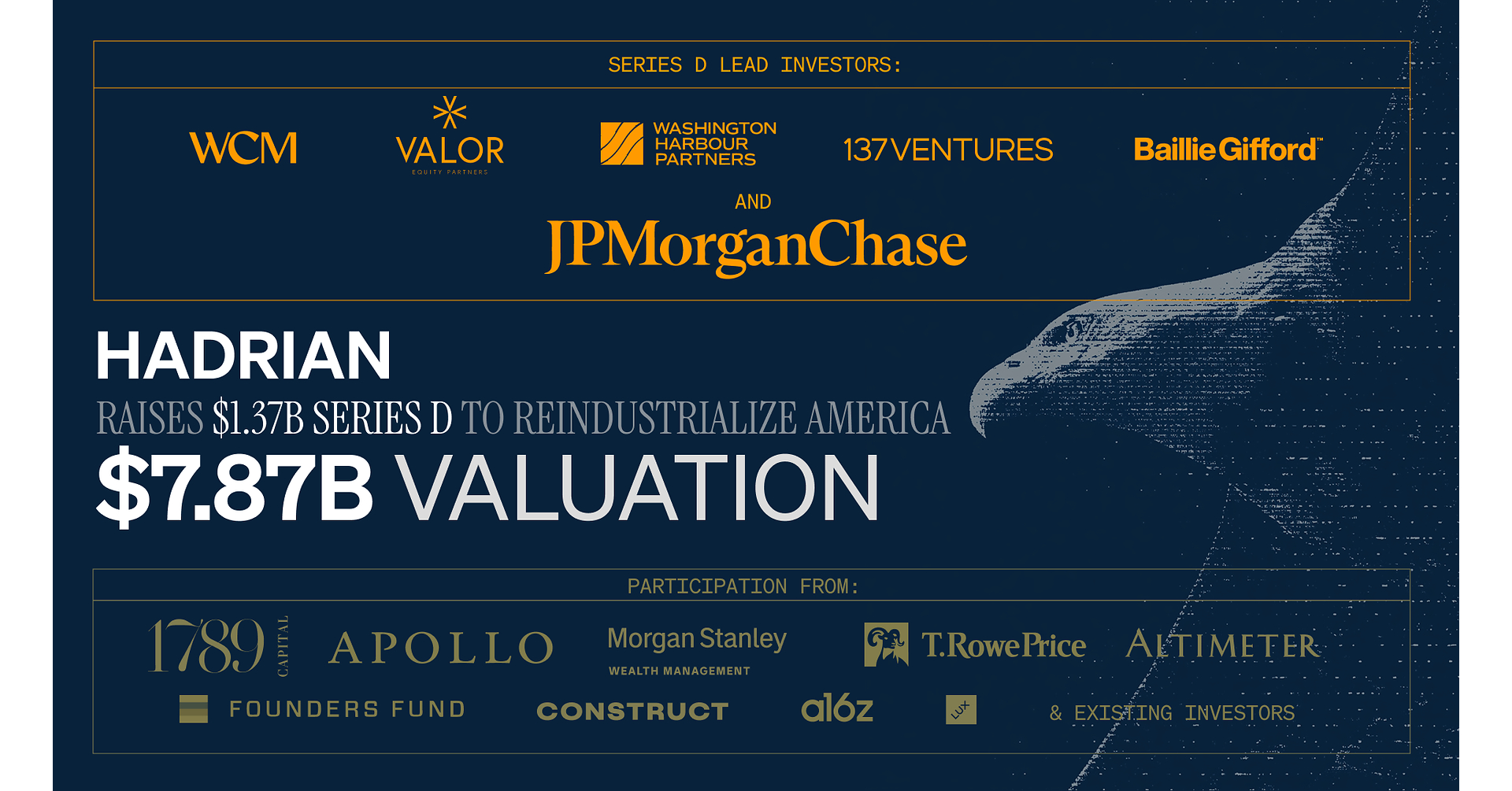
The company raised $1.37 billion at a $7.87 billion valuation. The investor list is serious: JPMorganChase’s Strategic Investment Group came in as anchor co-lead, alongside WCM Investment Management, Washington Harbour Partners, Valor Equity Partners, 137 Ventures and Baillie Gifford. Other backers include CapitalG, Andreessen Horowitz, Founders Fund, Lux Capital, Altimeter, Apollo-managed funds, T. Rowe Price and Morgan Stanley Wealth Management.
That is not merely venture capital turning up with a branded hoodie and a hope. It is a mix of tech investors and heavyweight pools of capital financing industrial build-out.
Hadrian had raised a $260 million Series C roughly a year earlier. TechCrunch estimates the new financing takes total capital raised to around $2 billion. The business now has nearly 3 million square feet across four sites, according to Axios, and says it is planning a Los Angeles headquarters plus an engineering and R&D hub in San Francisco.
That is what the market is paying for: a chance to build a repeatable manufacturing network before the bottleneck becomes unbearable.
The story behind the story: demand is not the same as supply
Everyone loves to talk about defence spending. It sounds tidy: governments allocate money, contractors receive orders, factories make equipment, job done.
Reality is messier. A nation can approve a defence budget on a Tuesday and still wait years for physical production to catch up. The limiting factor is often not demand, design intelligence or political will. It is whether the supplier base can make parts fast enough, consistently enough and at sufficient scale.
Hadrian works with large defence contractors including Lockheed Martin and RTX, as well as newer players such as Anduril. In March, the U.S. Navy said Hadrian would mass-produce components in Alabama for Virginia-class attack submarines and Columbia-class ballistic-missile submarines. TechCrunch reported that the public-private arrangement associated with that facility was valued at $2.4 billion.
That is the real business case. Hadrian is trying to sell throughput, quality and speed into markets where a late component can hold up an entire system.
Chris Power, Hadrian’s chief executive, put the central point bluntly to Axios: production capacity itself is deterrence. He is right. A country’s ability to build is not a back-office issue. It is strategic power.
And before anyone writes this off as a wartime niche, look wider. The same shortage exists wherever physical systems matter: energy infrastructure, aviation, semiconductors, mining equipment, ships, data centres and advanced medical devices. You can build a gorgeous software layer around any of them. Eventually someone still has to cut metal, qualify the part, deliver it and stand behind it when it fails.
Why this matters to venture capital
For two decades, venture money has preferred businesses where capital intensity was somebody else’s problem. Put the servers in the cloud. Contract out manufacturing. Lease the logistics. Grow fast and let the real world catch up later.
Hadrian is the opposite bet. The company is taking on the real world early and deliberately: machinery, facilities, workforce, production processes, customer qualification and long sales cycles. This is much harder than making an app. It is also harder to copy once it works.
That last bit matters.
The fashionable venture phrase is “moat,” usually used to describe a feature that can be cloned by lunchtime. An actual operating factory network, embedded in regulated supply chains and trusted by demanding customers, is closer to a moat. Not an invincible one, obviously. But a proper, expensive, time-consuming barrier that cannot be replicated by three smart graduates and an API key.
The round also tells us something about capital markets. The investors backing Hadrian are not just underwriting revenue growth. They are underwriting the time, equipment and execution required to create capacity. That requires a different temperament. You cannot demand SaaS-style quarterly magic from a company laying concrete, installing advanced equipment and training people to run it.
Founders should pay attention. The next wave of important companies will not all look like consumer internet businesses with AI sprinkled on top. Some will have lumpy capex, gross margins that mature slowly and operational risks that make traditional software investors twitchy. If they solve a serious bottleneck, that discomfort can be the opportunity.
The overlooked angle: “AI-powered” is not the point
Hadrian describes its factories as AI-powered, using proprietary software called Opus alongside automation and robotics. Fine. That may be useful. But let’s not lose the plot and call a factory valuable because it has AI in the brochure.
The valuable thing is that the factory produces useful parts, on time, at scale and to specification.
Too many founders now begin with the technology and go hunting for a problem large enough to justify it. The stronger approach is the reverse: find a painful, expensive constraint, then use every available tool—software, automation, AI, robotics, human expertise—to remove it.
That is what makes Hadrian more interesting than a standard defence-AI narrative. The company is applying technology to a constraint that existed long before generative AI became a dinner-party topic.
There is a warning in that, too. A $7.87 billion valuation is not an operating result. Hadrian now has a massive amount of capital and expectation to convert into factories that work, customers that reorder and economics that improve with scale. Hardware and industrial businesses can chew through money with frightening efficiency. Building a factory is hard; building several without losing quality, discipline or sanity is harder.
Capital is fuel. It is not proof of an engine.
The contrarian lesson: do not run from ugly problems
The best opportunities are often sitting inside businesses that clever people dismiss as boring, old-fashioned or too difficult.
Manufacturing has had that label for years. So has defence procurement. So have industrial supply chains. They are unglamorous right up until the day a shortage brings a giant programme to its knees.
The easy money ran toward zero-marginal-cost software because it was scalable. Fair enough. But when everyone chases the same model, the overlooked profit pool is often where coordination is painful, capital is required and execution is unforgiving.
That does not mean every founder should race out and start a factory. Most shouldn’t. You will not fix a production bottleneck because you watched a robotics demo and bought a few industrial arms.
It means you should look for the piece of your industry where demand repeatedly crashes into a real-world constraint. What takes too long? What fails too often? What relies on one ageing supplier, one person’s tribal knowledge or a spreadsheet held together by hope? What does every customer complain about but accept because they assume nobody can fix it?
That is where serious businesses are born.
What this means for you
If you are a founder, stop asking only, “Can this scale?” Ask, “What breaks when it does?” Map your supply chain, approvals, delivery capacity, customer implementation and talent requirements before the growth arrives. A business that cannot fulfil demand is not scaling. It is creating a more expensive version of disappointment.
If you are an operator, find one bottleneck that affects revenue, delivery time or quality and put a dollar figure on it this week. Not a vague annoyance—a number. Measure the delay, rework, stockout, lost sale or labour waste. Then make the business case to remove it. You will become more valuable by fixing constraints than by adding another slide to the strategy deck.
If you are an investor, be wary of categories where valuation has outrun the hard work of delivery. But do not confuse “capital intensive” with “bad.” A capital-heavy company with scarce capability, disciplined execution and customers who genuinely need it can be far more defensible than a low-capex business with no real barrier to entry.
Hadrian’s $1.37 billion round is a reminder I rather like: money eventually follows necessity. The winners will not just be the people who can imagine the future. They will be the people who can actually build it.