IMF October 2026 AI Warning: $6 Trillion Nvidia and S&P 500 Risk
If your portfolio is “diversified” because you own an S&P 500 fund, I’ve got bad news: you may be making one very large bet on AI.
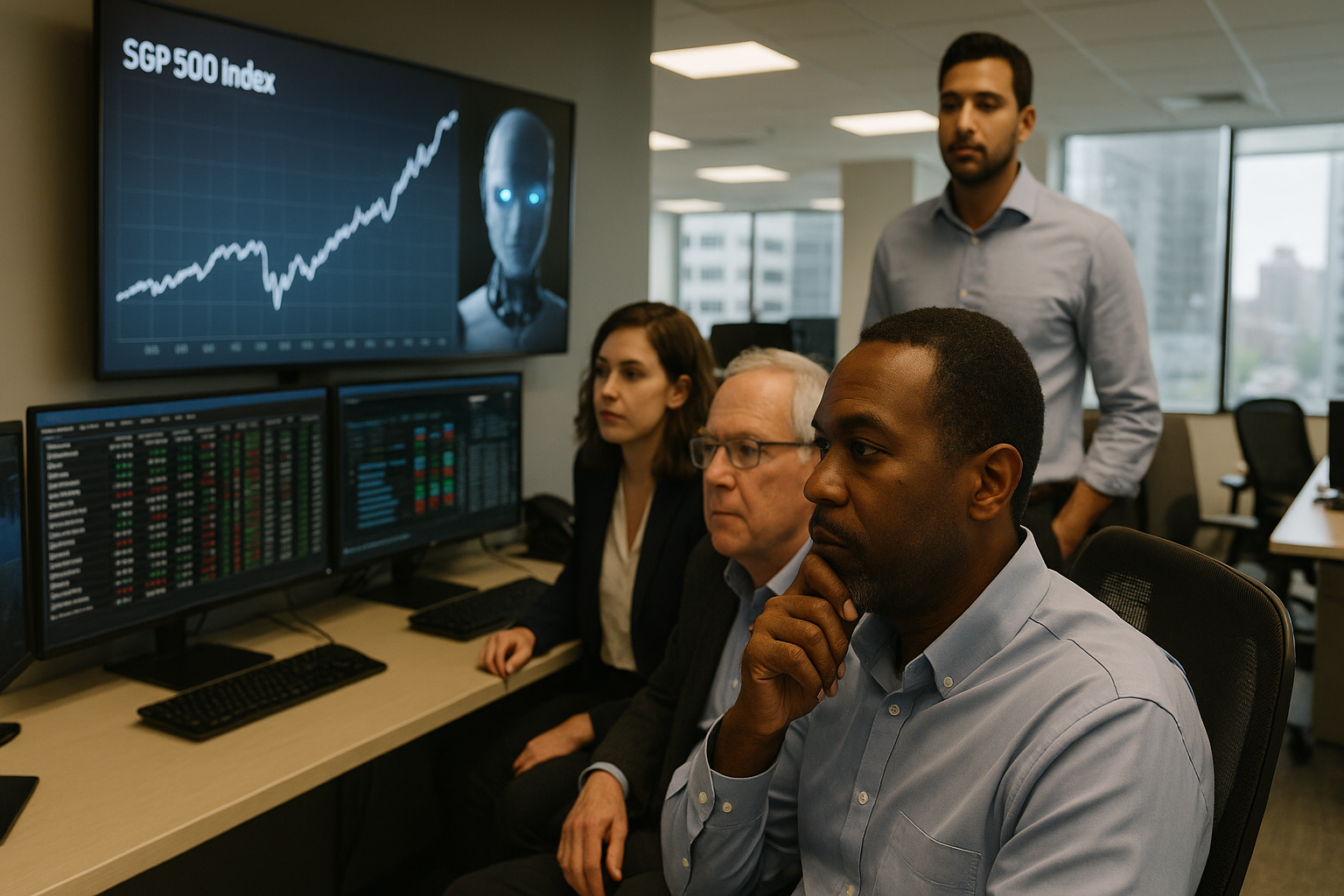
The most dangerous thing in markets is not a crash. It’s being told you’re diversified while everyone quietly owns the same trade.
That is where plenty of S&P 500 investors are sitting in October 2026: feeling sensible because they bought an index fund, while a narrow pack of mega-cap companies and the AI spending boom do an outsized amount of the heavy lifting.
The International Monetary Fund put the uncomfortable version of that warning on the table this week. Its latest Global Financial Stability Report says investors should not be complacent about elevated financial-stability risks. Among the plausible triggers it flags are an AI-led sell-off, a further surge in government-bond yields and a major cyberattack.
That is not the IMF saying “sell everything and hide under the doona.” It is saying the market has stacked a lot of optimism on top of a few highly connected assumptions: AI spending keeps rising, AI revenue arrives fast enough to justify it, financing remains available, yields do not run away, and investors remain happy to pay up for the companies at the centre of it.
That is a fair bit of faith packed into one trade.
The core story: AI is no longer just a technology bet
The AI trade has become the market’s main character because it has become much bigger than Nvidia chips or a chatbot subscription.
It now runs through chip designers, cloud platforms, data-centre builders, power infrastructure, networking equipment, software companies and the debt markets funding the lot. Bloomberg reported this month that major technology companies have continued tapping debt markets to fund AI infrastructure even as borrowing costs have risen. It also reported that OpenAI expects annualised revenue of at least $70 billion by the end of 2026.
Read that sentence carefully. The revenue number is huge. So is the investment required to chase it.
When companies borrow heavily to build physical infrastructure ahead of proven long-term cash flows, the upside can be enormous. So can the hangover if demand, pricing power or margins disappoint. I have seen this movie in business. A good market can turn a company’s expansion plan into genius. A tougher market turns the same plan into an expensive pile of fixed costs.
Markets are beginning to show the nerves. Bloomberg reported that technology weakness in the US rolled into Asia on October 13, with chip stocks in South Korea and Taiwan falling as investors worried about competition from Chinese rivals. The MSCI Asia Pacific gauge was down 1.5% and a US semiconductor index had fallen 2.7% in the prior session.
That does not prove the AI boom is over. Anyone declaring the end of AI because chip stocks fell for a day is just performing for the internet.
It does show something more useful: this market is sensitive. When the story shifts from “AI will change everything” to “hang on, who is paying for this and when?”, prices can move quickly.
What investors are actually exposed to
The lazy answer is that this only matters if you own individual technology stocks. That is wrong.
If you own a broad US index fund, retirement fund or managed portfolio with a standard allocation to large-cap American equities, you almost certainly have meaningful exposure to the same cluster of companies. You may not have bought the AI story deliberately. The index bought it for you because the winners became so large.
That is the oddity of market-cap-weighted investing. It is usually a brilliant low-cost way to own corporate America. But it does not promise equal exposure to corporate America. It gives more money to the companies whose share prices have already become larger.
Again: that is not a flaw. It is the design.
The problem comes when an investor mistakes a large number of holdings for a large number of independent risks. Holding 500 names is not proper diversification if a small group of them is driving returns, sentiment and the valuation multiple of the whole market.
The IMF made a similar point in its 2025 report, warning about historically high concentration in the S&P 500 and the narrow group of mega-cap IT and AI-linked companies driving the broader index. It also noted that US household exposure to equities had climbed to roughly 30% of total household assets.
That last point matters. In the old days, a tech wobble was something traders argued about on television. Today, it can hit retirement balances, confidence, spending and the willingness of households to take risks. Wealth effects are real, whether economists make them sound boring or not.
The second problem is not AI. It’s the price of money
AI stocks get the headlines, but the bond market can ruin everyone’s afternoon.
Higher long-term yields change the maths for growth companies because much of their value sits in profits expected years down the track. The higher the rate used to discount those future profits, the less those profits are worth today. That is Finance 101, and it is still true even when the company has an excellent logo and a very charismatic chief executive.
Bloomberg reported on October 5 that the S&P 500 hit a record as AI shares lifted sentiment, while Nvidia’s market value approached $6 trillion. The same report noted that the US 10-year Treasury yield had recently reached its highest level since 2002.
That is the tension investors need to understand. Equity markets are pricing a long runway of AI-led growth. Bond markets are demanding more compensation to lend money for a long time.
Those two things can coexist for a while. They do not coexist comfortably forever.
If yields rise because growth is genuinely strong and profits keep delivering, markets can cope. If yields rise because inflation proves sticky, government borrowing swells, energy costs jump or investors simply want more compensation for risk, the equation gets uglier. Expensive shares meet expensive money. That is when narratives stop being enough.
The overlooked angle: the biggest risk is forced behaviour
The contrarian view is not that AI is fake. That is too easy and probably wrong.
AI will create real businesses, destroy weak ones and make a handful of operators extraordinarily wealthy. I am building a technology company myself. I would be mad to pretend this wave is not real.
The overlooked risk is that investors have allowed a real technological shift to become an excuse for lazy portfolio construction.
When everything is rising, people stop asking what they own, why they own it and what would make them sell. Then a sell-off begins, and they discover their supposedly diversified retirement fund, growth ETF, tech fund, crypto allocation and employer shares are all responding to the same fear: that future growth will not justify today’s price.
That is not diversification. That is five different wrappers around one emotional trade.
The IMF’s warning about cyber risks is worth taking seriously here too. Modern markets are highly automated, highly interconnected and increasingly shaped by algorithmic tools. A serious cyber event would not need to destroy the financial system to create a nasty repricing. It merely needs to make liquidity disappear at the wrong moment.
You cannot predict that. You can avoid building a financial life that collapses if it happens.
What this means for you
Here is the practical bit. Not the usual “stay informed” nonsense. Actual work you can do tomorrow.
First, open your brokerage, retirement and managed-fund accounts. List every holding that is ultimately exposed to US mega-cap technology or AI infrastructure. Your global index fund counts. Your Nasdaq ETF counts. Your tech fund definitely counts. Company shares, crypto and private-market funds may count too.
Do not guess. Look through the holdings.
Second, calculate your exposure by dollar value, not by the number of funds. Owning four ETFs does not mean you have four separate sources of risk. If all four have large weights in the same mega-cap technology names, you have one concentrated position wearing four hats.
Third, separate money by time horizon. Cash you may need in the next three years for a home deposit, tax bill, business runway, school fees or an emergency should not be depending on whether AI chip shares have a good quarter. Markets do not care about your deadline.
Fourth, make sure you have boring assets on purpose. Cash reserves, high-quality fixed income, profitable businesses outside the AI chain, and exposure across countries are not exciting at a barbecue. Good. Your defensive allocation is not meant to impress anyone. It is meant to stop you becoming a forced seller when the exciting assets are temporarily on fire.
Finally, do not respond to concentration risk by rage-selling a broad index at the first red day. That would be just as silly as ignoring the risk. The answer is to know what you own, decide your acceptable concentration before volatility arrives, and rebalance with rules instead of mood.
AI may keep creating fortunes. I would not bet against human ingenuity.
But I would absolutely bet against the comforting lie that a portfolio is safe simply because it has a lot of ticker symbols in it.