James Harden’s $97M Cavaliers Deal Is Cleveland Buying Time, Not a Title
The Knicks swept Cleveland, then the Cavaliers paid 36-year-old James Harden $97 million. That is not a title plan. It is the cost of refusing to start over.
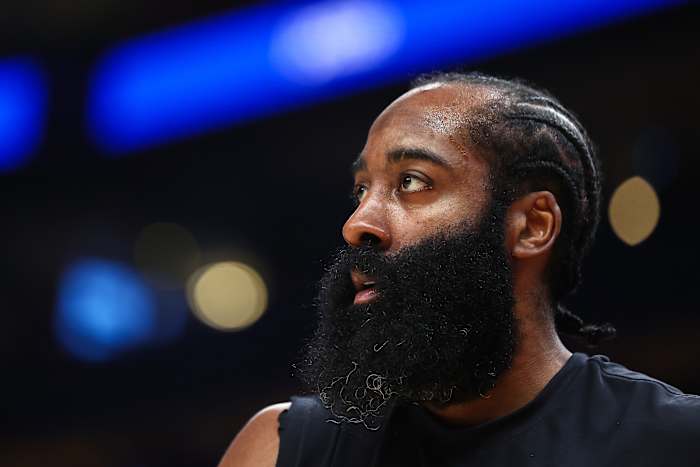
Paying a 36-year-old James Harden $97 million after the New York Knicks swept you out of the Eastern Conference finals is not a championship plan.
It is Cleveland admitting that replacing a star guard is even more expensive — and much riskier — than keeping one.
Cleveland just made its biggest bet on continuity
James Harden has agreed to stay with the Cleveland Cavaliers on a three-year, $97 million deal, with a player option for 2028-29 and a trade kicker. The deal followed Harden declining his $42.3 million player option for next season in late June.
On the surface, the maths looks simple. Harden gave up the certainty of one $42.3 million season, and Cleveland got his annual number down to roughly $32.3 million across three years.
That is the polite version.
The real deal is this: Harden got more long-term security as he approaches 37. Cavaliers president of basketball operations Koby Altman got a lower annual salary figure, a player who already knows the system, and fewer reasons to explain to Donovan Mitchell why Cleveland had dismantled the team around him after reaching the conference finals.
Nobody should pretend this is merely a good-value veteran extension. It is a wager on a shrinking window.
Cleveland acquired Harden from the Los Angeles Clippers at the February 2026 trade deadline, sending Darius Garland and a second-round pick the other way. Garland was 26 and in the third year of a five-year, $197 million contract. Harden was 36, on a deal carrying a $42.3 million player option, and had played for five teams before arriving in Ohio.
That trade told us Cleveland wanted a different type of team. This contract tells us it is all-in on making that choice work.
Harden averaged 20.5 points and 7.7 assists in 26 regular-season games with the Cavaliers, who reached the Eastern Conference finals for the first time since 2018 before being swept by Jalen Brunson’s Knicks. He is still an elite organiser of an offence when the game slows down. He still bends a defence with the threat of his scoring and passing. He can still make the difficult possession look boring, which is an underrated form of value in May.
But this is not 2018 James Harden, nor does it need to be. Cleveland is paying for a high-level secondary or co-primary creator beside Mitchell — one with enough profile to keep the franchise relevant, enough skill to ease Mitchell’s burden, and enough credibility to convince the locker room that last season was not the high-water mark.
That is a real asset. It is also a bloody expensive one.
The $42.3 million opt-out was the tell
The key figure is not $97 million. It is $42.3 million.
Harden had the right to take that amount for one more season. Instead, he opted out and accepted a deal with a lower yearly average in exchange for a longer runway. That is the classic veteran-player trade: surrender some immediate cash, remove the injury and age risk from the next contract negotiation, and secure a much larger pool of guaranteed earnings.
For Cleveland, spreading the bill matters. The Cavaliers carried the NBA’s highest payroll in 2025-26. They were not negotiating from a position of limitless optionality. Every dollar saved against Harden’s prior $42.3 million number mattered because it affected what the club could do elsewhere with the roster.
This is where people get lazy and say Harden “took a discount.” He did not suddenly become a charity case for the good people of Cleveland. He exchanged one form of leverage for another.
Harden got duration, a player option, and a trade kicker. The Cavaliers got an annual number that is about $10 million lower than the option he declined. Both sides got something useful.
That is what a proper negotiation looks like: not one side winning the press conference, but both sides avoiding the outcome they hated most.
Harden did not want to hit the market at nearly 37 with one year of security gone. Cleveland did not want to lose its point guard after trading Garland, then attempt to replace Harden’s production with whatever was left in free agency or through a rushed trade.
So they made the obvious deal. Obvious does not mean safe.
Donovan Mitchell is the centre of this decision
The Cavaliers are not really paying Harden for his highlights. They are paying for the message this sends to Donovan Mitchell.
Mitchell is the franchise player. He is also the bloke who has to believe that Cleveland is serious about winning now, not serious about maintaining the appearance of trying.
When a team reaches the Eastern Conference finals and gets swept, it has two choices. It can convince itself the run was a fluke and rip the thing apart. Or it can identify the gap, keep the expensive talent that got it there, and try to improve at the margins.
Cleveland chose the second path.
That is defensible. The Cavaliers did not lose in the first round. They did not limp into the playoffs and get found out immediately. They reached the final four, which is close enough to the prize that blowing up the roster would be an act of panic.
But there is a catch: continuity is only valuable if the underlying product can improve.
The Knicks did not sweep Cleveland because the Cavaliers lacked a famous name. They swept them because the better team, at that moment, executed better across four games. Harden’s contract does not fix defensive matchups, late-game shot quality, injury risk, or the simple fact that the Eastern Conference will not get easier.
The Cavaliers have paid to preserve their floor. Whether they have raised their ceiling is another question entirely.
The overlooked angle: the trade kicker matters more than the headlines
Most fans see a trade kicker and shrug. They should not.
A trade kicker is not just a sweetener. It is a tax on future flexibility. If Cleveland later decides the Harden experiment has run its course, moving his contract becomes more complicated and potentially more costly. The player option adds another layer: Harden retains a degree of control over the timing and structure of his next decision.
That is not a criticism of Harden’s camp. It is their job to extract protection. His agents, Mike Silverman, Troy Payne and Brandon Grier, did exactly that.
But it does mean the Cavaliers have bought stability at a price beyond the headline salary. They have made it harder to casually change their minds.
Frankly, good. Too many sporting organisations act as if decisions are reversible because they can trade a player, sack a coach, or issue a press release. They are reversible only if someone else wants to take your problem, on terms you can stomach.
Cleveland has now made a clear commitment to Harden and Mitchell. That clarity has value. It forces the front office to stop fantasising about a clean reset and focus on the hard work: finding complementary defenders, preserving enough flexibility to respond to injuries, and building a playoff rotation that does not ask too much of a 36-year-old guard in June.
Why the deal could still work
Here is the contrarian view: people will overreact to Harden’s age because that is what sports fans do when a big number lands.
The Cavaliers did not sign him to be a 25-year-old ironman. They signed him because great playmaking ages better than raw athleticism, provided the player accepts the job in front of him. Harden’s ability to run an offence, create shots and make life easier for scorers remains valuable. In a league where competent primary ball-handlers are scarce, $32.3 million a year is not automatically insane.
The larger issue is role discipline.
If Harden is asked to dominate every fourth quarter, carry the offence through injuries, and defend elite guards in space for 40 minutes, this contract will age like milk in the Queensland sun.
If he is asked to be the intelligent engine beside Mitchell — manage possessions, punish switches, feed bigs, keep the second unit organised, and save his best for the playoffs — Cleveland may have found a sensible way to extend its window.
That distinction is everything.
What this means for you
There is a roster-building lesson here that has everything to do with how you judge this deal.
When you look at a costly move, stop asking whether the price is high. Ask compared with what.
Cleveland did not compare Harden’s $97 million against zero. It compared it against the cost of losing Harden after trading Darius Garland, finding a replacement, unsettling Donovan Mitchell, and potentially wasting a conference-finals-level roster.
That is the right framework for Cavaliers fans judging the front office.
Keeping an ageing star may look expensive until you price the drop-off in production, the cost of finding another creator, and the damage done when the franchise player thinks the team has stopped trying. A long contract may look restrictive until you price the chaos of losing the player and scrambling for an answer.
Do the full comparison, not the headline comparison.
Then be honest about the downside you are locking in. Harden’s player option and trade kicker mean Cleveland has less room to reverse course. Every serious roster decision comes with that kind of constraint. The trick is not avoiding commitment. The trick is committing only where the downside is survivable and the upside genuinely moves the needle.
Cleveland has made its call. Harden and Mitchell are the bet now.
If it works, the Cavaliers will look disciplined for choosing continuity over panic. If it fails, nobody will care that the annual salary was technically lower than $42.3 million.
That is sport. You do not get rewarded for making a deal that sounds clever. You get rewarded for making one that still looks smart when the pressure arrives.