Japan’s 3.0% 10-Year Yield Just Broke a 30-Year Global Money Machine
Japan’s 10-year bond yield hit 3.0% for the first time since 1996. Thirty years of cheap Japanese money just got a price tag—and global capital will feel it.
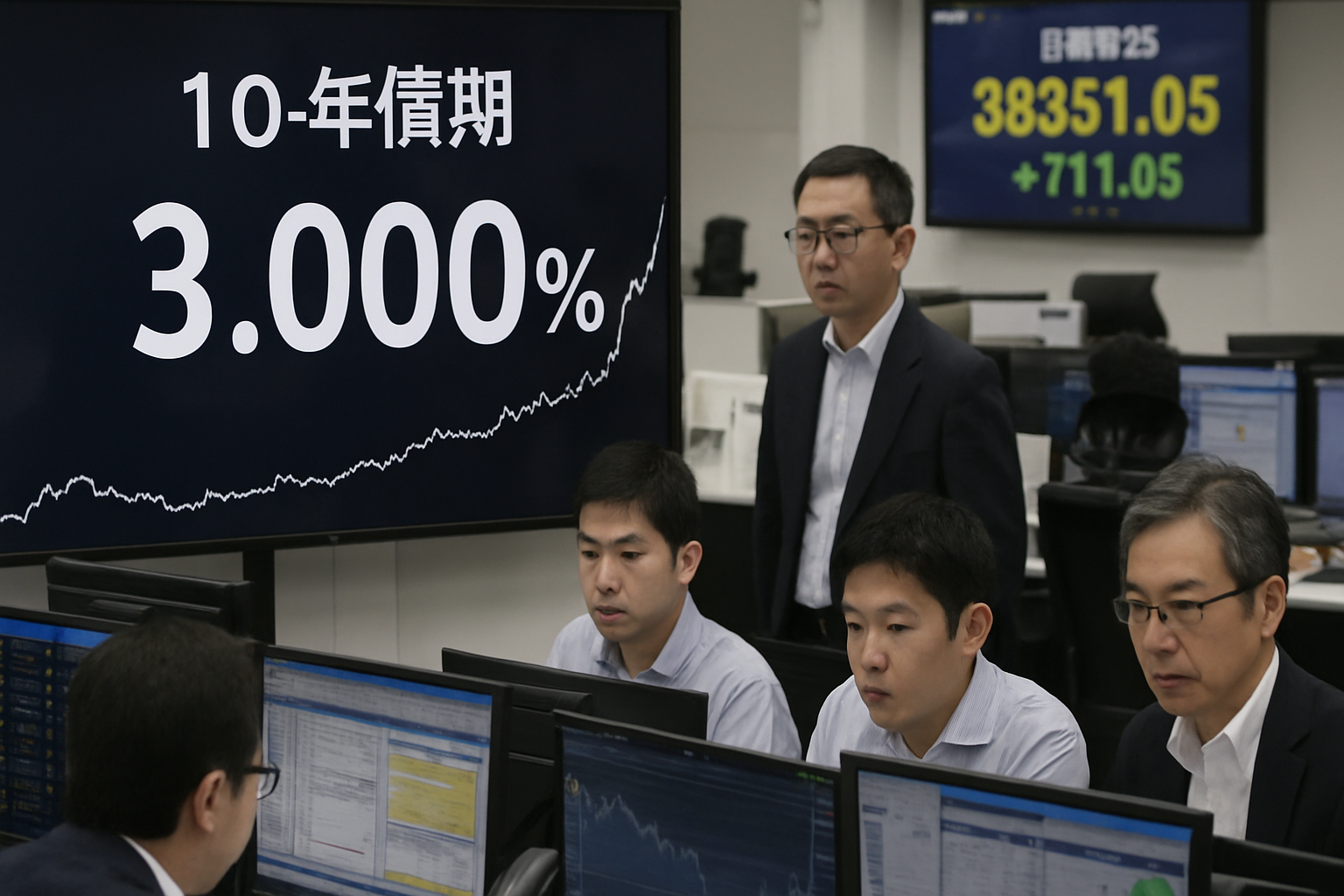
The world spent 30 years treating Japan like a free-money vending machine. On September 1, that machine flashed an error message: Japan’s benchmark 10-year government bond yield reached 3.0% for the first time since September 1996.
That is not a Japanese curiosity for economists to mutter about over instant coffee. It is one of the more important price changes in global finance, because cheap Japanese money has been part of the furniture for so long that most people stopped seeing it.
The 3.0% number that should make you sit up
Japan’s 10-year government bond yield hit 3.0% on Tuesday, September 1. Reuters reported that the yield has more than tripled in two years. Its five-year yield is at a record high, while the two-year yield is at a 31-year high.
Read that again: a country synonymous with near-zero rates is now repricing money right across its government bond curve.
For decades, Japan was the anomaly. Its rates were extraordinarily low. Its government bonds offered pitiful yields. Its central bank worked relentlessly to keep financial conditions loose. That made the yen a cheap funding currency and Japanese capital a dependable buyer of assets far beyond Japan.
Now inflation concerns, fiscal worries and rising expectations for further Bank of Japan rate hikes are pulling that old arrangement apart.
The exact 3.0% level matters for a brutally practical reason. Japan used a 3% long-term interest-rate assumption when calculating debt-servicing costs in its fiscal 2026 budget. Once market rates move above the number in your budget, the spreadsheet stops being a plan and starts becoming a problem.
That is the bit plenty of politicians and investors learn too late: debt is manageable right up until refinancing turns up with a different price tag.
This is not merely a Japan story
Global government bond markets have been selling off together. Reuters reported that German 10-year yields have returned to levels last seen in 2011, French 10-year yields to levels last seen in 2008, and Britain’s long-term borrowing costs are near multi-decade highs.
The reasons are hardly mysterious. Energy-driven inflation fears have returned. Governments have large spending ambitions. Central banks are under pressure to prove they are serious about inflation. Investors are asking to be paid properly before lending money for 10, 20 or 30 years.
Good. They should.
A bond yield is not just a number on Bloomberg that traders pretend to care about. It is the base price of money. Mortgages, business loans, project finance, private-equity deals, commercial property values and government budgets all eventually take their instructions from it.
When yields rise, yesterday’s business case gets uglier. The acquisition that worked at cheap debt costs does not work at expensive debt costs. The warehouse development that looked clever at a low discount rate suddenly needs heroic rent growth. The startup that planned to bridge to profitability with another capital raise discovers that “growth at all costs” was only fashionable while money cost bugger-all.
And when Japan joins the higher-yield club, global capital gets another option. That matters because capital is not patriotic; it goes where the return, risk and liquidity stack up best.
The old carry trade is losing its comfort blanket
Here is the overlooked angle: the real issue is not that Japanese investors wake up tomorrow and dump every overseas asset they own. Markets are rarely that theatrical, despite what the bloke on television says.
The issue is that the maths changes at the margin.
For years, a global investor could look at Japanese government bonds and see very little competition for other assets. If domestic yields were close to nothing, foreign bonds, credit, equities and alternative assets looked comparatively more attractive—even after taking currency risk into account.
At 3.0% on Japan’s benchmark 10-year bond, that comparison is no longer automatic.
A Japanese insurer, pension fund, bank or conservative saver does not need to become reckless to alter behaviour. They only need to look at a higher domestic yield and decide that taking foreign currency risk, credit risk or illiquidity risk is no longer being rewarded enough.
That is how financial regimes change: not with one dramatic sell order, but with thousands of investment committees quietly saying, “Actually, we can get a decent return at home now.”
For US and European markets, that creates a less friendly backdrop. Governments are issuing plenty of debt. Companies, especially big technology firms, are raising enormous sums for AI infrastructure. Everyone wants investor capital at the same time. Japan becoming a more credible destination for Japanese savings does not make that queue shorter.
It is not a prediction of catastrophe. It is a warning that the easy assumption—cheap global capital will always be there if you are big enough—has expired.
The Bank of Japan has no painless option
The Bank of Japan is stuck in the sort of corner central bankers hate.
If it moves too slowly against inflation and a weak yen, price pressure can become harder to contain. If it raises rates faster, it increases borrowing costs for households, companies and, crucially, the Japanese government.
Reuters reported that markets were pricing a near certainty of another Bank of Japan rate increase at its meeting this month. That is a sharp departure from the era when Japan’s monetary policy was essentially a global subsidy for risk-taking.
There is no clean outcome here. Higher rates may be necessary, but necessity is not the same thing as painlessness.
Japan’s government has lived with a giant debt burden for years because the interest bill was kept extraordinarily low. As bonds mature and are refinanced at higher rates, the cost does not hit all at once. It creeps. Then it compounds. Then finance ministries start making choices they swore they would never have to make: higher taxes, lower spending, more borrowing, or some ugly cocktail of all three.
That is why a 3.0% yield matters more than the neatness of the number. It is a line between an old financial model and a new one.
The contrarian view: higher rates are not automatically bad news
Now for the bit that will annoy the doom merchants.
Japan having a real cost of capital again is not inherently a disaster. A functioning economy should not require permanently free money to keep standing upright. Savers deserve returns. Capital should have a price. Zombie businesses should not survive simply because refinancing has been absurdly cheap.
Higher rates can force better decisions. They punish sloppy balance sheets. They reward businesses that generate cash rather than PowerPoint slides. They make management teams justify investments with actual returns, not a ten-year fantasy about total addressable markets.
I have built businesses and invested through enough cycles to know this: easy money flatters average operators. It lets mediocre ideas live longer than they deserve. It makes leverage look like genius. Then the rate changes and suddenly everyone discovers they were not Warren Buffett; they were just borrowing cheaply.
The danger is not that capital gets more expensive. The danger is that too many businesses, funds and governments structured themselves as though it never would.
What this means for you
If you are a founder, stop treating your next fundraise as a business model. Build a version of your company that can survive if equity takes longer, costs more and comes with less flattering terms. Know your monthly cash burn, your true gross margin and exactly which costs you would cut in the first 30 days of a capital squeeze.
If you run an established business, review every floating-rate exposure and every refinancing date. Not next quarter. This week. A cheap loan rolling over into an expensive one can erase years of operational improvement faster than most operators expect.
If you are buying assets, use uglier assumptions. Model a higher discount rate. Model slower revenue growth. Model customers taking longer to pay. If the deal only works in a world where money stays cheap, it does not work—it is a punt dressed up as a spreadsheet.
If you are an investor, do not confuse a higher yield with an automatic sell signal for every asset. But do demand more. Demand real cash flow. Demand sensible debt. Demand businesses with pricing power and customers who can still pay when financing costs bite.
Japan’s 3.0% yield is not the whole story. But it is a loud reminder that the world is rebuilding a price for money after years of pretending it was nearly free.
The practical move is not to predict the next crisis. It is to review your debt, your refinancing dates, your cash burn and your deal assumptions before the next price of money turns your plan into a problem.