Kalshi’s 5-MLB-Team Deal Gives Sports Betting a New Front Door
Five MLB clubs just handed Kalshi access to their fans while New York calls its product illegal gambling. This is not sponsorship. It is a distribution land grab.
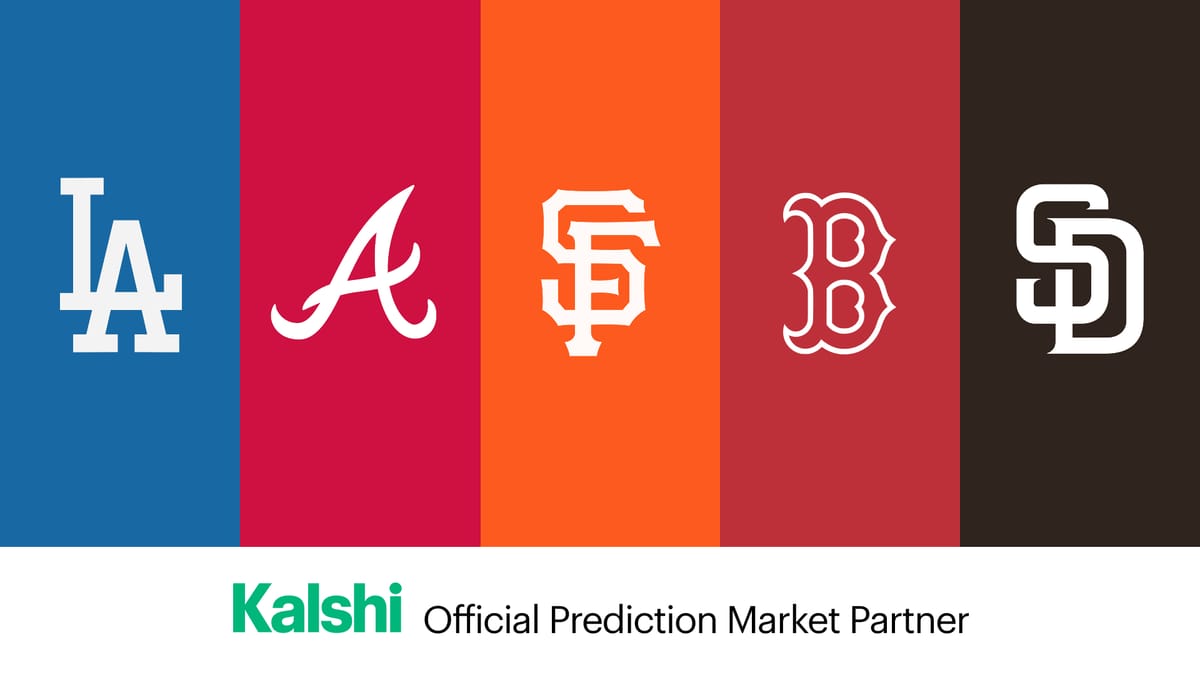
Five MLB clubs have just handed Kalshi access to their fans while New York Attorney General Letitia James alleges it is operating an illegal, unlicensed gambling business in the state. That is not a sponsorship story. It is a distribution land grab.
The real significance of Kalshi’s new deals with the Atlanta Braves, Boston Red Sox, Los Angeles Dodgers, San Diego Padres and San Francisco Giants is not a few logos or LED boards. The company has announced exclusive, multi-year brand partnerships with five of baseball’s biggest clubs. Terms were not disclosed. They rarely are when the number would make someone uncomfortable.
But do not mistake a missing dollar figure for a small story.
Kalshi is not buying a few LED boards and hoping nobody sees them. It is buying legitimacy, habitual attention and a route around the old sports-betting playbook. And MLB clubs are helping it do it while the legal argument over whether Kalshi’s sports contracts are regulated financial products or unlicensed gambling is still very much alive.
Five MLB teams just made a very deliberate bet
Kalshi’s partnerships cover in-stadium signage, social media, online, radio and fan activations. At Dodger Stadium, the arrangement includes Kalshi branding on LED signage and naming rights to the Gold Glove Bar, according to the company. That is not a tiny digital-banner buy tucked down the bottom of a website. That is physical, repeated, premium real estate inside one of the sport’s most valuable properties.
The five clubs are not random either.
The Dodgers are a global baseball brand. The Red Sox own one of American sport’s most loyal and commercially valuable fan bases. The Braves have built a formidable regional business around Truist Park and The Battery. The Padres and Giants give Kalshi two major California markets with serious baseball audiences.
If you are trying to normalise a new category with sports fans, this is a much better list than five struggling clubs nobody watches after July.
Kalshi says baseball-related trading volume on its platform is up 36 times year-on-year. Treat company-supplied growth figures with the appropriate caution: they are designed to impress. But the strategic point does not require blind faith in the number. The company is spending on distribution because it believes sport is becoming its acquisition engine.
That should concern every established bookmaker, fantasy operator and media executive pretending prediction markets are a niche sideshow.
The old gambling funnel was fairly obvious: broadcast an ad, offer a bonus bet, hammer the customer with odds, then hope retention outruns acquisition cost. Kalshi is taking a different route. It wants the language of markets, probabilities and trading to sit beside sport fandom. A fan does not have to think of himself as having a punt. He can think he is making a view.
That linguistic difference may sound like marketing fluff. In consumer businesses, it is often worth a fortune.
The product is the argument — and the argument is not settled
Kalshi operates event contracts: customers take positions on whether specified outcomes will occur. In sports, that can look an awful lot like betting to a normal human being, because economically it often is a wager on a sporting result or event.
Kalshi’s position is that it is a federally regulated event-contract exchange. State regulators have not universally accepted that framing.
New York Attorney General Letitia James sued Kalshi on July 31, alleging the platform was operating an illegal, unlicensed gambling business in the state. The case seeks to stop Kalshi from operating there and pursue penalties. Kalshi disputes that state regulators have the authority to regulate products it says fall under federal oversight.
This is not a minor compliance footnote buried in the back of a pitch deck. It goes to the heart of the business model.
Traditional sportsbook operators pay for state licences, navigate state-by-state rules, work within advertising restrictions and shoulder gambling taxes. Prediction-market operators argue they belong in a different regulatory bucket. If that argument succeeds broadly, the prize is enormous: national scale with a structure that does not resemble the expensive patchwork confronting bookmakers.
If it fails, the sports-business partnerships now being signed could look less like clever first-mover deals and more like branding attached to a legal headache.
That is why I would not call this a betting story alone. It is a regulatory-arbitrage story with baseball branding stuck on the front.
Why MLB clubs are saying yes now
Sports teams have become ruthlessly good at monetising every patch of attention.
Bars have naming-rights partners. Dugouts have sponsors. A midweek social post has a sponsor. A player interview has a sponsor. The serious commercial teams no longer ask, “Should we put a brand here?” They ask, “What is the opportunity cost of leaving this unsold?”
That discipline is not wrong. In fact, it is how proper sports businesses are run.
But there is a difference between selling sponsorship inventory and lending your credibility to a category that is still defining its legal borders. The league may have relationships with betting businesses, but each club that makes Kalshi an official partner is contributing something far more valuable than advertising space: trust.
Fans understand sponsorship as a soft endorsement. If the Dodgers put a company’s name inside the stadium, plenty of people will reasonably assume the club has done its homework. They will not read the court filings. They will see the logo near the beer line and conclude it is safe enough.
That is precisely why Kalshi wants these deals.
And it is why the value of the deal cannot be measured only by the cheque written to each club. The real asset is customer conversion through borrowed institutional trust.
There is another angle here. The five-team announcement comes as Kalshi is also reported to be in serious talks with The Athletic, the New York Times-owned sports outlet, about a sponsorship deal. That deal has not been finalised, and both sides declined to comment. But the direction is obvious: teams on one side, sports media on the other, and a new wagering-adjacent brand threaded through the middle.
That is how categories become normal. Not through one Super Bowl commercial. Through repetition across the places fans already trust.
The overlooked risk is not gambling. It is bad unit economics disguised as growth
Here is the contrarian view: Kalshi’s biggest risk may not be losing a courtroom argument. It may be winning the customer-acquisition battle and discovering that sports punters are just as expensive, fickle and promotion-hungry as every other wagering customer.
Sports betting is littered with companies that confused gross betting activity with a durable customer relationship. A punter can be acquired cheaply during a big event and lost just as quickly when the offers stop or another app has better odds.
Prediction markets are not magically exempt from this. If the core customer is simply a sports fan looking for action during a game, then the product eventually competes on ease of use, liquidity, pricing, brand trust and promotional spend. That is a hard business. It is not made easier by sticking the word “market” on it.
The 36-times baseball-volume claim is interesting because it signals momentum. It does not prove quality of revenue, customer retention or lifetime value. Those are the numbers that matter. I have seen plenty of businesses grow fast by spending money faster. That is not a moat. It is cardio.
The smarter question is whether Kalshi can turn sports into a gateway for a broader platform: politics, economics, culture and other event markets. If a customer arrives because he follows the Dodgers, then stays because he uses the platform to express views across multiple events, the economics may become much stronger.
That is the upside case.
The downside case is that it becomes another costly sports-wagering interface operating under constant legal pressure, with teams happy to collect sponsorship revenue while the operator carries the regulatory risk.
This should make traditional bookmakers nervous
The sports-betting incumbents should not dismiss Kalshi because its product looks unfamiliar.
Disruption rarely arrives wearing a badge that says, “Hello, I am here to wreck your margin.” It usually arrives with a different user experience, a new regulatory theory and a better way to acquire customers.
Kalshi’s five-club MLB move matters because it attacks all three.
First, it changes the interface. Trading a binary event contract feels different from taking a conventional bet, even if the consumer’s underlying impulse is similar.
Second, it asserts a different regulatory posture. Whether that position ultimately holds up is for courts and regulators, not marketing departments. But the possibility alone changes the competitive equation.
Third, it gets Kalshi into baseball’s commercial bloodstream. The company is not waiting outside the stadium for customers. It is being invited in.
For MLB clubs, this is a straightforward commercial calculation: there is revenue available from a fast-growing category. For Kalshi, it is a far bigger play. It is trying to make prediction markets part of ordinary fan behaviour before the category’s rules are fully settled.
That is ambitious. It may also be bloody effective.
What this means for you
Whether you run a startup, buy stocks or manage a sports business, take three lessons from this.
1. Distribution beats novelty. Kalshi’s product is interesting. Its access to the Dodgers, Red Sox, Braves, Padres and Giants is more important. If you build something new, do not obsess only over the product. Find trusted channels that already own your customer’s attention.
2. Borrowed trust is valuable — so protect your own. A team logo, respected publication or established partner can make a young company look bigger and safer overnight. Use that power carefully. The partner’s reputation is an asset, not a decorative sticker.
3. Regulatory uncertainty can create opportunity, but it is not a business model. The best operators build for the world as it is while retaining the capacity to survive the world as regulators decide it should be. If your entire advantage depends on one legal interpretation lasting forever, you do not have a moat. You have a wager.
Kalshi has just bought five very good distribution channels. Now it has to prove it has built a business worthy of them.