Kathy Hochul’s 50MW Freeze Just Repriced New York Data-Centre Land
The hottest property trade in America just discovered it isn’t buying land. It’s buying power — and Kathy Hochul has put a one-year stop sign in front of it.
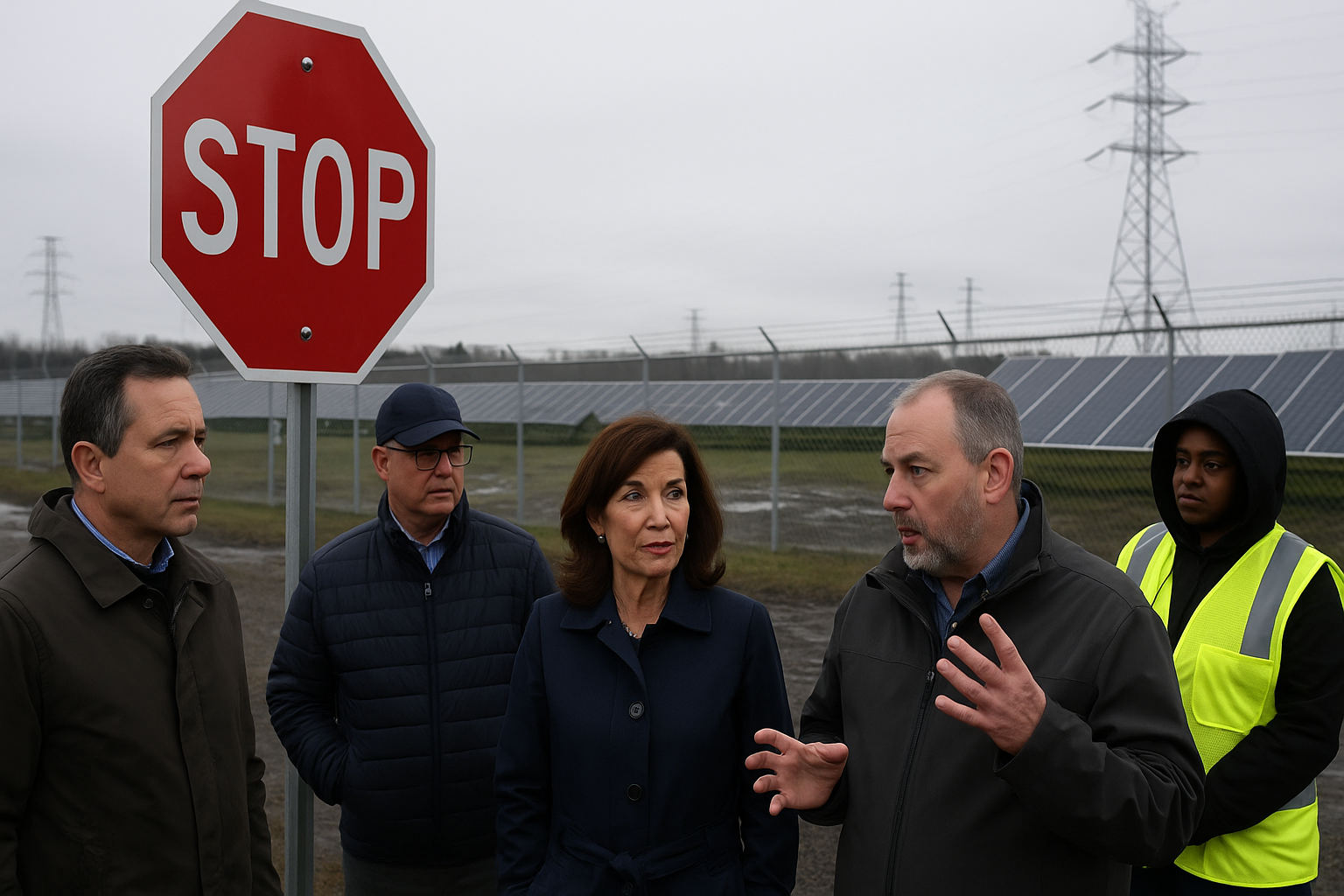

New York has just reminded every bloke waving a data-centre feasibility study around that a signed land contract is not the same thing as an investable project.
Governor Kathy Hochul’s July 14 executive order pauses new hyperscale data-centre development in New York for a year, targeting facilities that require 50 megawatts or more of electricity. That is not a minor planning nuisance. It is a direct hit to the assumption underpinning one of commercial property’s hottest trades: find cheap land, promise AI demand, secure an approval, sell the story.
This is a property story, not a tech story
Everyone wants to call data centres an AI trade. Fair enough. Nvidia chips, cloud demand, model training, all that jazz.
But a data centre is ultimately a massive real-estate project with an electricity problem. It needs land, zoning, fibre, water or cooling infrastructure, construction capacity and — most importantly — a believable route to power. Miss any one of those and your shiny “AI infrastructure” asset is just an expensive block of dirt with a PowerPoint attached.
New York’s moratorium applies to large new facilities awaiting permits while the state develops standards around environmental impacts, grid costs and benefits for local communities. Reuters reported that it is the first statewide US halt of its kind. TechCrunch noted that the policy could affect more than a dozen projects and that the state is considering measures including grid-support payments and changes to tax benefits.
That matters because property investors have spent years treating data centres as the clean escape hatch from the office-market mess. Offices had weak demand, refinancing pain and far too many owners hoping a rate cut would fix an asset nobody really wanted. Warehouses were crowded. Apartments were expensive. Retail was selective.
Data centres looked like the adult table: long leases, giant tenants, structural demand and a narrative every investment committee could understand.
The problem is that the narrative skipped the hard bit. Power is now the scarce asset. Not buildings.
Kathy Hochul has made the hidden risk obvious
The 50-megawatt threshold is where the fantasy gets awkward. These are not small server rooms tucked behind a corporate office. They are industrial-scale loads competing for finite grid capacity.
At the same time New York is pausing large projects, federal regulators are pushing in the opposite direction. On June 18, the Federal Energy Regulatory Commission directed six regional grid operators to justify or reform how data centres, factories and other large users connect to the electricity system. The federal message is simple: connect big loads faster. New York’s message is equally simple: not until the costs and consequences are clearer.
That tug-of-war is the real investing story.
If you own a conventional warehouse, a shopping centre or an apartment block, your main questions are demand, rents, expenses and debt. With a hyperscale data-centre site, those questions still matter — but they come after power availability, transmission upgrades, interconnection timing, local approvals and community tolerance.
A site can look brilliant on a broker’s spreadsheet and still be worthless for its intended use if the utility cannot deliver the load when promised. Worse, it can be worth far less than the buyer paid if a new policy forces the developer to wait while holding land, consultants, options and financing costs.
I have seen this movie in business plenty of times. People mistake a strong market for a strong deal. They are not the same thing.
The second-order effect: land values will split brutally
The lazy conclusion is that New York’s freeze is bad for all data-centre real estate. That is too simple.
It is bad for speculative sites whose value depends on receiving future approvals. It may be very good for sites that already have a clearer path to power, permits and transmission capacity. Scarcity has a nasty habit of making the best assets more valuable while exposing the average ones as marketing material.
That is where the land market will split.
First, permitted or substantially advanced projects may command a premium because they possess something new entrants cannot buy quickly: time. In a capital-intensive sector, shaving years from a development timetable can matter more than shaving a few dollars off the land price.
Second, states and regions with available power, sensible permitting and credible infrastructure plans may attract projects that would otherwise have landed in New York. This is not necessarily a win for the next state over. Local residents, regulators and utilities are watching the same headlines. But capital does not sit still. It moves toward certainty.
Third, developers will increasingly need to behave like energy businesses. That sounds dramatic until you look at the direction of travel. TechCrunch reported last year that property firms were already pivoting toward energy development because grid constraints were preventing data-centre projects from simply plugging in. That trend has only become more obvious.
The valuable developer is no longer just the person who can buy land cheaply and get a building up. It is the operator who can structure generation, storage, transmission upgrades, utility agreements and community benefits without blowing up project economics.
That is a much tougher skill set. Which is exactly why it will be paid better.
The overlooked angle: this could save investors from themselves
Here is the contrarian view: a one-year pause might be healthier than a free-for-all.
Before you throw your laptop at me, hear me out. Booms get dangerous when capital chases a label rather than underwriting the asset. “AI-enabled” has become one of those labels. Add it to a plot of industrial land and suddenly people start treating projected rents as guaranteed cash flow.
They are not.
A moratorium forces the market to price costs that should have been in the model from day one: grid reinforcement, environmental compliance, water, political risk, tax-policy risk and the possibility that a community decides the promised jobs do not justify higher bills or disrupted land use.
Axios reported in June that Oracle’s recent results had made investors nervous about the cash burn associated with data-centre expansion. That is relevant to property investors because tenant demand is not independent from tenant economics. A giant tenant can sign a big lease, but somebody still has to earn an acceptable return on the servers, buildings, power contracts and debt supporting it.
The data-centre boom is real. That does not mean every project is sensible. Both things can be true at once, and usually are.
The best investment opportunities often appear after the market is forced to separate “must have” infrastructure from “nice story, shame about the economics.”
What this means for you
If you are a property investor, founder or operator looking at data-centre exposure, stop asking only whether AI demand is growing. Of course it is. Start asking whether the project has earned the right to exist.
Use this checklist tomorrow:
1. Underwrite power before land. Get specific on megawatts, connection dates, upgrade obligations, curtailment risk and who pays if the timetable slips. “The utility is supportive” is not an answer.
2. Treat permits as an asset class. Separate sites with completed or advanced approvals from sites that merely have a hopeful planning pathway. They should not be valued remotely the same.
3. Stress-test political risk. Assume a state, city or utility can change the rules after you buy. Model a 12-month delay, higher grid charges and the loss of tax incentives. If the return dies, it was never a return.
4. Follow the infrastructure, not the hype. Fibre, substations, transmission, generation and cooling are the boring bits. Boring is where the money gets protected.
5. Do not confuse a premium tenant with a risk-free tenant. Check the economics of the operator, its capital commitments and its ability to fund expansion. A famous logo does not repair a bad development budget.
New York’s 50-megawatt freeze is not the end of the data-centre trade. It is the end of pretending that land alone is the trade.
For investors with discipline, that is good news. The easy-money crowd hates constraints because constraints expose sloppy thinking. The serious operators should welcome them. They make it easier to see what is actually valuable.