Liux’s €16M Big Bet: Why China Can’t Be Beaten on Cheap EVs
A 65-person Spanish startup thinks it can take on China’s EV machine with €16 million. It can’t win on price — which is exactly why its plan might work.
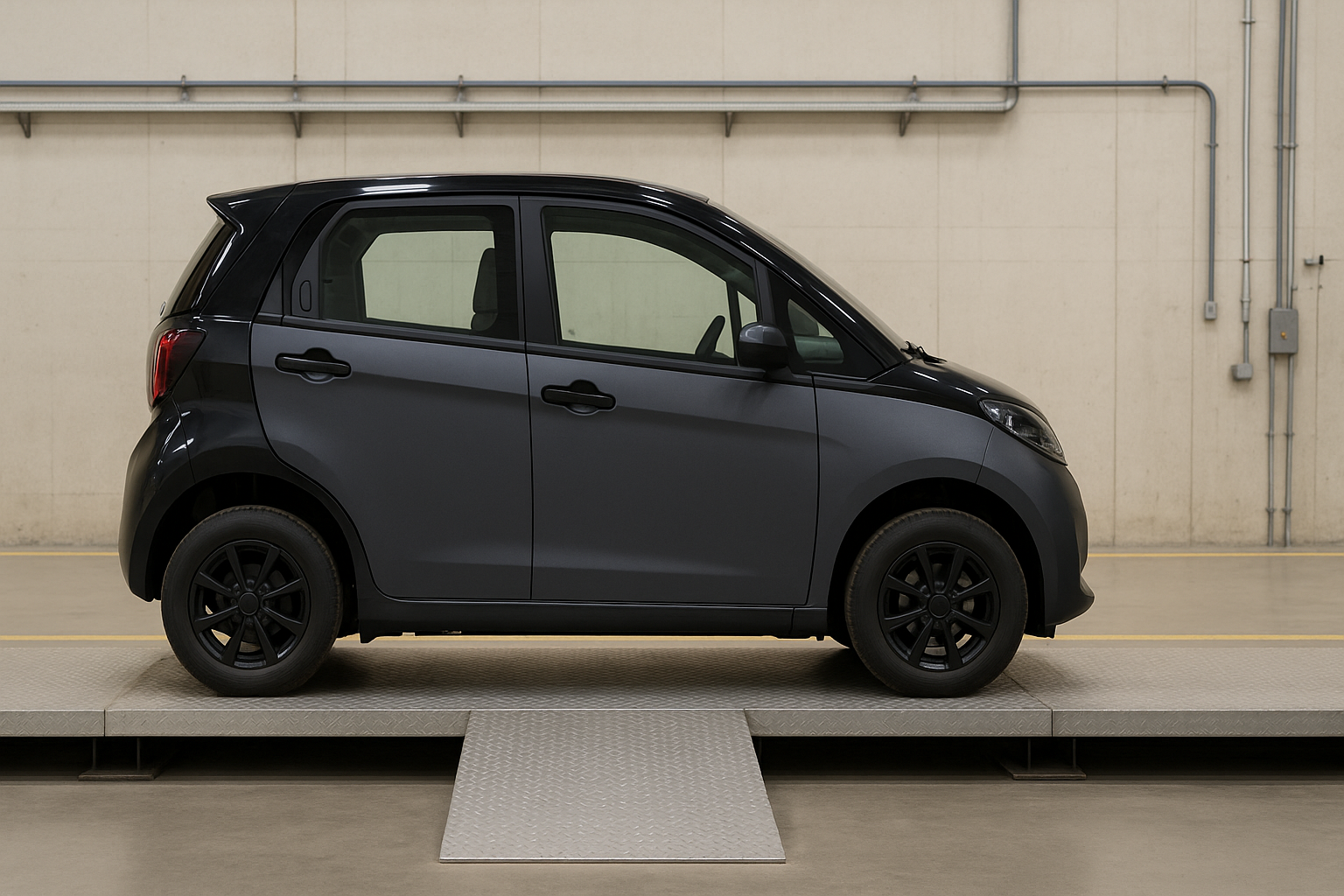
China will eat any startup stupid enough to compete on cheap electric cars.
That is the uncomfortable truth behind Liux, the 65-person Spanish startup taking €16 million and a tiny electric vehicle called the Big into a market full of better-funded Chinese manufacturers. If Liux tries to out-price them, it gets flattened. If it builds a product people can’t easily compare on a spreadsheet, it has a puncher’s chance.
The €16 million bet is not really about a car
Liux has secured €16 million so far, including European funding, and is preparing to sell its Liux Big microcar across Europe in the first half of 2027. It has Europe-wide homologation, a workforce of 65 people, three Spanish facilities, and a stated ambition to reach annual capacity of 20,000 cars by 2030.
Those are respectable numbers. They are also microscopic beside China’s EV industrial machine.
That is not criticism. It is the whole point.
The Liux Big is an L7e-class electric quadricycle, not a conventional passenger car. It will come with 15 kWh and 20 kWh battery options, a planned cargo version, and a price below €18,000 before subsidies. It is small enough to park perpendicular to the kerb, but Liux has managed to fit a 240-litre boot into it. The company says more than 7,500 people have joined its waiting list.
Before everyone starts cheering, a waiting list that costs nothing is not revenue. It is an expression of interest. Founders regularly make the mistake of treating it like proof of demand. It is not. It is proof that the offer caught someone’s eye.
But it is still useful.
A free waiting list tells Liux who is looking, what they care about, where they live, and whether the product is becoming a second household car, a city runabout or a fleet tool. Liux says its most common prospective buyer is a 55- to 60-year-old urban resident. That is much better than the usual startup rubbish about serving “everyone who wants sustainable mobility.”
Nobody serves everyone. Businesses win by being painfully specific about whom they are for.
Liux has correctly refused the sovereignty fantasy
Liux co-founder Antonio Espinosa de los Monteros made a statement that many European politicians and plenty of founders will hate: a fully European car supply chain is unattainable.
Good. At least someone is speaking plainly.
Europe wants local manufacturing, resilient supply chains and reduced dependence on China. Fair enough. But wishing does not make batteries, components, minerals, scale economics and supplier depth appear. China did not wake up one Tuesday morning with EV dominance. It built supply chains, factories, know-how and brutal volume over decades.
A startup cannot beat that with patriotic branding and a LinkedIn post about “European innovation.”
Liux is assembling in Spain but is not pretending every component is locally made. Its batteries are not European-made. Instead, the company is trying to control the bits it can control: modularity, repairability, materials, final assembly, design and customer experience.
Its linen-based biocomposite body is the standout choice. The aim is not merely to say “recyclable” in a marketing brochure. Liux says it has designed the vehicle so materials and components can be extracted later rather than shredded into low-value waste. That is a harder, more operational definition of circularity.
I like that thinking because it starts with the product architecture, not the ad campaign.
A lot of sustainability talk is just expensive decoration. A recycled tote bag handed out at a conference does not make a business circular. Designing a product to be repaired, disassembled and kept useful longer might.
The clever move is picking a category with different rules
The overlooked part of the Liux story is not the linen body. It is the L7e classification.
Liux did not begin by trying to homologate a five-seat electric car. Its first prototype, the Animal, was a five-seater. After unveiling it in 2022, the founders pivoted to the smaller Big because the odds of getting through homologation were better.
That is not retreat. That is adult decision-making.
Founders become emotionally attached to the grand version of the product: the full-size car, the all-in-one software suite, the global marketplace, the category-defining platform. Then reality turns up with regulations, capital requirements and a cost base that would make a mining company blush.
Liux cut the problem down.
The L7e category has constraints on size and weight, but it also avoids some of the requirements faced by full passenger cars. For example, the category does not require crash tests. Liux says it has nonetheless tested braking, handling and slalom performance because consumers do not care what a regulatory category permits when they are sitting inside the thing.
That is the lesson: use regulatory and technical constraints to narrow the product, but never use them as an excuse to build a second-rate experience.
Liux is not selling an apology for a car. It is trying to sell a credible urban vehicle that happens to be small.
The real competitor is not China. It is the buyer’s second car.
Here is where I think Liux may be smarter than the broader EV conversation.
The EV industry loves talking about replacing every internal-combustion car on earth. That is a lovely ambition and a terrible initial go-to-market plan for a startup.
Liux appears to be targeting a narrower job: give city households a practical second vehicle that is easier to park, cheaper to run, reasonably spacious and less wasteful to own.
That reframes the buying decision.
The buyer is not asking whether a Liux Big can drive across Europe with the family and a Labrador. They are asking whether it can handle school runs, errands, commuting, short regional trips and urban parking without being a pain in the neck.
For that job, a massive battery is unnecessary. A huge SUV is absurd. And a €50,000-plus EV is often overkill.
This is where Chinese rivals may not automatically win. They will almost certainly have better cost structures. They may have more polished supply chains and more capital to spend on distribution. But if Liux can make the Big feel distinctly better suited to this very specific use case — repairable, compact, local in service, visually different and genuinely pleasant to own — it does not need to win the whole EV market.
It needs to win a small, defensible corner of it.
That is how startups survive industries dominated by giants. They do not attack the fortress gate. They find the side door nobody is guarding properly.
The contrarian risk: sustainability will not save a bad business
Now for the bit founders often do not want to hear.
Being sustainable does not give Liux permission to be slow, unreliable or expensive to maintain. It does not excuse weak dealership execution. It does not turn a free waiting list into paid orders. And it certainly does not overcome the economics of manufacturing at low volume.
Cars are cruel businesses. You have inventory, warranties, safety exposure, supplier dependency, physical distribution, service requirements and customers who expect the product to work every day. Software founders moan about churn; car founders have to worry about a faulty part turning into a recall.
Liux’s lean manufacturing approach is sensible. Its factory in Azuqueca de Henares handles the final stages of production rather than trying to vertically integrate everything. But “lean” is not magic. The company still must prove it can deliver consistent quality, secure supply, support dealers and keep cash under control while scaling.
The danger is that Liux becomes a beautiful proof of concept for circular design rather than a durable business.
That is why I would watch paid conversions, deposit levels, production quality, service economics and repeatable dealer demand far more closely than the size of the waitlist. Those are the numbers that separate a promising product from an investable company.
What this means for you
Whether you build cars, software, consumer products or a boring old services business, Liux offers a useful operating lesson: stop trying to beat incumbents at the game they were built to win.
Use this tomorrow:
1. Write down the giant you are supposedly competing with. Then list the three things it does better than you because of scale. Do not argue with reality.
2. Choose a narrower customer job. Not a demographic. A job. Liux is not chasing “EV buyers”; it is chasing a practical urban use case. What is yours?
3. Find a constraint that helps you focus. Regulation, geography, product limits or customer behaviour can be a wedge if you build around it intelligently.
4. Design for lifetime value from day one. Repairability, serviceability and modularity are not just sustainability ideas. They reduce friction, build trust and can create better economics.
5. Treat interest as interest. A waitlist, a newsletter signup and a viral post are not sales. Ask for deposits, contracts, renewals or repeat usage before you get carried away.
Liux may still fail. Most companies trying to manufacture vehicles do. But its strategy is far more credible than pretending a small startup can beat China at China’s own game.
The founders have accepted the battlefield they are on. That is not a limitation. It is usually the beginning of a real strategy.