Lovable’s $400M Round Values Vibe Coding at $13.3B
A 2024 startup is now worth $13.3 billion because people are sick of waiting for engineers. That should excite every operator — and terrify every software business charging rent for mediocre tools.
Software teams have spent years telling the rest of the business to get in line. Lovable’s $13.3 billion valuation says that queue is being set on fire.
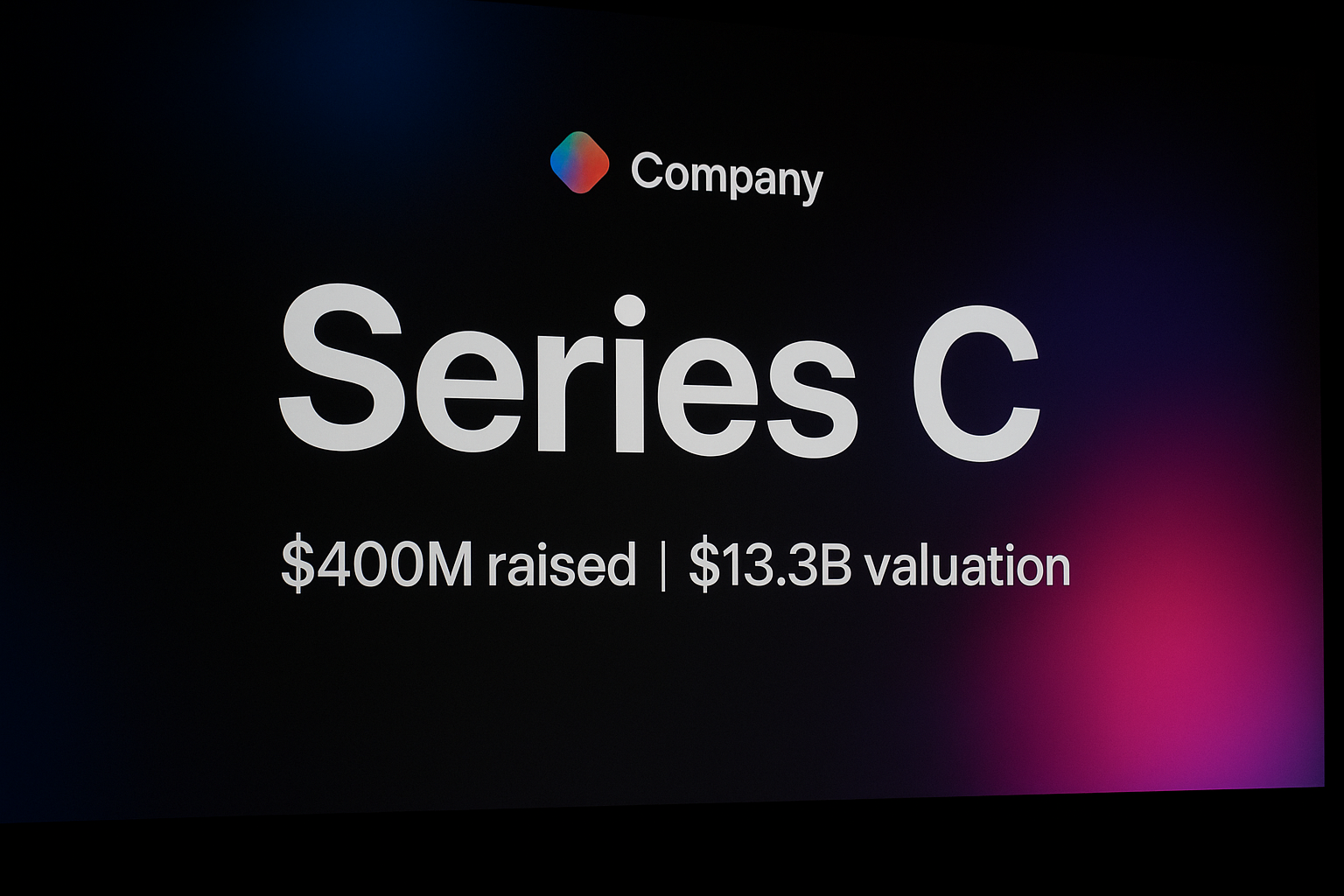
On August 12, Stockholm-based Lovable announced a $400 million Series C led by Menlo Ventures and co-led by EQT’s Scaleup Europe Fund. Eight months earlier, it raised $330 million at a $6.6 billion valuation. That is a doubling of the price tag in less time than most companies take to finish an annual planning cycle. ([lovable.dev](https://lovable.dev/blog/series-c))
The easy reaction is to call it another AI bubble and move on. Lazy. There is obviously froth in AI valuations, but Lovable is not getting paid for making cute pictures or producing meeting notes nobody reads. It is getting paid because software creation has been an expensive bottleneck for decades, and it has made a credible dent in it.
That matters far beyond coders.
Lovable is selling speed, not “vibe coding”
“Vibe coding” is a silly label for a serious shift. You describe the product or workflow you need in plain language; the system helps turn it into functioning software. Lovable’s pitch is not merely that a non-technical person can make a prototype. It is that the person closest to the problem can build and run a real tool without first assembling a small parliament of engineers, designers, product managers and security reviewers.
Since launching in November 2024, Lovable says users have created more than 60 million projects, while apps built on the platform receive more than 900 million visits a month. It says usage has reached employees at nearly two-thirds of Fortune 500 companies, including Nvidia, Adidas and Deutsche Telekom. ([lovable.dev](https://lovable.dev/blog/series-c))
That is the actual story behind the $400 million round. Not “AI is hot.” Everyone knows that. The story is that employees inside big companies are no longer prepared to wait six months for IT to approve a dashboard, a customer portal, a workflow tool or an internal app that should have existed last Tuesday.
I’ve built businesses. I know what happens when a capable operator sees a problem and gets told, “Put it in the product backlog.” They either give up, buy another SaaS subscription, hire a contractor, or build a clunky workaround in spreadsheets. All four options cost time, money and momentum.
Lovable is betting that a fifth option wins: let the operator build it.
That is not a feature. It is a redistribution of power inside companies.
The numbers are enormous — but the execution burden is worse
Lovable’s valuation rose from $6.6 billion in December 2025 to $13.3 billion in August 2026. Reuters reported that the company’s annual recurring revenue had grown from $200 million to nearly three times that amount, with Lovable targeting a $600 million run rate by the end of August. Sifted separately reported $500 million in ARR for June. ([boursorama.com](https://www.boursorama.com/bourse/actualites/lovable-une-start-up-specialisee-dans-le-vibe-coding-leve-400-millions-de-dollars-avec-une-valorisation-de-13-3-milliards-de-dollars-55045ec24ab95e27705db5d19be17398))
Those are proper numbers. A business heading towards $600 million in recurring revenue is not a weekend hack pretending to be a company.
But before founders start putting “the Lovable of X” in their decks, here is the part they will conveniently ignore: valuation is the easy bit. Holding quality together at speed is the job.
Lovable is now expected to turn a flood of prompts into secure, reliable and governable software. That means permissions. Data handling. Testing. Version control. Compliance. Payments. Integrations. Uptime. Audit trails. What happens when a finance manager builds a tool that touches customer data? What happens when a sales team launches something that breaks a pricing workflow? What happens when an employee leaves and nobody knows who owns the app they created?
These are not edge cases. They are the whole ball game.
Lovable knows this, which is why it is pushing security scanning, governance controls, publishing controls, workspace visibility and integrations with tools such as Google Workspace, Microsoft 365, Salesforce and Stripe. The company says its hiring focus is machine learning, product, infrastructure and security, with plans to reach roughly 450 staff this year. ([lovable.dev](https://lovable.dev/blog/series-c))
Good. Because if the product becomes the place where companies run pieces of their business, the company is no longer selling an app builder. It is selling trust.
And trust is much harder to build than a slick demo.
The overlooked angle: this is an attack on the SaaS graveyard
The contrarian take is that Lovable’s biggest victims may not be software developers. They may be the thousands of bloated SaaS products charging businesses monthly fees for narrow workflows that should never have become standalone companies.
Think about it. A department buys a tool for onboarding, another for campaign planning, another for reporting, another for approvals, another for customer tracking. Then it pays consultants to stitch them together. Then it pays people to manually move data between them because the integrations are rubbish.
It is madness, but it has been profitable madness.
Lovable highlights a case in which Nursa, a US healthcare staffing company, used its platform to create an enterprise product over a weekend, rebuilt a core platform 12 times faster, and began retiring 10 SaaS systems as teams built their own tools. That is one company’s account, not universal proof. But it points to the real commercial threat: custom software is becoming cheaper than tolerating generic software. ([lovable.dev](https://lovable.dev/blog/series-c))
For a lot of SaaS founders, that should be uncomfortable.
If your product is basically a database, a few forms, business logic and a decent user interface, you are no longer protected merely because customers cannot code. Your protection now needs to be proprietary data, embedded distribution, regulatory credibility, extraordinary workflow depth, or a genuinely superior outcome.
“Being hard to build” is fading as a moat. “Being hard to replace” is what matters.
There is a second sting in this. The same tools that threaten mediocre SaaS also threaten mediocre internal teams. Businesses will not need fewer good engineers. They will need fewer engineers doing predictable implementation work that begins with, “Can you build us a simple internal tool?”
The winners will be engineers who can design systems, secure them, judge trade-offs and turn business chaos into durable architecture. The losers will be people whose entire value proposition is translating a clear request into standard CRUD software.
That is blunt because it is true.
Europe finally has a useful answer to the late-stage capital problem
There is another reason this deal matters. EQT’s Scaleup Europe Fund co-led it, and Lovable is among the fund’s early investments. The fund was created to address Europe’s persistent shortage of late-stage capital for strategically important growth companies; Sifted reported it has a €5 billion mandate. ([sifted.eu](https://sifted.eu/articles/lovable-raises-e400m-series-c))
Europe has never lacked smart founders. It has often lacked the later-stage chequebooks and commercial aggression required to keep its best companies from becoming American acquisitions, American subsidiaries, or American relocations with a European origin story.
Lovable’s round had investors from the US, Europe, Latin America and Asia, including Menlo, EQT, Balderton, Tencent, Kaszek and World Innovation Lab. That is not charity for European tech. It is global capital chasing a company with global distribution. ([lovable.dev](https://lovable.dev/blog/series-c))
The lesson for founders outside Silicon Valley — including Australia — is not that geography no longer matters. Geography still matters when you need customers, capital and world-class talent.
The lesson is that a product that crosses borders digitally can earn the right to raise globally. Build for a local market if you must. Do not build with a local ceiling in your head.
The real risk is that people confuse building faster with thinking less
Here is where the Lovable hype can go badly wrong.
Giving more people the ability to make software does not automatically give them good judgement. It can produce a lot more rubbish, much faster. The internet did not become better because everyone could publish. It became noisier, then the best operators learned distribution, quality control and reputation.
The same will happen here.
Every founder will be able to get a product into the market faster. Great. That means speed of execution becomes less scarce. The scarce things become taste, customer insight, distribution, retention and the ability to keep solving real problems after the first shiny version ships.
So do not use AI-built software as an excuse to skip customer conversations. Do not confuse a working app with a business. And do not put sensitive processes into a tool just because a prompt made it look finished.
The technology reduces the cost of building. It does not reduce the cost of being wrong.
What this means for you
If you are a founder, stop treating product development as a ceremony. Pick one painful internal workflow or customer problem that has been waiting on engineering for too long. Build a controlled version in a week. Put it in front of real users. Measure whether it saves time, makes money or removes a bottleneck. If it does none of those, kill it without sentimentality.
If you run a larger business, do not ban these tools and pretend the problem goes away. Your employees are already finding ways around slow systems. Create a simple operating rule: teams can experiment freely with low-risk workflows, but anything touching customer data, payments, regulated information or core systems goes through a defined security and ownership check.
If you are an investor, look past the prompt box. Ask whether the company owns distribution, has genuine retention, can secure enterprise trust, and gets stronger as more customers use it. A clever AI wrapper is not a moat. A workflow that becomes the operating system for a business might be.
And if you sell software, take this personally. Audit every feature customers tolerate rather than love. Audit every workflow they could build themselves. Then make your product so useful, integrated and trusted that replacing it is a stupid idea.
Lovable did not just raise $400 million. It put a $13.3 billion price tag on a brutal new expectation: the people with the problem should no longer have to wait for permission to solve it. ([lovable.dev](https://lovable.dev/blog/series-c))