May Mobility’s $1.4B SPAC Is a $93M Bet That Robotaxis Can Finally Scale
May Mobility made $10 million last year and burned $93 million doing it. Now the market is being asked to value its robotaxi future at $1.4 billion.
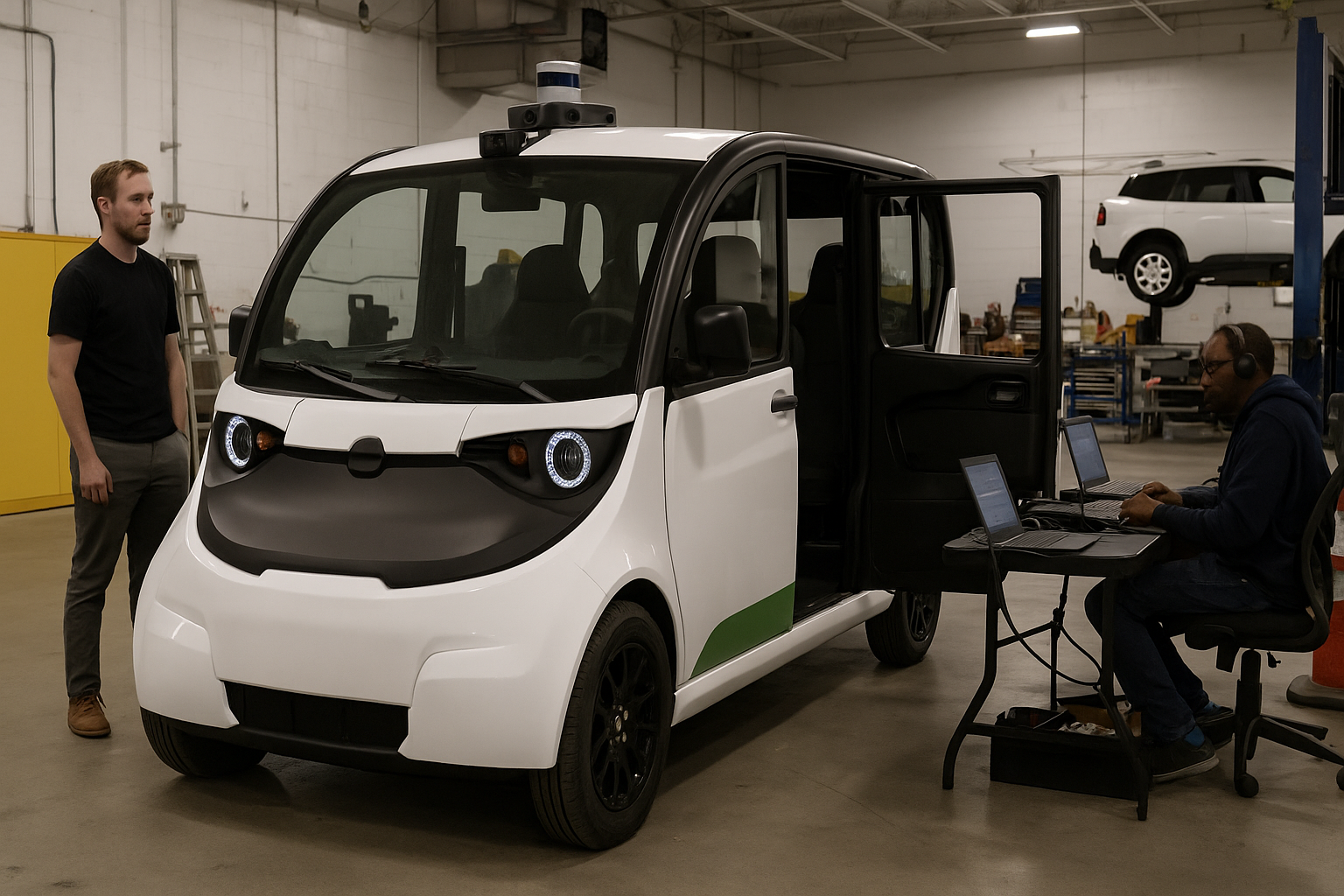
May Mobility made roughly $10 million in 2025 revenue, burned about $93 million in cash, and has now struck a deal worth $1.4 billion. That is either a ridiculous valuation or the first honest test of whether robotaxis can become a real business without setting fire to billions.
The deal: $1.4 billion for a company still proving the middle
On September 16, May Mobility announced plans to go public through a merger with ACP Holdings Acquisition Corp., a SPAC. The proposed transaction gives May an implied pro forma enterprise value of approximately $1.4 billion and could deliver up to $337 million in gross proceeds.
That headline number needs a bit of adult supervision.
The proceeds include a fully committed $120 million PIPE — private investment in public equity — plus up to $217 million held in the SPAC’s trust account. “Up to” is doing the heavy lifting there. SPAC shareholders can redeem their shares rather than fund the deal, which means the final cash May receives could be materially lower.
The merger agreement was signed on September 15, 2026. Closing is expected by year-end, subject to shareholder approvals and a Nasdaq listing. In other words, it is a signed deal, not money in the bank. ([sec.gov](https://www.sec.gov/Archives/edgar/data/2111542/000121390026100367/ea030470201ex2-1.htm?utm_source=openai))
May says it would become the first US-listed pure-play autonomous ride-hail technology company. Fine. It is a neat label. But labels do not pay for fleets, engineers, vehicle integration, insurance, remote operations or the inevitable mess that happens when software meets an actual city.
The business has completed more than 550,000 commercial autonomous rides and operates in three US locations: with Lyft in Atlanta, plus services in Eden Prairie and Grand Rapids, Minnesota. It is also targeting an Uber launch in Arlington, Texas, in the fourth quarter of 2026 or first quarter of 2027. That is meaningful commercial progress — more than most autonomy startups can claim — but it is still very early relative to the valuation being placed on the business. ([techcrunch.com](https://techcrunch.com/2026/09/16/may-mobility-is-going-public-in-a-1-4b-spac-deal/?utm_source=openai))
May Mobility is not selling robotaxis. It is selling a financial model.
The interesting part of May’s pitch is not that it has self-driving vehicles. Plenty of companies have been able to make a vehicle drive itself under carefully chosen conditions.
The real pitch is that May wants to be asset-light.
Instead of owning and operating huge fleets itself, the company intends to license its autonomous-driving system while fleet partners own or operate the vehicles. May retains control over software updates and remote supervision, and aims to earn fixed fees or per-trip licensing revenue.
That is a much smarter story than the old robotaxi dream: raise a mountain of capital, buy thousands of cars, run the whole fleet yourself and pray that utilisation saves you before the cash runs out.
May has raised $445 million since its 2017 founding. Its investor materials say 2025 non-GAAP operating expenses were $81 million and free cash flow was negative $93 million. Those are not pretty numbers, but they are also not in the same galaxy as the cash incineration seen at some earlier autonomy players. ([sec.gov](https://www.sec.gov/Archives/edgar/data/2111542/000121390026100367/ea030470201ex99-2.htm?utm_source=openai))
Here is the catch: asset-light does not mean capital-light for the system.
Cars still need to be purchased. Sensors still need to be installed. Vehicles still need maintenance. Depots, charging, cleaning, insurance, local approvals and customer support do not magically disappear because a startup calls itself software. May is shifting some of that capital burden to partners. Sensible, yes. But partners will only carry that burden if the economics work for them too.
That is the whole deal in one sentence: May is asking public-market investors to believe it can turn a technically impressive service into a repeatable partner product before the money runs thin.
The $1.4 billion question is not whether the cars can drive
Robotaxis have spent years being discussed like a science project. That phase is over.
The question now is brutally commercial: can a company deploy enough vehicles, in enough places, at a low enough cost, with enough paying rides, to produce returns that justify the capital?
May’s 2025 numbers show the distance it still has to travel. About $10 million in revenue at a 27% gross margin is encouraging in the narrow sense that there is revenue and there is a stated positive gross margin. But a $93 million cash burn against $10 million of revenue tells you the company is spending heavily ahead of scale.
That may be entirely rational. Building a new transport network is not cheap. The danger is not spending money. The danger is confusing spending with progress.
I have watched founders make this mistake in every sector. They tell themselves their losses prove ambition. Sometimes they do. More often, losses simply prove that customers are not yet paying enough for the complexity they are being asked to fund.
May’s deal is a valuation of future fleet density, lower vehicle costs and higher utilisation — not of the current business. The company says it plans to use deal proceeds for research and development, supply-chain investment, cost reduction, new deployments and general corporate purposes. Those are exactly the right uses of capital. They are also exactly the areas where execution delays can chew through a balance sheet. ([techcrunch.com](https://techcrunch.com/2026/09/16/may-mobility-is-going-public-in-a-1-4b-spac-deal/?utm_source=openai))
The overlooked angle: this is a referendum on SPAC discipline
Most people hear “SPAC” and immediately think of the graveyard of overpromised listings from the last cycle. Fair enough. Plenty of them deserved the reputation.
But that is precisely why this deal matters.
A SPAC is not inherently stupid. It is just a public-market vehicle that makes it easier to bring a company to market before a standard IPO would. The stupidity comes when sponsors, founders and investors pretend a slide deck is the same thing as a functioning business.
May at least has real operations, paying rides, deployment partners and a defined commercial model. It is not pitching a prototype and a dream. But public investors should still treat the trust-account proceeds as uncertain until redemptions are known, and should remember that a $1.4 billion enterprise value is not a verdict from the market. It is the opening price in an argument.
The proposed PIPE is more useful than the headline valuation because committed capital gives management room to execute. Still, $120 million is not an endless war chest in autonomous vehicles. If rollouts are delayed, costs stay high or partners move slowly, May may need more capital later. The company itself flags risks around closing, redemptions, future financing, scaling, regulatory changes and maintaining its Nasdaq listing. That is not pessimism; it is the disclosure telling you where the bodies are buried. ([sec.gov](https://www.sec.gov/Archives/edgar/data/2111542/000121390026100367/ea030470201ex2-1.htm?utm_source=openai))
Why the partner strategy could be May’s best move
The contrarian view is that May may be better positioned precisely because it is not trying to become the entire robotaxi economy.
Uber has the riders. Lyft has demand and a consumer app. Toyota brings vehicle expertise. Other fleet and mobility partners can bring local operational muscle. May’s job is to make its autonomy stack reliable enough, cheap enough and easy enough to deploy that those businesses want it in their network.
That is a far less sexy ambition than owning every vehicle and every rider relationship. It is also how many durable infrastructure businesses are built.
Founders routinely overestimate the value of owning every layer. Owning more layers can improve margins — once you have scale. Before that, it often means owning more headaches, more capex and more reasons to go broke.
May’s model will work only if it can prove two things at once: its software materially improves fleet economics, and its partners can launch services without turning every new city into a bespoke engineering project. If every rollout requires months of custom work, the asset-light story becomes corporate wallpaper.
What this means for you
If you are an investor, do not buy the robotaxi narrative just because the technology is impressive. Watch four numbers after the deal closes: net cash actually received after redemptions, revenue per deployed vehicle, cash burn per quarter and the pace of driver-out commercial launches. Those numbers will tell you more than any keynote.
If you are a founder, steal the useful bit of May’s strategy: find out which expensive parts of your value chain a credible partner can own better than you can. Do not confuse vertical integration with strength. It is only strength when you can afford it and execute it.
If you are an operator, pay attention to the real lesson. The market increasingly rewards companies that turn an expensive capability into a repeatable system. May is not being valued at $1.4 billion because it has given 550,000 rides. It is being valued because investors think those rides can become a template.
That is the standard you should apply to your own business. Not: “Can we do this once?” Not even: “Can we sell it?”
Ask the harder question: Can we deploy it repeatedly, with less friction, less capital and better margins every time?
If the answer is no, you do not have scale. You have a very expensive demonstration.