McKesson’s $5.8B Option Care Health Deal: Why Home Infusion Matters
McKesson paid $5.8 billion because expensive hospital treatment is the problem, not the prize. Option Care gives it a route into care delivered elsewhere.
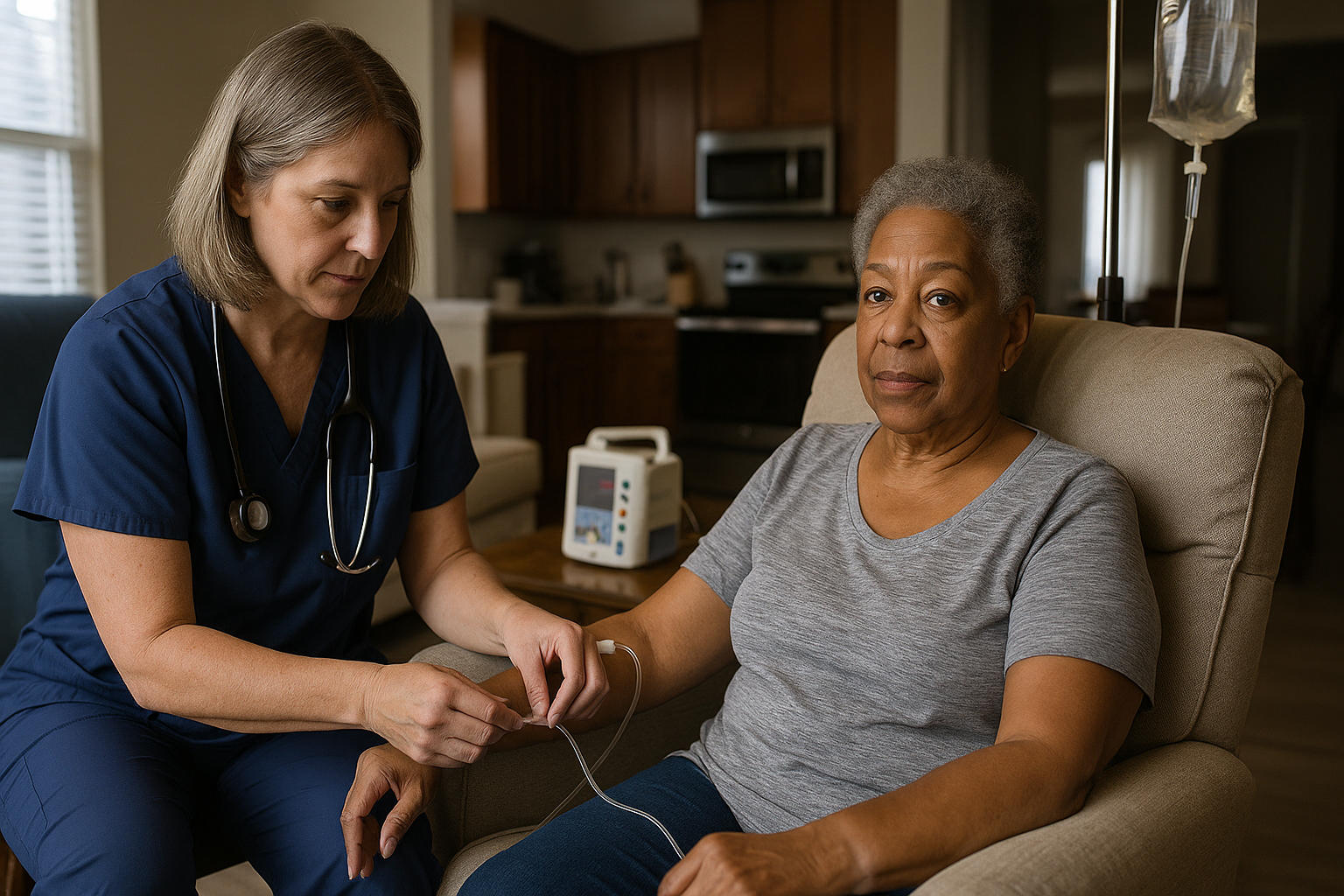
McKesson didn’t pay $5.8 billion for an infusion business. It paid to own a bigger piece of the healthcare system’s exit ramp from expensive hospital treatment.
That is the real story behind Clayton, Dubilier & Rice and McKesson agreeing to buy Option Care Health for $32.05 a share in cash, an enterprise value of roughly $5.8 billion. The price is a 37% premium to Option Care’s October 5 closing price. CD&R will own 51%; McKesson will put in about $1.4 billion for 49%. And, crucially, the pair have built a framework for McKesson to buy CD&R’s stake later, subject to conditions and approvals.
This isn’t private equity taking a punt on a sleepy healthcare asset. It is a strategic buyer using private equity as a temporary co-owner while it secures a position in a part of medicine where the money, the patients and the complexity are moving.
McKesson Is Buying Care Delivery, Not Just Drug Distribution
For years, healthcare distributors made their money by being very good at moving products: medicines, medical supplies, inventory and information. Huge business. Necessary business. But it is also a brutally competitive business where scale matters and differentiation can get thin fast.
McKesson has been steadily walking away from the idea that its future should be limited to shifting boxes.
It bought an 80% interest in PRISM Vision Holdings for $875 million in April 2025, giving it a deeper foothold in ophthalmology and retina services. It also acquired a controlling interest in Core Ventures, the management-services organisation connected to Florida Cancer Specialists & Research Institute, in June 2025. Now it is adding Option Care, the country’s largest independent provider of home and alternate-site infusion services.
The pattern is not subtle: McKesson wants to sit closer to the patient, closer to the specialist, and closer to the decision about where treatment actually happens.
Option Care served more than 315,000 patients in 2025. It has more than 5,000 clinicians, more than 190 US locations, roughly 90 full-service pharmacies and licences in all 50 states. It generated $5.65 billion in 2025 revenue and $471.3 million in adjusted EBITDA.
That means this deal values the business at roughly one times trailing revenue and about 12.3 times adjusted EBITDA. That is not bargain-bin pricing. It is what you pay when an asset has national infrastructure, payer relationships, clinical labour, pharmacy capability and a hard-to-replicate operating machine.
Anyone can make a slide deck about healthcare moving into the home. Far fewer can coordinate a specialty drug, a nurse, reimbursement, patient monitoring, physician orders, pharmacy logistics and compliance without stuffing it up. That capability is the asset.
The $32.05 Price Is Really a Bet on Where Medicine Happens
Infusion therapy is not glamorous. It is also precisely the kind of business sophisticated buyers should like.
Many acute and chronic conditions require intravenous therapies that cannot simply be handed over a pharmacy counter. Historically, plenty of that care happened in hospitals and hospital outpatient departments. But hospital care is expensive, patients would rather not spend their lives in waiting rooms, and payers have every incentive to push appropriate treatment to lower-cost settings.
Home and ambulatory infusion are not a universal substitute for hospitals. Some patients need hospital-level supervision. Some therapies are too complex or risky. Reimbursement rules can change. Clinician availability is real-world constraint, not a spreadsheet footnote.
But when treatment can safely shift, the incentives are lining up in one direction.
Option Care itself has pointed to aging demographics, rising disease complexity, more specialty and rare-disease therapies, payer pressure and patient preference to age in place as structural drivers. Its own investor materials describe the US home-infusion market as growing at a high-single-digit annual rate.
The cynical take is that McKesson and CD&R are simply financialising care. There is always a risk of that when a PE firm enters healthcare, and readers should not pretend otherwise. If you make returns by squeezing clinical staffing, cutting service or gaming billing, you will eventually hurt patients and destroy the asset.
But the smarter reading is simpler: lower-cost care settings are becoming strategic infrastructure. The winner is not necessarily the company with the most clinics. It is the one that can reliably deliver difficult treatment where the patient is, while keeping doctors, payers, drugmakers and regulators comfortable.
That is a much harder business than it looks from outside.
CD&R Gets Control. McKesson Gets Time.
The ownership structure matters more than the press-release adjectives.
CD&R gets 51% control at closing. McKesson gets 49%, remains a minority investor for accounting purposes, and Option Care remains a separate company under its existing management team. The deal is expected to close in the first half of 2027, subject to shareholder and regulatory approvals.
Why not just buy the whole thing now?
Because this structure gives McKesson strategic exposure without immediately swallowing the entire operational and regulatory burden. It also gives CD&R a controlling stake in a business with clear operational levers: capacity, patient conversion, payer partnerships, pharmacy operations, technology, procurement and selective acquisitions.
Then there is the future-purchase framework. That is the tell.
McKesson is not behaving like a passive minority investor who woke up and fancied some healthcare exposure. It is putting a flag in the ground while preserving a route to full ownership. CD&R, meanwhile, gets the chance to own the control position, work the asset and eventually sell into a buyer that already understands the business inside out.
That is a grown-up deal structure. No romance, no grand promises, just a sensible division of risk and capability.
The Overlooked Angle: This Is a Defence Against Drugmakers
Most commentary will frame this as McKesson expanding into home-based care. Fair enough. But there is another angle that matters just as much.
Specialty drugmakers increasingly need more than a distributor. They need a delivery pathway.
A drug can be clinically brilliant and commercially disappointing if doctors cannot get it authorised, patients cannot access it, and the treatment cannot be administered efficiently. For infused specialty therapies, the site of care is part of the product’s commercial reality.
That makes Option Care valuable not merely because it provides therapy today, but because it can become a channel through which future therapies are introduced, supported and monitored.
This is where old-school business thinking still wins. Don’t just ask, “What does this company sell?” Ask, “Which bottleneck does it control?”
Option Care controls a difficult bottleneck: converting a prescription for a complex therapy into treatment delivered in a viable setting. McKesson already has deep specialty-drug and provider relationships. Put those assets beside a national home-infusion platform and the strategic logic becomes obvious.
The danger, of course, is that obvious logic can make buyers overconfident. Healthcare deals fail when executives assume the spreadsheet creates operational integration. It doesn’t. The work is in referral flows, payer contracts, nurse retention, service levels, pharmacy execution and keeping clinical judgement ahead of financial engineering.
If McKesson treats Option Care as a volume pipeline, it will wreck the thing it bought. If it treats the business as clinical infrastructure that needs investment and disciplined growth, it could own one of the most valuable toll roads in US specialty care.
This Is What Smart M&A Looks Like When It Is Done Properly
The best acquisitions do not start with, “We need growth.” That sentence has incinerated more shareholder money than most executives will admit.
They start with a sharper question: what capability would take us years to build, is hard to copy, and becomes more valuable inside our existing system?
Option Care gives McKesson an answer on all three counts.
Building a national home-infusion network from scratch would mean recruiting thousands of clinicians, winning payer contracts, building or acquiring pharmacy capacity, earning trust from physicians and navigating state-by-state complexity. It would take years, cost a fortune and still leave McKesson behind an established operator.
Buying the platform does not eliminate execution risk. It does eliminate the fantasy that a giant company can casually build specialised care infrastructure because it has a big balance sheet.
That distinction matters for founders as much as it does for public-company CEOs. Strategic value is not created by being generally useful. It is created by becoming painful to replace.
What This Means for You
If you are a founder, stop obsessing over whether a large company might buy your product one day. Build something they would be irresponsible not to own.
That means three things.
First, own a bottleneck, not a feature. A feature gets copied or bundled. A bottleneck becomes a strategic asset. Option Care is valuable because it makes a complicated care pathway work at national scale.
Second, make your business operationally ugly in a useful way. The best companies often do jobs competitors find too hard, too regulated, too local or too boring. That mess becomes your moat if you systemise it properly.
Third, understand the buyer’s second-order problem. McKesson is not merely buying revenue. It is buying a way to participate in specialty therapies, lower-cost care settings and the fight for control over patient access. If you can see the buyer’s next problem before they do, you will negotiate from strength.
For investors, the lesson is equally blunt: look past the deal headline. Follow where control is moving. In this case, it is moving away from the hospital as the default venue and toward platforms that can deliver complex care across the patient’s actual life.
That is where McKesson has put $1.4 billion of its own money. Pay attention when smart operators spend real cash to secure an escape route from the old model.