Meta’s $145B AI Bet Starts Making Its Own Chips This September
If you’re spending $145 billion on AI in one year, buying Nvidia chips forever isn’t a strategy. It’s a hostage situation.
If you’re spending $145 billion on AI in one year, buying Nvidia chips forever isn’t a strategy. It’s a hostage situation.
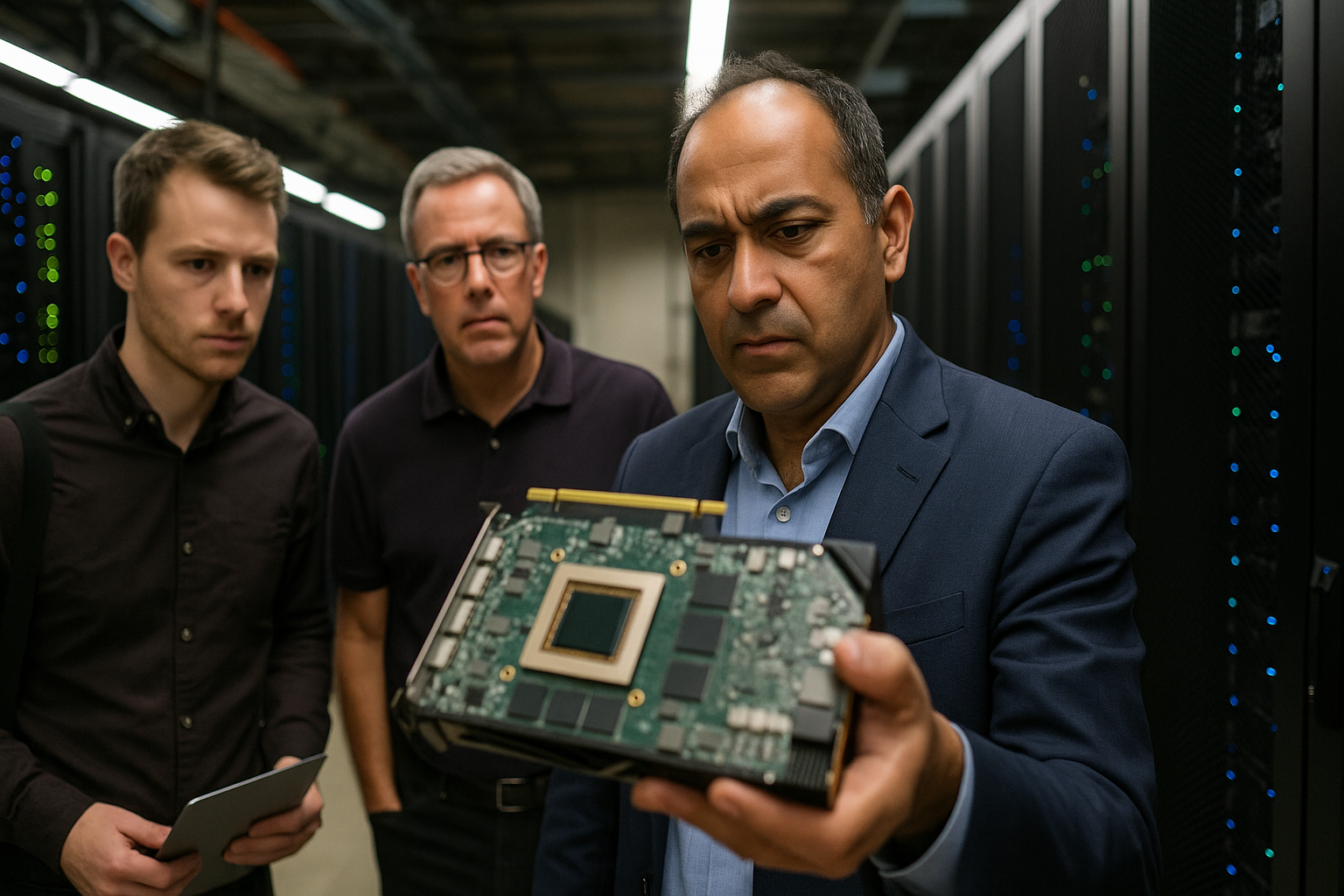
Meta is moving its new in-house AI chip, code-named Iris, into manufacturing in September. The important bit is not that Mark Zuckerberg wants to play semiconductor dress-ups. It’s that one of Nvidia’s biggest customers is now doing what every serious buyer eventually does when a supplier becomes too expensive, too scarce and too powerful: building an alternative. ([investing.com](https://www.investing.com/news/stock-market-news/meta-to-put-ai-chip-into-production-in-september-as-it-looks-to-double-computing-capacity-memo-shows-4787372?utm_source=openai))
Meta has stopped treating chips as someone else’s problem
Reuters reported in July that Meta planned to begin manufacturing Iris in September after roughly six weeks of testing found no major issues. The chip sits inside Meta’s MTIA program — Meta Training and Inference Accelerator — and is designed for the particular jobs Meta does at industrial scale: recommendations, ranking and generative-AI inference across Facebook, Instagram and its other products. Meta is working with Broadcom on design and Taiwan Semiconductor Manufacturing Co. on production. ([investing.com](https://www.investing.com/news/stock-market-news/meta-to-put-ai-chip-into-production-in-september-as-it-looks-to-double-computing-capacity-memo-shows-4787372?utm_source=openai))
That sounds technical. Here’s the plain-English version: Meta is trying to make the cost of serving AI to billions of people less dependent on whichever GPU vendor has Silicon Valley by the throat.
The company still needs Nvidia and AMD. Iris is meant to augment, not replace, the masses of general-purpose GPUs Meta buys. Training frontier models is one workload; running recommendations, feeds, ads and AI features billions of times a day is another. The first is a drag race. The second is a trucking business. You do not buy a Ferrari to deliver beer around Sydney.
Meta’s own explanation of its strategy is unusually revealing. It says it already deploys hundreds of thousands of MTIA chips for inference, and it is developing four new chip generations within two years. MTIA 300 is already in production for recommendation training; MTIA 400, 450 and 500 are expected to support a broader mix of workloads, with near-term emphasis on generative-AI inference. ([about.fb.com](https://about.fb.com/news/2026/03/expanding-metas-custom-silicon-to-power-our-ai-workloads/amp/?utm_source=openai))
That cadence matters more than the Iris name. Most companies announce a custom chip, take a victory lap, then discover the software is awkward, the supply chain is late and engineers quietly return to Nvidia. Meta is attempting something harder: a repeatable internal chip pipeline, with releases every six months or less. That is how you turn custom silicon from a science project into negotiating power. ([about.fb.com](https://about.fb.com/news/2026/03/expanding-metas-custom-silicon-to-power-our-ai-workloads/amp/?utm_source=openai))
The real number is 14 gigawatts, not one chip
The eye-watering figure is not the price of Iris. It is the electricity behind the machines that will use it.
The Reuters report said Meta planned to deploy 7 gigawatts of computing infrastructure in 2026 and double that to 14 gigawatts in 2027. It also said Meta expected to spend as much as $145 billion on AI infrastructure this year. That is a capital allocation decision on a scale that makes most “AI strategies” look like a bloke buying a ChatGPT subscription and calling himself transformed. ([investing.com](https://www.investing.com/news/stock-market-news/meta-to-put-ai-chip-into-production-in-september-as-it-looks-to-double-computing-capacity-memo-shows-4787372?utm_source=openai))
A gigawatt is not a cute cloud metric invented by consultants. It is power-station territory. Once you are building at that scale, a 10% improvement in the cost or efficiency of a heavily repeated task is not an engineering footnote. It is real money — and, just as importantly, capacity you can redirect into the next product, model or market.
Meta says conventional mainstream chips are generally designed around demanding large-scale training workloads, then used less efficiently for inference. Its stated response is an inference-first approach: build silicon tailored to the tasks its apps repeat endlessly, while retaining flexibility for other jobs. ([about.fb.com](https://about.fb.com/news/2026/03/expanding-metas-custom-silicon-to-power-our-ai-workloads/amp/?utm_source=openai))
That is the overlooked commercial logic. The AI race is sold to the public as a contest to build the cleverest model. For Meta, and eventually for every consumer platform with enough traffic, it is also a contest to deliver an answer, an ad, a recommendation or an assistant response at the lowest reliable cost.
The winner does not necessarily have the flashiest demo. The winner may simply have the better unit economics after serving ten billion requests.
Nvidia is not losing. But the toll road is being bypassed.
Let’s not get carried away and declare Nvidia finished. That would be idiot talk.
Nvidia remains essential because its hardware, networking and software ecosystem are deeply embedded across AI development. Meta’s own strategy is explicitly a portfolio: it is pairing MTIA with external silicon and has partnerships spanning Broadcom, Arm, AWS, AMD and Nvidia. ([about.fb.com](https://about.fb.com/news/2026/06/what-is-compute-power-meta-ai-infrastructure/?utm_source=openai))
But dependence is not the same as loyalty. Meta’s move says the largest AI buyers are becoming more sophisticated customers. They will keep buying GPUs where GPUs make sense. They will also peel away workloads where a purpose-built chip can do the job more cheaply or efficiently.
That changes the next phase of the AI infrastructure business. The question is no longer just, “Who sells the most chips?” It is, “Which workloads remain valuable enough to justify buying general-purpose compute at a premium?”
Broadcom is a quiet beneficiary of that shift. In April, Meta and Broadcom said they would co-develop multiple generations of MTIA silicon across chip design, advanced packaging and networking. Their initial commitment exceeds 1 gigawatt, with an aim for a sustained multi-gigawatt rollout. ([about.fb.com](https://about.fb.com/news/2026/04/meta-partners-with-broadcom-to-co-develop-custom-ai-silicon/amp/?utm_source=openai))
That is not a vendor relationship in the ordinary sense. It is a giant customer taking ownership of its economic destiny while using Broadcom’s expertise to get there. For Broadcom, these deals are attractive because hyperscalers provide scale, visibility and years of demand. For Meta, the value is less glamorous but more powerful: it gets more control over cost, supply and performance.
The contrarian angle: Meta is not trying to win the chip war
The lazy reading is that Meta wants to become a chip company. It doesn’t.
Meta wants to become less exposed to being priced like a desperate buyer. Very different thing.
Founders regularly make this mistake in miniature. They see a strategic bottleneck and conclude they must build the entire missing industry themselves. Usually that is vanity wearing an operations hat. The better move is to own the part that gives you leverage and rent the rest from people who are already world-class.
Meta is not opening fabs. TSMC manufactures. Broadcom helps co-design. Arm is working with Meta on data-centre CPUs. Meta is concentrating on the workload knowledge, system architecture and deployment scale that no supplier can replicate as easily. ([about.fb.com](https://about.fb.com/news/2026/03/meta-partners-with-arm-to-develop-new-class-of-data-center-silicon/?utm_source=openai))
That is a properly grown-up version of vertical integration. Do not own everything. Own the decisions that determine your margin, your speed and your ability to say no.
There is another uncomfortable implication. Smaller AI companies will find it increasingly hard to compete merely by having access to the same foundational models and rented GPUs. The giants are building advantages underneath the model layer: power contracts, data centres, networking, proprietary chips, distribution and mountains of real-world usage data.
A startup cannot outspend Meta on infrastructure. It should stop pretending that is the game.
Its chance is to find a market where being smaller is an advantage: a painful workflow, a proprietary dataset, a sharper product, a faster sales motion, or a customer segment the giants cannot be bothered serving properly. AI makes generic software cheaper to build. It does not make defensibility automatic. If anything, it makes vague businesses easier to kill.
What this means for you
I like this story because it is not really about chips. It is about margins.
When a business becomes successful, the costs that looked harmless at $1 million of revenue become dangerous at $100 million. A 3% payment fee. One cloud provider. A single paid-acquisition channel. One manufacturer. One employee who knows how the whole machine works. These are not operational details. They are future ransom notes.
Meta has enough scale to justify designing silicon. You almost certainly do not. But the principle travels beautifully: map the handful of dependencies that can tax your success, then start creating options before you need them.
Do this tomorrow:
1. List your five biggest variable costs. Not your total expenses — the costs that rise every time you make a sale, serve a user or deliver a product. Include cloud, payments, fulfilment, commissions, advertising and key contractors.
2. Ask which supplier has pricing power over you. If they doubled their price or cut access in 90 days, where would you be? Be honest. “We’d be annoyed” is not an answer. Put a dollar figure on the damage.
3. Build a second option before the crisis. This may mean a second supplier, a different technical architecture, owned customer data, a negotiated rate card or a cash buffer. You do not need to replace the incumbent tomorrow. You need the ability to walk.
4. Customise only where repetition creates leverage. Meta is building chips for workloads it performs at absurd volume. Apply the same discipline. Automate, build proprietary software or bring a function in-house only after you know the task repeats enough to pay for it.
5. Treat efficiency as offensive, not defensive. Lower unit costs give you room to charge less, invest more, survive longer and outlast competitors. That is not bean-counting. That is a weapon.
Meta’s Iris chip will not make headlines like a new AI model. It may matter more. Models attract applause; infrastructure decides who can afford to keep playing after the applause dies down.
The lesson for founders and investors is brutally simple: the moment a supplier controls the economics of your growth, start building an exit. Not because you hate them. Because successful businesses are built on leverage, and leverage only exists when you have a choice.