Microsoft Maia 300’s 40% Power Bet Changes AI Economics
Microsoft says Maia 300 will deliver 40% more tokens per megawatt than leading GPU-based systems. That is not a chip announcement. It is a margin announcement.
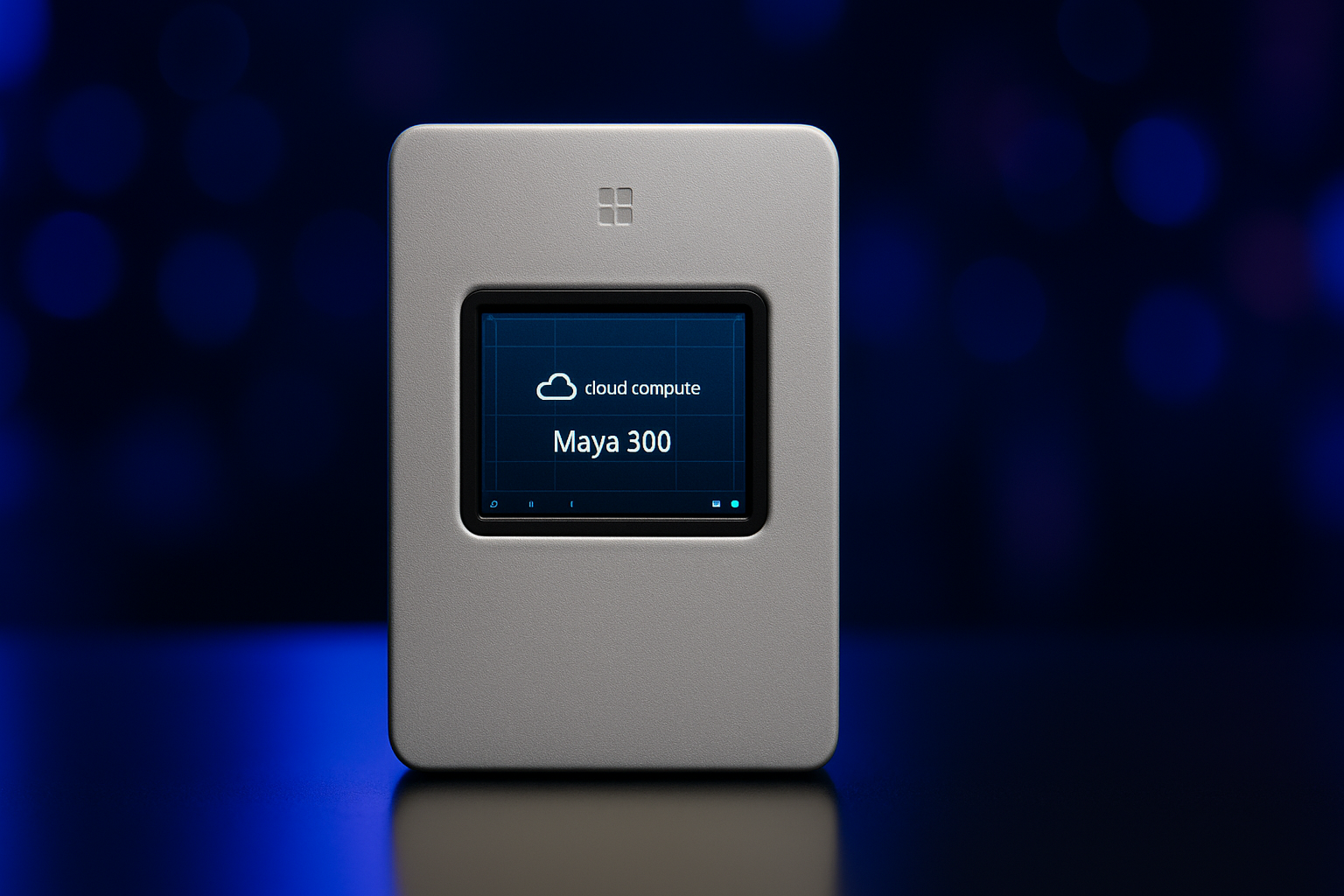
Microsoft says Maia 300 will produce 40% more tokens per megawatt than leading GPU-based systems. That is not a chip announcement. It is a margin announcement.
On October 12, Microsoft made the far more interesting admission: buying that future from Nvidia forever would be a bloody expensive way to run a business.
Its answer is Maia 300, a custom AI system Microsoft plans to make its primary inference system for Microsoft products and services through multi-gigawatt deployments beginning in 2027.
That is the real bet.
Microsoft Maia 300 is about owning the cost of intelligence
Most people still talk about AI as though the important thing is which model gives the cleverest answer. That matters, obviously. But once you are serving Copilot, Teams, GitHub Copilot, Foundry and enterprise agents at serious scale, the commercial question becomes brutally simple: what does every useful answer cost you to deliver?
Microsoft says Maia 200 is already serving production workloads, including Microsoft Copilot, and is supporting its MAI model team. It says GitHub Copilot and Microsoft Foundry are due to follow by the end of 2026. Maia 300 is scheduled for production deployments in 2027.
The new system is built specifically for inference: the endless, expensive job of generating answers after a model has been trained. Microsoft says Maia 300 is aimed at long-context reasoning, latency-sensitive conversations and sustained multi-step agent work. In plain English, it is designed for AI that does more than spit out a paragraph and disappear.
The numbers matter. Microsoft says a full Maia 300 rack combines 96 accelerators within a 167-kilowatt power envelope. That rack is claimed to deliver up to 7 times the token throughput of Maia 200. Each accelerator is specified with eight HBM4 memory stacks, 18.0 TB/s of peak memory bandwidth and a 950-watt thermal design power.
None of that is bedtime reading unless you run a cloud platform. But the commercial implication is very easy to understand: Microsoft is trying to get more sellable AI work from each megawatt, each rack, each data-centre connection and each dollar of capital it spends.
That is where the real fight is.
The part Nvidia investors should not ignore
This does not mean Nvidia is cooked. Anyone claiming a single Microsoft announcement has killed Nvidia is confusing a strategy deck with a supply chain.
Microsoft itself is careful: Maia 300 will work across OpenAI models, Microsoft’s own MAI models and open-source model families. Nvidia remains deeply embedded across AI infrastructure, and Microsoft has enormous existing GPU fleets. Custom silicon also takes years to design, manufacture, validate and deploy. It is difficult work, not a cheeky procurement swap.
But the direction is unmistakable.
The largest AI buyers are becoming less willing to pay permanent tolls on every unit of intelligence they sell. Microsoft, Google, Amazon and Meta are not building custom chips as a hobby. They are trying to turn compute from a variable cost controlled by a supplier into an asset they can optimise around their own workloads.
Microsoft’s wording is particularly telling. It says Maia is intended to become the primary inference system for its products and services from 2027. Not a side experiment. Not a science project for press releases. Primary.
The Information reported that Microsoft had been in talks with TSMC about capacity for more than 300,000 Maia chips for delivery in 2027. It also noted that multi-gigawatt deployment would require millions of chips. That is a useful reality check: a power-efficient chip is only strategically important if you can get enough of the things made.
This is the awkward truth for every AI hardware challenger. Designing a chip is impressive. Building, packaging, networking, cooling and deploying enough of them to move the economics of a hyperscaler is where the grown-ups earn their money.
Why “40% more tokens per megawatt” is the headline, not marketing garnish
I have watched plenty of founders get seduced by feature comparisons. They’ll debate which model has the best benchmark score while quietly ignoring the invoice arriving at the end of the month.
Microsoft’s 40% claim should be read as a cost-and-capacity claim, not merely a speed claim. If the company can generate materially more useful output with the same energy supply, it can do one or more of four things: lower its cost to serve, improve product margins, offer customers more AI usage for the same price, or push into workloads that were previously uneconomic.
Those choices change markets.
The current AI gold rush has made software founders a little lazy. Many are reselling intelligence bought from somebody else’s cloud, somebody else’s model and somebody else’s hardware. There is nothing wrong with that at the start. It is often the smart move.
But once usage becomes meaningful, your gross margin is no longer a spreadsheet detail. It is your business model. If your product needs increasingly long context windows, repeated agent loops and real-time responses, your compute bill can go from manageable to obscene faster than your sales team can say “enterprise rollout.”
Microsoft is building Maia 300 because it understands that agents will make inference much hungrier. A chatbot answering one question is cheap compared with an agent reading files, checking systems, calling tools, revising its work and keeping going for an hour.
The winners in that world will not necessarily have the flashiest demo. They will have the best cost per useful outcome.
The overlooked angle: this is also a power strategy
The common line is that custom chips reduce dependence on Nvidia. Fair enough. It is also incomplete.
The scarcer resource is increasingly not silicon alone. It is power.
You can have capital, a brilliant model and customers waving contracts around. None of it helps if your data-centre capacity is constrained by energy availability, grid connections, cooling and physical space. Every efficiency gain buys room to grow without waiting for another substation, another campus or another approval process.
That is why Microsoft keeps framing Maia 300 in tokens per megawatt rather than just raw compute. The company is treating power as a first-class product constraint.
This should make operators rethink their own AI plans. “We will just use more AI” is not a strategy. It is the technological version of saying you will just hire more people. More of what? At what unit cost? With what bottleneck? And who gets squeezed when demand doubles?
Microsoft’s own Maia 200 performance claims offer another clue. The company says Maia 200 provides up to 1.7 times more tokens per watt for certain built-in AI capabilities in Teams, Copilot and Cowork than leading GPU infrastructure. Maia 300 is not arriving from nowhere; it is the next lap in a system Microsoft is already testing in live products.
That matters because the hardest part of infrastructure is rarely inventing it. It is integrating it into a real operation without breaking the customer experience.
Don’t confuse vertical integration with instant advantage
Here is the contrarian bit: most businesses should not copy Microsoft.
A founder sees Maia 300 and decides they need proprietary models, proprietary data centres and a small army of chip designers. That is how you set money on fire with terrific conviction.
Microsoft can justify this because it serves AI to an enormous installed base across consumer software, enterprise software, developer tools and cloud infrastructure. It has recurring demand, huge distribution and enough workload visibility to design hardware around real use cases.
A startup usually has none of that.
Your job is not to own every layer. Your job is to know which layer creates your edge. For most founders, that will be proprietary workflow data, customer access, trusted distribution, switching costs or a product customers genuinely do not want to live without.
But you must still build with the assumption that intelligence gets cheaper and more available. Maia 300 is another sign that model access will not remain the moat. The platforms are attacking the cost curve from below while model providers compete from above.
If your only differentiator is “we put AI into a familiar workflow,” you are living on borrowed time.
What this means for you
For founders: measure your AI product in cost per completed customer outcome, not cost per token and definitely not benchmark bragging rights. Track the full loop: model calls, retries, tool use, human review and support cost. You cannot manage a margin you refuse to calculate.
For operators: start separating AI workloads by value and urgency. A customer-facing real-time task may justify premium inference. Internal drafting, batch analysis and background workflows usually do not. One expensive model for every job is lazy procurement.
For investors: ask whether a company’s AI revenue rises faster than its inference costs. Revenue without a believable path to improving unit economics is not scale; it is subsidised enthusiasm.
And for anyone building on AI platforms: assume the infrastructure giants are determined to make intelligence cheaper, faster and more bundled into the software their customers already use. Build where they cannot easily copy you: the awkward workflow, the proprietary data, the customer trust, the distribution relationship and the operational know-how.
Microsoft Maia 300 is not the end of Nvidia. It is more important than that. It is another confirmation that AI’s next winners will be decided less by who can access a clever model and more by who can deliver useful intelligence at a cost that leaves room for profit.
That is the game. Everything else is noise.