Moderna’s $30B One-Day Gain Is Not a Turnaround Yet
Moderna added roughly $30 billion in a day, then gave a big chunk back the next. That is not Wall Street being irrational. It is Wall Street charging interest on uncertainty.
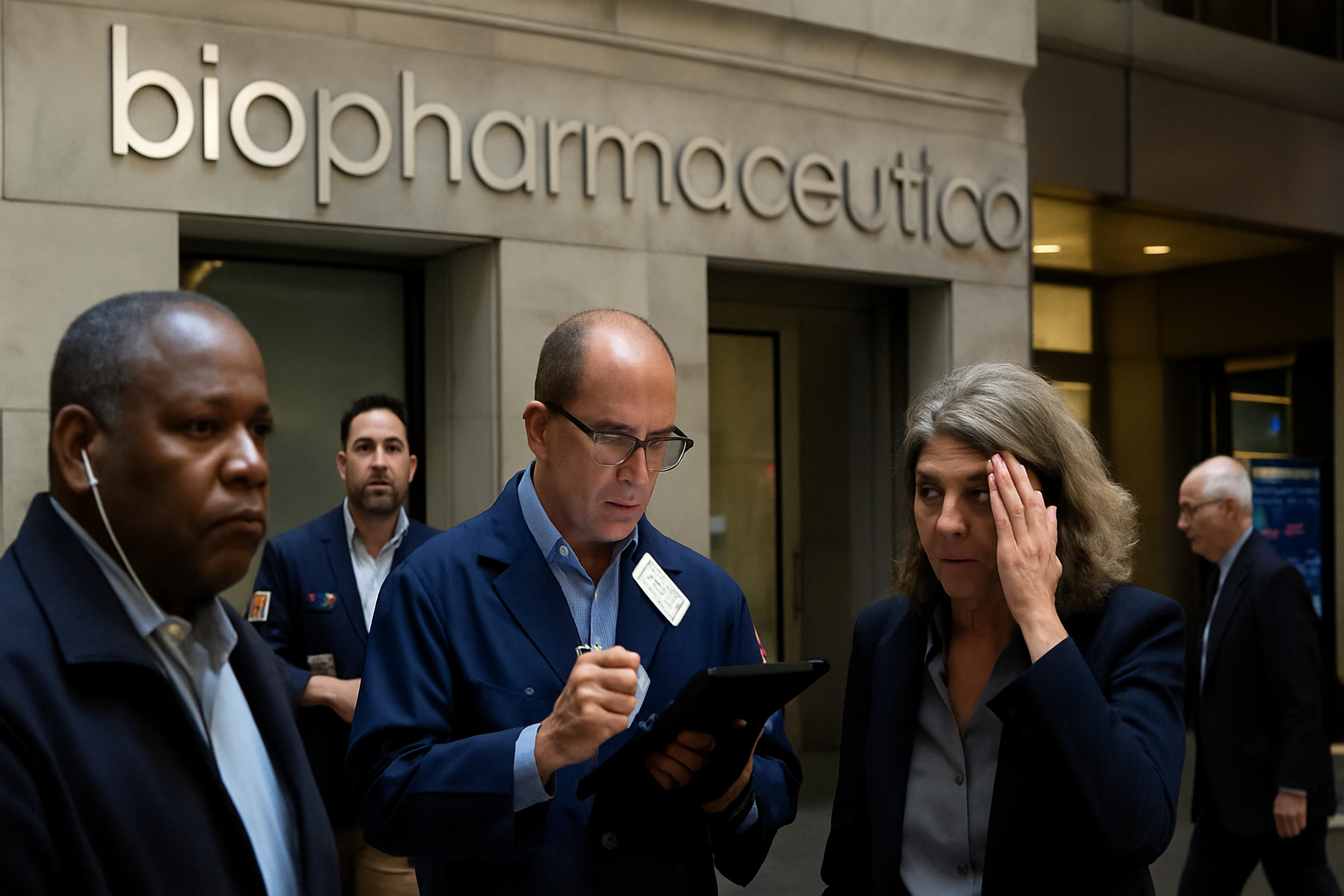
Moderna added roughly $30 billion in market value in a single session this week, then watched its shares fall about 25% the following day.
That is not Wall Street being irrational. It is Wall Street charging interest on uncertainty.
The $30 billion repricing
On August 19, Moderna and Merck announced that their personalised mRNA cancer therapy, intismeran autogene, met its primary and key secondary endpoints in the Phase 3 INTerpath-001 trial in more than 1,100 patients with high-risk melanoma after surgery.
The treatment combines a bespoke mRNA therapy with Merck’s monster immunotherapy franchise, Keytruda. The idea is simple enough to explain over a beer, even if the science underneath it is not: sequence a patient’s tumour, identify mutations, design an mRNA treatment around those mutations, and train the immune system to hunt what is left.
The market heard one thing: mRNA may have a serious second act after COVID.
Moderna shares more than doubled on the news, adding about US$30 billion in market value. Merck rose too, though nowhere near as violently. That difference matters. Merck owns a giant, profitable oncology business led by Keytruda. Moderna had become, in investor shorthand, a one-hit COVID shop with a shrinking revenue base and a costly pipeline.
Then reality stepped into the room.
On August 20, Moderna shares fell sharply as traders took profits and analysts pointed out the obvious: a successful clinical trial is a massive milestone, but it is not yet an approved product, a reimbursement agreement, a manufacturing operation at scale, or a dependable revenue stream. By the end of that session, the stock had surrendered roughly a quarter.
Anyone calling the first move proof that Moderna is “back” is getting ahead of themselves. Anyone calling the second move proof the trial result does not matter is equally off their rocker.
Both things can be true: this is a genuine scientific and commercial breakthrough, and the share price is still trying to work out what the breakthrough is worth.
What the market actually bought
Investors did not suddenly decide that melanoma alone justifies a US$30 billion revaluation. They bought an option on a platform.
That is the whole game.
A conventional drug can be brilliant and still have a narrow commercial life. A platform that can repeatedly produce therapies across cancer types, however, changes the frame entirely. If personalised mRNA can work in a large late-stage cancer study alongside Keytruda, it creates a far bigger question: can the same production and clinical model be used in other tumours?
That is where the upside lives. It is also where most of the risk lives.
The latest result is specific to high-risk melanoma patients who have had tumours removed, using this treatment in combination with Keytruda. It does not prove the therapy works across every cancer. It does not establish overall-survival benefit. And it does not answer the operational question that eventually separates clever science from a great business: can every patient receive an individually designed therapy quickly, reliably and at a cost a health system will pay?
Personalisation sounds lovely until you are the poor bugger responsible for delivering it to thousands of people across hospitals, labs, regulators, insurers and supply chains.
The market’s first-day jump priced the dream. The next-day sell-off priced the execution bill.
Moderna’s financial hole did not disappear
This is the inconvenient bit for investors who only want the victory lap.
Moderna reported second-quarter 2026 revenue of roughly US$100 million and a GAAP net loss of roughly US$800 million. It ended the quarter with US$6.9 billion in cash and investments, and guided to US$4.7 billion to US$5.2 billion of year-end cash after reducing its operating-expense outlook.
That is not a company on death’s door. But it is not a self-funding growth machine either.
COVID vaccine demand made Moderna look like a cash-printing juggernaut. Then the pandemic market normalised, as markets do, and the company was left carrying the cost base of an ambitious platform business while its main commercial engine shrank.
This cancer result materially improves the story. It does not repair the income statement overnight.
That distinction is vital. Markets are very good at confusing a better future with a better present. They are not the same thing.
For Moderna, the next few years will involve regulatory work, commercial planning, manufacturing capacity, more clinical data and the plain old cash burn required to do it all. The company also has other products and programs, including an mRNA flu vaccine approved for older adults in the United States this month. That helps prove it is building beyond COVID. But a portfolio is not a portfolio until multiple products generate durable sales.
Merck got the better end of the risk equation
This is the overlooked angle.
Most of the headlines went to Moderna because its stock went ballistic. But Merck may be the quieter winner.
Keytruda is already one of the world’s biggest cancer drugs. Merck brings the oncology footprint, doctors, trial infrastructure, commercial muscle and payer relationships. Moderna brings the mRNA platform and the personalised-treatment engine. If the combination reaches patients, Merck gets a credible way to extend and deepen the clinical value of its existing franchise.
That is a better place to negotiate from than trying to build an oncology empire from scratch.
For Moderna, the partnership is validation and distribution. For Merck, it is strategic insurance.
That does not mean Merck is automatically the better stock. It means the risk is different. Moderna offers bigger upside if personalised cancer vaccines become a large category. Merck offers exposure to the upside without needing one unproven platform to carry the whole business.
Investors often get seduced by the stock that moves 100%. Operators should pay attention to the company that has the customers, channel, cash flow and ability to make the thing real.
A breakthrough without distribution is a science project. A breakthrough plugged into an existing commercial machine can become an industry.
The contrarian view: volatility is the honest price
People love to call these swings “casino behaviour.” Sometimes they are. But in biotech, big moves are often the most honest thing a market can do.
Before the trial result, Moderna’s value reflected substantial doubt that its mRNA platform could produce a major post-COVID commercial win. After the result, that doubt dropped sharply. But uncertainty did not vanish. It simply changed shape.
The questions are now bigger and more expensive:
- How strong are the full data, not just the headline endpoints? - What will regulators require before approval? - How long does a personalised therapy take to manufacture for each patient? - What will treatment cost? - Can health systems process and pay for it at scale? - Does the approach translate into other cancers?
The share price is bouncing around because the answers are not yet worth a neat spreadsheet cell.
Here is the part most punters miss: uncertainty is not a flaw in an investment. Unpriced uncertainty is where returns come from. But if you cannot survive being wrong, you have no business pretending volatility is conviction.
I have made enough money, and lost enough money, to know that a stock doubling is not a research process. It is an invitation to finally start one.
What this means for you
If you are an investor, do not buy a story at the loudest possible moment because you are terrified of missing the next leg up. Write down what must happen for the investment to work: approval, launch timing, adoption, pricing, cash burn and proof that the platform works beyond one setting. Then decide what position size lets you be wrong without doing something stupid.
If you already own a stock that jumps 100% on one announcement, do not automatically sell it all or worship it harder. Re-underwrite it. The company is not the same company after new information. Neither should your thesis be.
If you are a founder, study the Merck-Moderna partnership. Technology alone is rarely the moat. The winner is often the business that pairs a technical advantage with distribution, trust and operational muscle. Build the clever thing, absolutely. Then build the boring machinery that gets it into customers’ hands.
And if you are tempted to trade a headline, remember this: Moderna’s US$30 billion day was not the finish line. It was the market admitting that the company may have found a far better race to run.
Now it has to run it.
Sources
- Moderna and Merck shares soar on mRNA cancer vaccine — Axios
- Moderna shares double as cancer vaccine data rekindles investor hopes — Reuters
- Moderna Reports Second Quarter 2026 Financial Results and Provides Business Updates
- Moderna and Merck Present 5-Year Data for Intismeran Autogene With Keytruda — Merck