Movember’s $629M Prostate Cancer Bet on 12M Men
A false belief about a prostate check can keep men from talking to a doctor. Movember is targeting 12 million men by saying the awkward bit out loud.
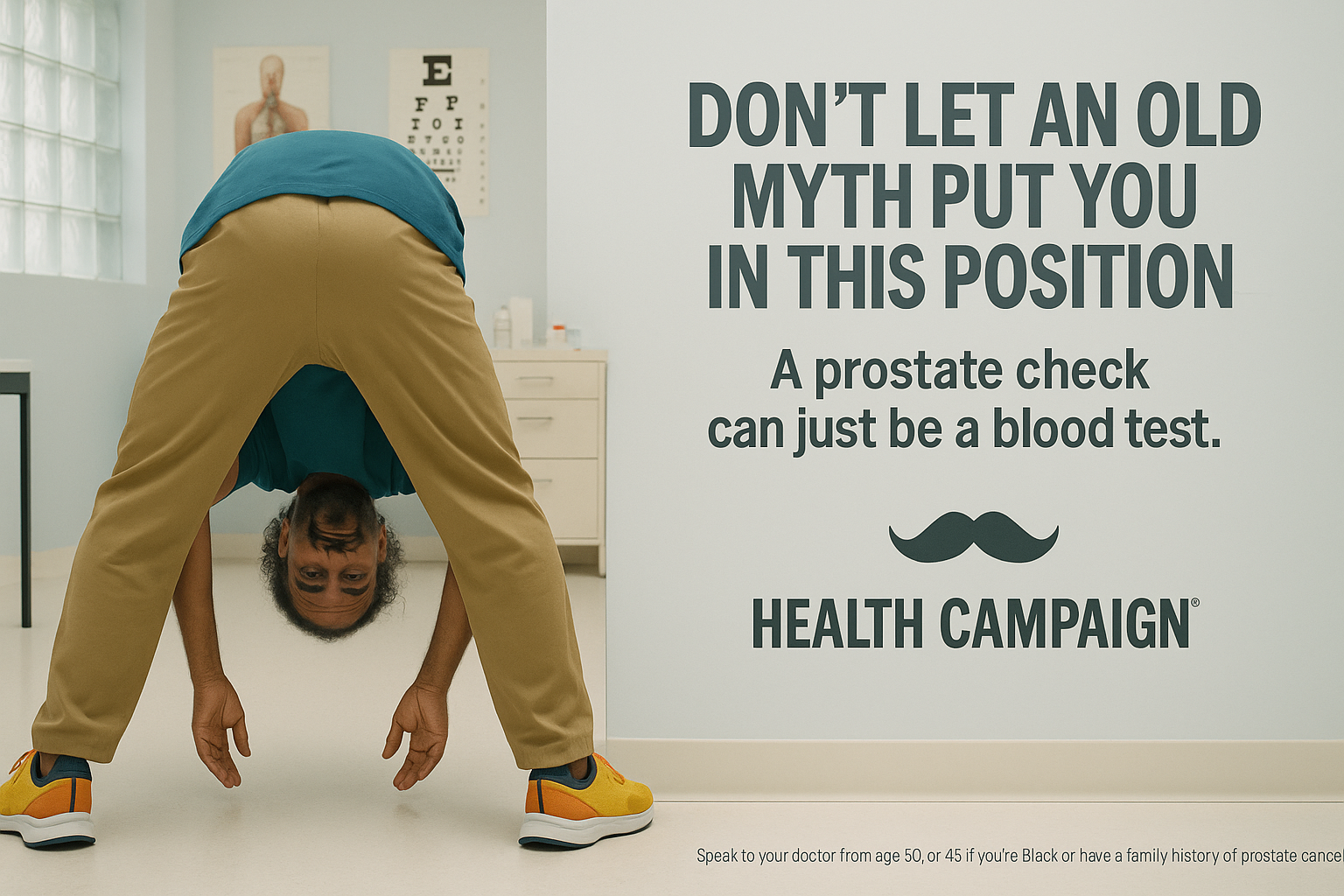
Most marketing is too polite to change anything. If your campaign cannot bear to name the real reason customers avoid your product, your doctor, your store or your category, it is probably just expensive decoration.
On September 1, 2026, Movember launched a prostate-cancer-awareness campaign across Australia, New Zealand, Canada and the United States built around a stubborn piece of misinformation: plenty of men believe a prostate check automatically means a digital rectal exam. The creative makes the discomfort visible, then gives men the information they need to have a proper conversation with a doctor. No misty-eyed brand anthem. No committee-approved soup. Just the obstacle, said plainly. ([campaignbrief.co.nz](https://campaignbrief.co.nz/2026/09/01/movember-aims-to-dispel-prostate-cancers-most-persistent-myth-in-new-campaign-created-in-house-in-conjunction-with-creativitycommerce/?utm_source=openai))
The campaign is expected to reach 12 million men globally through out-of-home, radio, digital and social media. Campaign Brief reported that pre-launch concept testing found exposure alone shifted attitudes and beliefs. Movember has put serious institutional weight behind the subject: prostate cancer was its first cause area in 2003, and the organisation says it has invested A$629 million across 864 prostate-cancer projects globally. ([campaignbrief.co.nz](https://campaignbrief.co.nz/2026/09/01/movember-aims-to-dispel-prostate-cancers-most-persistent-myth-in-new-campaign-created-in-house-in-conjunction-with-creativitycommerce/?utm_source=openai))
That is the marketing story worth studying today. Not because every brand should start making people squirm. Please don’t. It is because Movember has understood something that most founders, CMOs and agency decks desperately avoid: the job is not to make the brand look clever. The job is to remove the behaviour-stopping belief.
The campaign found the real competitor
Movember is not competing only against other charities for attention. It is competing against avoidance.
That matters. Businesses regularly define their competitors far too narrowly. A meal-prep company thinks it is competing with another meal-prep company. It is actually competing with a tired bloke opening Uber Eats. A finance app thinks it is competing with another finance app. It is competing with a customer’s belief that getting organised will be painful, confusing and make them feel broke. A premium spirits brand thinks it is competing with the bottle beside it. Often, it is competing with the customer’s fear of wasting money on something they will not like.
Movember’s campaign identifies an exact friction point: a mistaken assumption about what happens when a man raises prostate-cancer risk with a doctor. That is not a vague awareness problem. It is a specific behavioural blockage.
This is where most brand work goes off the rails. Teams spend months debating colours, taglines, creator lists and whether a logo should be 8% larger. Meanwhile, nobody has written down the single sentence the customer is privately telling themselves before they decide not to act.
That sentence is the business.
If you can find it, you can build a campaign around changing it. If you cannot, you are probably buying impressions and hoping the universe sorts the rest out.
A$629 million gives bluntness credibility
There is another lesson here. Being direct is not the same as being reckless.
Movember can run a confronting message because it has earned the right to be in the conversation. It has spent more than two decades funding men’s-health work, and its current site says it has raised $1.4 billion for men’s health overall. Its work spans mental health and suicide prevention, prostate cancer and testicular cancer. ([us.movember.com](https://us.movember.com/about-us/our-financials?utm_source=openai))
That existing credibility changes how the message lands.
A random brand trying to borrow medical anxiety for clicks would look grubby. Movember is addressing a barrier directly connected to its mission. There is a world of difference between using discomfort as a cheap attention hack and using it to get people past misinformation that can stop them seeking help.
Founders miss this distinction when they hear that “edgy” marketing works. They see the surface-level provocation and ignore the underlying permission structure.
You do not get permission through a louder social post. You get it by doing the work:
- Know the customer’s problem better than they do. - Have a legitimate reason to solve it. - Make sure your product or service actually delivers after the campaign has done its job. - Say only what you can substantiate.
Movember’s own information is careful on the practical point: it urges men to understand their risk factors and talk with their doctor about testing where appropriate. That is a far more responsible position than pretending one-size-fits-all medical advice belongs in an ad. ([us.movember.com](https://us.movember.com/men-s-health/prostate-cancer/what-causes-prostate-cancer?utm_source=openai))
For operators, that is the standard. A sharp campaign can open the door. The actual product, expert advice, onboarding or service experience must carry the customer through it.
Reach first is the right call when the problem is ignorance
The campaign is using an unapologetically reach-first media strategy: out-of-home, radio, digital and social. That will annoy the performance-marketing crowd who want every dollar tied neatly to a last-click conversion event before lunch.
Bad luck. Some jobs cannot be reduced to a coupon code.
When the barrier is misinformation, awareness is not fluff. Awareness is the product’s first mile.
You cannot retarget your way out of a problem people do not yet recognise. You cannot optimise a funnel when the customer has opted out before entering it. And you cannot expect a single search ad to fix a belief built through years of embarrassment, jokes and bad information.
That is why broad reach is sensible here. The campaign’s first commercial-style task is not to persuade every man who sees it to take immediate action. It is to replace a false mental picture with a more accurate one. Once that happens, a later conversation with a doctor becomes more likely.
Businesses should steal this logic without copying the creative.
If customers do not understand your category, stop obsessing over conversion-rate optimisation before you have made the category legible. If buyers think enterprise software takes 12 months to implement when yours takes 12 days, that belief is the campaign. If people assume tequila is all cheap shots and headaches, that belief is the campaign. If your product looks more complicated than the pain it solves, that belief is the campaign.
This is something I keep seeing while building Agave Finder: information gaps are commercial gaps. The customer who cannot confidently choose does not become a loyal buyer. They either buy the familiar thing, buy the cheapest thing, or buy nothing. Better discovery is not a nice feature. It is the bridge between interest and action.
The overlooked angle: the campaign is ruthlessly useful
Here is the contrarian bit: the best thing about this campaign may be that it is not trying to be loved.
Marketers are addicted to applause. They want people to share the ad, praise the craft, call it brave, put it in an awards case and nod approvingly at the case study video later. Fine. Nice work if you can get it.
But an awareness campaign has a more serious test: did it make the right person do the next useful thing?
Movember’s creative starts with a familiar fear, punctures the myth, and directs people to further information. It is not asking the audience to decode a brand metaphor. It is not confusing attention with comprehension. Its value exchange is brutally clear: here is the thing you have been worried about; here is what you have wrong; here is where to learn what to do next. ([campaignbrief.co.nz](https://campaignbrief.co.nz/2026/09/01/movember-aims-to-dispel-prostate-cancers-most-persistent-myth-in-new-campaign-created-in-house-in-conjunction-with-creativitycommerce/?utm_source=openai))
That is a tidy operating model for any business.
The more complex, expensive or emotionally loaded the customer decision, the less room you have for clever ambiguity. Your marketing should reduce uncertainty at the exact moment uncertainty causes delay.
The premium branding crowd will hate hearing this, but mystery is often just friction wearing a nice jacket.
What this means for you
You do not need Movember’s budget, cause or global reach to use this tomorrow. You need the nerve to identify the sentence killing your conversions.
Start with this exercise. Ask your sales team, support team and most sceptical customers to finish one line:
“I would buy this, but…”
Do not accept vague answers such as price, awareness or trust. Keep digging until you get the actual thought. “I will look stupid choosing it.” “It will take too long to set up.” “I do not understand what I am paying for.” “I think this will be awkward.” “I do not believe it will work for someone like me.”
Then do four things:
1. Pick one belief, not seven. A campaign with five messages is a brochure with a media budget. 2. State the uncomfortable truth in the first line. Do not warm up. The audience is busy and your customer already knows the problem exists. 3. Replace the belief with proof. Demonstration, customer evidence, transparent pricing, an expert explanation or a product trial—use the proof that matches the fear. 4. Measure the behaviour after attention. Track qualified conversations, demo completion, repeat purchase, doctor-resource visits, or whatever the real next step is. Likes are not a business model.
Movember’s 12-million-man campaign is a useful reminder that good marketing is not about making everyone comfortable. It is about making the right next action feel possible.
Say the thing your customer is already thinking. Then give them a better reason to move.