Navitas Claros Acquisition: $232.8M AI Power Bet
A $40,000 chip is useless if you cannot feed it electricity cleanly. Navitas just paid up to $232.8 million for the unsexy answer to AI’s next bottleneck.
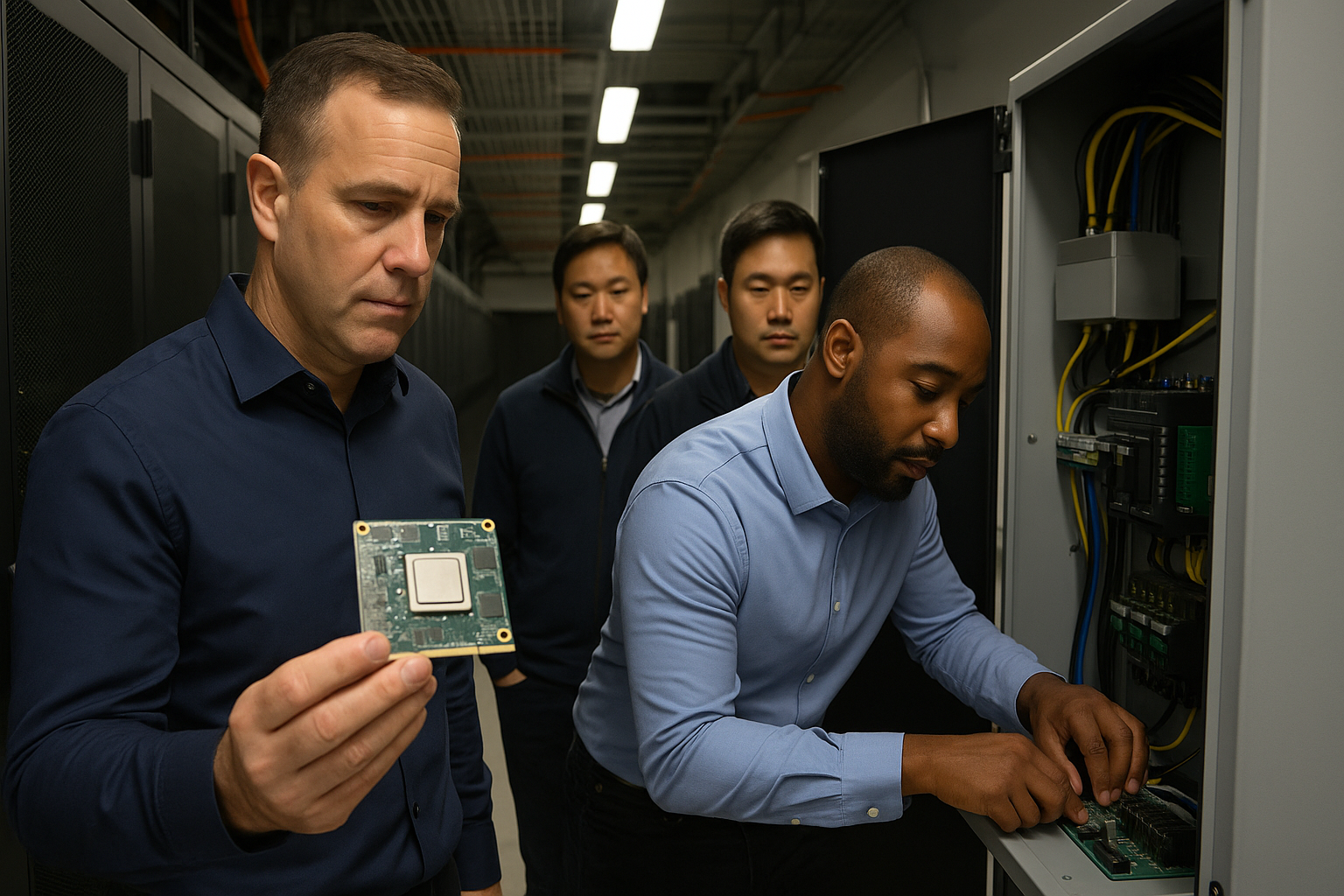
A $40,000 chip is useless if you cannot feed it electricity cleanly.
AI has a power problem, and it is far more expensive than most investors realise.
Everyone is fighting over GPUs, model weights and data centres. Meanwhile, the bloke selling the electrical plumbing closest to the chip may end up with the better business. Navitas Semiconductor’s deal to buy Claros for up to $232.8 million is a small deal by AI standards. It is also a very loud signal about where the real bottleneck has moved.
Navitas is paying for the last few centimetres
Navitas announced on August 24 that it had signed a definitive agreement to acquire Claros, a power-management company building vertical power delivery and integrated voltage regulator technology for next-generation AI data centres.
That sounds like the sort of sentence people skip while waiting for the next Nvidia earnings report. Don’t.
The deal is valued at up to approximately $232.8 million, calculated using Navitas’s August 21 closing share price of $12.97. About $216 million is due at closing through a mix of cash and Navitas Class A shares. More specifically, Navitas expects to pay roughly $126.4 million in cash and $89.7 million in stock, or about 6.9 million shares. The remaining $16.7 million is an earnout payable in stock if Claros hits agreed business milestones during the two years after closing.
There is another $28.9 million of potential performance stock units earmarked for certain continuing Claros employees, tied to those same milestones. That matters. Navitas has not simply bought some patents and hoped for the best; it has made the people who built the thing financially responsible for making it work inside a much larger company.
The transaction still requires regulatory clearance and other customary conditions, with closing expected before December 31, 2026. So this is not a completed victory lap. It is a bet.
But it is an unusually clear bet: AI computing is running into a physics problem, and Navitas wants to own more of the answer.
The boring bits of AI are becoming the valuable bits
Claros makes technology that helps deliver power directly beneath or inside the chip package or circuit board. The aim is to shrink the distance electricity has to travel from inches to millimetres.
Why should anyone outside a semiconductor lab care?
Because high-performance AI chips operate at very low voltages while demanding absurd amounts of power. Move that power around inefficiently and you create losses, heat and instability. That means less useful compute from the expensive equipment already sitting in the rack.
Navitas calls this the AI infrastructure “power wall.” Corporate language aside, the problem is real: AI server racks are getting denser, hotter and more power-hungry. The traditional approach to transforming and distributing electricity through the data centre is being pushed harder every year.
Navitas already sells gallium nitride, or GaN, and silicon carbide, or SiC, power semiconductors. Those technologies sit further up the electrical chain, where the job is converting and managing high-voltage power efficiently. Claros brings the low-voltage, close-to-the-processor piece: vertical power delivery and integrated voltage regulation.
Put simply, Navitas wants to go from selling a component in the power system to offering something closer to a full grid-to-xPU platform. “xPU” is industry shorthand for the expensive processing units doing the AI work: GPUs, CPUs and specialised accelerators.
That is the strategic leap here. The company is buying its way closer to the point where infrastructure pain is most acute and customer switching costs can become much nastier.
A $232.8 million deal with an $8 billion story attached
Navitas says the acquisition will more than double its identified 2030 serviceable addressable market to more than $8 billion.
Take any “addressable market” figure with a healthy dose of scepticism. Founders and listed companies love drawing enormous circles around markets they would like to enter. A market slide is not revenue. It is barely even a plan.
Still, the breakdown is worth looking at. Navitas puts the opportunity at $3.5 billion for GaN and high-voltage or ultra-high-voltage SiC, another $3.5 billion for vertical power delivery and integrated voltage regulation, and about $1 billion for junction field-effect transistor technology.
The important bit is not the neat $8 billion total. It is the timing.
Navitas says its existing short- to mid-term financial plan for 2027 and 2028 remains unchanged. It does not expect Claros to materially alter its path to profitability in that period. The company expects the new technology to become a growth accelerator from 2028 and 2029 onward.
That is refreshingly honest, by the standards of AI dealmaking. There is no pretence that buying Claros magically turns next quarter into a bonanza. Navitas is paying now for a position in an infrastructure transition that it believes will matter later.
This is how sensible strategic M&A should work. Buy capability before every competitor agrees it is indispensable and the price is ten times higher. Then tie part of the payout to delivery, because a clever technology that does not win customers is just an expensive science project.
The second-order consequence: chips are not the only tollbooth
The fashionable AI trade has been obvious: own the companies that make the compute, own the companies that rent the compute, own the companies that build the sheds full of compute.
That trade may keep working. But the next layer is forming underneath it.
Every increase in AI rack density puts pressure on power conversion, power distribution, cooling, backup systems, transformers, grid connections and physical packaging. If a data centre cannot reliably deliver usable power to its processors, its billion-dollar chip order turns into very expensive furniture.
This is why Navitas’s move is more interesting than its price tag suggests. The company is trying to sit across multiple points in the electrical chain rather than be squeezed into one commodity component category.
It also changes the customer conversation. Instead of pitching a single part to an equipment manufacturer, Navitas can attempt to solve a broader engineering problem for hyperscalers, power original-equipment manufacturers, original-design manufacturers and chip vendors. Broader technical ownership can mean deeper customer relationships. Deeper relationships can mean earlier design wins. Earlier design wins can mean that competitors arrive after the architecture has already been chosen.
That is where margins live.
The risk, naturally, is that Navitas is buying a roadmap rather than a mature revenue engine. Claros launched in 2024. Its technology has to prove itself in a brutal environment where reliability is not a nice-to-have and qualification cycles take time. The company also has to integrate a specialist team without suffocating the very engineering speed it paid to acquire.
There is no shortcut around that. Semiconductor deals are won in product qualification, manufacturing execution and customer trust—not in PowerPoint.
The overlooked angle: this is a disciplined deal, not AI panic buying
The lazy read is that every company with “AI” in the slide deck is buying anything with a circuit board and a decent acronym.
I don’t buy it in this case.
First, the structure is sensible. More than 90% of the stated purchase price is allocated to closing consideration, but $16.7 million is held back behind two years of milestones. The additional $28.9 million in employee performance stock also gives the Claros team a reason to stay and execute. Navitas has used shares for a meaningful portion of the price, preserving some cash while making sellers participate in the acquirer’s outcome.
Second, the deal fills a specific hole. Navitas had high-voltage power technology. Claros sits much closer to the processor. That is adjacency with a commercial purpose, not diversification by boredom.
Third, management has not promised a near-term miracle. The expected acceleration begins in 2028 or 2029. Frankly, I trust a deal more when the buyer admits the cheque clears long before the payoff arrives.
The uncomfortable truth for founders is this: strategic buyers do not pay top dollar because your technology is clever. They pay because your technology removes a constraint in a system they already need to own. Claros appears to have done exactly that.
What this means for you
For founders, the lesson is painfully practical: stop describing your product as a feature and start identifying the bottleneck it removes.
Ask three questions tomorrow morning. What part of your customer’s system breaks first as demand scales? What becomes materially more expensive, slower or riskier? And can you prove that your product fixes that problem in a way that makes switching away from you inconvenient?
That is how you become acquisition-worthy. Not by collecting buzzwords. By becoming the missing piece in someone else’s much larger machine.
For operators, remember that the bottleneck is rarely where the glamour is. If you are building with AI, do not just budget for software licences and compute capacity. Map the dependencies underneath your growth plan: power, connectivity, suppliers, compliance, data quality, people and cash. The thing you dismiss as operations can be the thing that stops the whole business.
For investors, this is a reminder not to chase only the obvious headline names. The richest picks-and-shovels businesses are often not selling the shovel. They are selling the hard-to-replace component that lets the shovel work at scale.
Navitas has not solved AI’s power problem yet. It has paid up to $232.8 million for the right to try. But that is the point: as AI moves from a software story to an industrial buildout, the winners will increasingly be the companies that make the physical system work.
The chips get the attention. The electricity gets the cheque.