Nike Names Jane Ewing CCO After $46.4B Flatline
$46.4 billion in revenue. Zero reported growth. Nike has put Jane Ewing in charge of fixing where, how and why customers buy its gear.
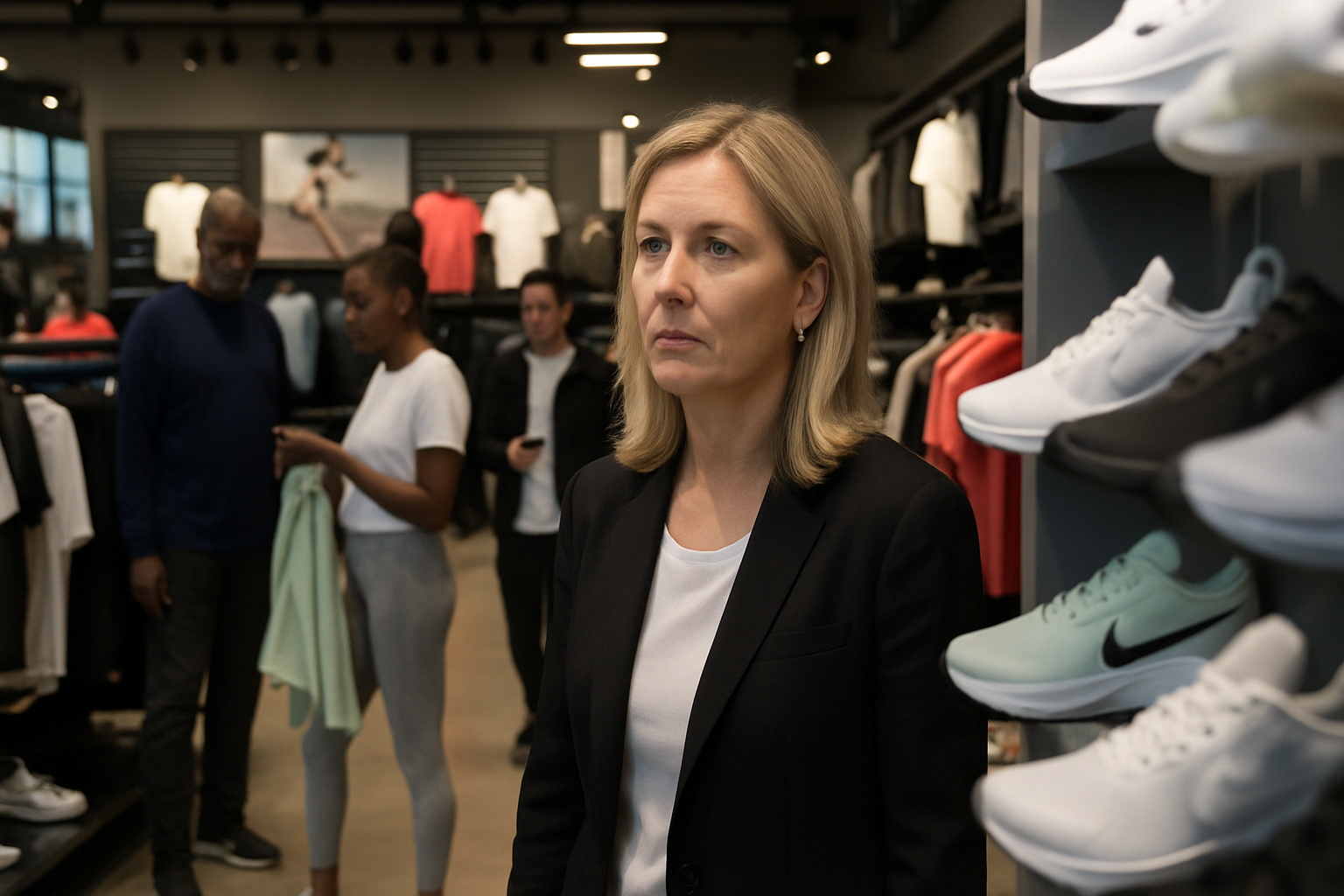
$46.4 billion in revenue. Zero reported growth.
That is Nike’s fiscal 2026 scorecard — and it is why the world’s biggest sportswear brand has put Jane Ewing in charge of fixing where, how and why customers buy its gear.
Today, September 7, Nike has handed Ewing the job that matters most in its comeback: Executive Vice President and Chief Commercial Officer. She will run the global Marketplace organisation, covering Sales and Nike Direct, and report straight to CEO Elliott Hill.
This is not just another senior hire with a shiny title. It is Hill admitting that Nike’s commercial machine needs one owner, one scoreboard and far less internal nonsense.
Nike’s problem was never just product
For years, Nike behaved as if owning the customer relationship meant it had to own every part of the sale.
The logic behind direct-to-consumer was seductive: sell more through Nike’s own stores and apps, collect richer customer data, protect margins, own the relationship. On a spreadsheet, it looked brilliant. In the real world, it created gaps in distribution, strained wholesale relationships and made Nike less visible in the places people actually shop.
Customers do not wake up desperate to validate a channel strategy. They want the shoes they want, in their size, where they already buy shoes.
Nike’s own fiscal 2026 filing tells the story without the PR perfume. The company generated $46.4 billion in revenue, versus $46.3 billion a year earlier — flat in reported terms and down 2% on a currency-neutral basis. Meanwhile, Nike Brand wholesale revenue rose to $27.5 billion, from $25.9 billion the year before.
That matters because the issue was not simply whether Nike could sell product. It was whether its channels were working together instead of pulling in different directions.
That is why Ewing’s appointment matters. Nike has explicitly put both global sales and Nike Direct under her control. Erica Bullard, vice president of Global Sales; Shannon Glass, vice president of Nike Direct; and Gail Cornelius, vice president of Geo & Marketplace Analytics, will report to her.
That reporting line is the whole bloody point.
Before this, the normal corporate disease was available: the digital team wants online growth, the wholesale team wants better partners, the brand team wants premium presentation, finance wants margin, and everyone can produce a slide explaining why someone else is the bottleneck.
Ewing now owns the argument and the outcome.
Elliott Hill is rebuilding the commercial engine, not polishing it
Hill’s stated turnaround plan is called “Win Now,” which is a slightly dramatic name for something every operator should understand: get the basics right before the market decides you are irrelevant.
Nike says it is repositioning Nike Brand Digital as a full-price platform while reinvesting in wholesale distribution. That means clearing old inventory through markdowns in Nike Direct, accepting higher returns and discounts with wholesale partners, and making room for newer product.
None of that is glamorous. It is also exactly what a serious turnaround looks like.
When you have too much inventory, you do not have a marketing problem. You have a cash, product and decision-making problem. Discounting can clear the decks, but it also trains customers to wait for sales. Giving wholesale partners better economics can win back shelf space, but it can pressure margins. Rebuilding physical retail presentation costs money before it produces a cent.
The important detail is that Nike expects these marketplace actions to run through December 2026. North America has made the most progress, according to Nike’s filing. Greater China and Converse will take longer.
That timeline matters. This is not a clean handover after the ugly work is done. It is a live reset, with markdowns, partner concessions and uneven progress still running through the business.
So Ewing is not arriving after the hard work. She is arriving while the company is still paying for it.
Her background explains the choice. Nike says she spent almost 14 years at Walmart, most recently as interim CEO of Sam’s Club China, where she oversaw a multibillion-dollar membership business across 30 cities during a leadership transition. Earlier, she held roles across merchandising, digital acceleration and international operations. Before Walmart, she led a major global division at Diageo.
That is not the standard Nike pedigree of brand storytelling and product worship. It is a commercial operator’s résumé: complicated markets, big teams, customer behaviour, physical retail, digital retail and messy handoffs.
Exactly what Nike needs.
The overlooked angle: Nike is fixing decision rights
Most people will read this as a personnel story. “Nike hires Walmart executive.” Fair enough. That is the headline.
But the more useful read is that Nike is redesigning who gets to make trade-offs.
A business gets slow when the person accountable for revenue cannot control the levers that create it. That is how you end up with a direct channel chasing its own growth target while wholesale partners are understocked; a brand team demanding full-price positioning while the warehouse is full; and a finance department calling for cleaner margins while the customer has quietly moved on to a competitor.
Nike previously placed Global Sales and Nike Direct under its finance leadership as part of a December 2025 management reshuffle. Now it has created a dedicated chief commercial officer role for Ewing, directly under the CEO.
Read that for what it is: commercial execution is no longer being treated as an extension of finance or a side project of brand strategy. It is being elevated into its own command centre.
The change only works if the authority is real. A chief commercial officer cannot fix a marketplace if every meaningful call still needs to survive a tug-of-war between digital, wholesale, brand and finance.
That is why the structure matters more than the title. Ewing has sales, Nike Direct and marketplace analytics beneath her. That gives one leader visibility across demand, distribution and the customer path — the places where businesses usually hide their excuses.
That is sensible. But it is not magic.
Ewing can align the channel leaders. She cannot manufacture demand for stale product. She cannot wish away pressure in China. And she cannot make a turnaround painless for retailers, employees or investors.
Her real job is harsher: decide where Nike should be available, what it should protect, what it should discount, which partners deserve investment, and where the company must stop kidding itself.
Good commercial leadership is partly about making sales. Mostly, it is about making fewer stupid compromises.
Why the Walmart experience may be more valuable than a sneaker résumé
Here is the contrarian view: Nike did not need another footwear insider for this role.
It needed someone who understands retail as an ecosystem rather than a collection of channels fighting for credit.
Walmart is not a premium sneaker brand, obviously. But it is ruthlessly useful training for marketplace complexity. You learn that availability matters, pricing matters, partners matter, store execution matters and customer habits outrank head-office theories.
Nike’s recovery depends on precisely that kind of discipline.
The company wants Nike Direct to be a full-price destination. Fine. It should be. A great owned channel gives Nike control over storytelling, data and launch experiences. But direct cannot become a religious belief. If wholesale partners put Nike in front of customers Nike cannot reach efficiently on its own, then wholesale is not a lower-status channel. It is distribution muscle.
The same applies in reverse. Wholesale cannot be a dumping ground for product Nike failed to sell itself. Partners can smell desperation. If Nike wants better shelf space, better storytelling and better economics, it has to give retailers a reason to back the brand hard.
That balancing act is Ewing’s mandate.
It is also the test. Nike does not need its channels to agree on everything. It needs them measured against the same commercial outcome, with someone senior enough to settle the fight.
The number that should worry Nike
The $46.4 billion revenue figure is the headline. The more telling number is zero: zero reported growth for the full year.
At Nike’s scale, standing still is not neutral. The market keeps moving. Competitors keep taking shelf space, athlete mindshare and customer attention. Fashion shifts. Running shifts. Football shifts. China shifts. Digital acquisition gets more expensive. Consumer patience gets shorter.
A giant company can tolerate a reset. It cannot tolerate permanent drift.
That is the real commercial risk in a flat year. A business can tell itself it is protecting margin, cleaning inventory or preserving brand position. Maybe it is. But if customers cannot find what they want in the places they want to buy it, the market does not care about the internal logic.
Hill appears to understand that. His leadership changes since taking over have repeatedly moved decision-makers closer to the actual work: product, marketing, consumer and sport, geography, sales and now the integrated marketplace.
That is the right instinct. A turnaround does not start with a motivational speech. It starts when the organisational chart stops protecting old assumptions.
What this means for you
Whether you run a startup, a division or a modest family business, take three lessons from Nike’s move.
First, put one person in charge of the customer journey. If sales, marketing, e-commerce, partnerships and customer success all have separate goals, your customer will experience the gaps between them. Give someone real authority across the handoffs — not a fancy title without control.
Second, do not confuse channel ownership with customer ownership. Your website is not automatically your best channel. Your store, distributor, marketplace, sales team or strategic partner may reach customers more effectively. Go where customers already have trust and intent. Pride is an expensive distribution strategy.
Third, name the trade-off and make it quickly. Nike is accepting markdowns and partner concessions to clear inventory and create capacity for better product. That hurts. But dead stock, muddled positioning and slow decisions hurt more. In your own business, identify the thing you are preserving because admitting it failed would sting — then decide whether it is costing you growth.
Ewing has not been hired to make Nike’s org chart prettier. She has been hired because a $46.4 billion company cannot afford another year of commercial drift.
That is the standard. One owner. One marketplace. No excuses.