Nvidia’s $5.8T Rally Is Ignoring 5.35% Treasury Yields
A 5.35% US 10-year yield should be ruining the party. Instead, Nvidia is worth $5.8 trillion and the Nasdaq keeps making records — which is either brilliant or bloody dangerous.
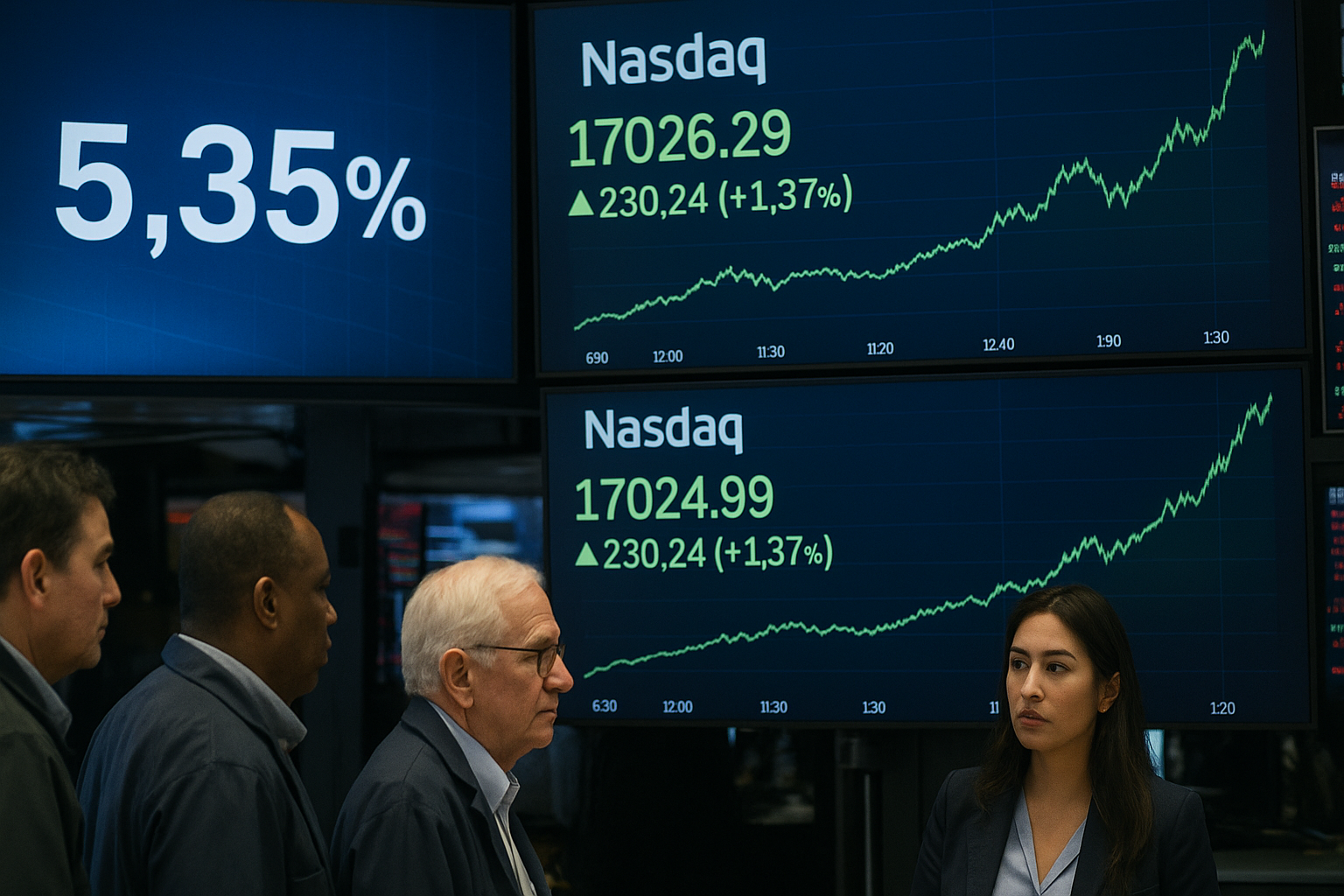
A 5.35% US 10-year Treasury yield should be punching growth stocks in the teeth. Instead, Nvidia is valued at about $5.8 trillion and the Nasdaq has just closed at a record.
That is not normal. It might be rational. But don’t kid yourself: the market is currently betting that earnings growth will outrun the cost of money, higher energy prices, inflation pressure and a government debt load that is getting harder to ignore.
That is a big bet. And when everybody is making the same big bet, you don’t need to panic — but you do need to stop being lazy.
The market is treating 5.35% like a rounding error
On October 5, the US 10-year Treasury yield briefly hit 5.35%, its highest level since 2002. The 30-year yield had also touched 5.70%, another level not seen since 2002. These are not cute little moves that only matter to bond nerds in windowless offices.
The 10-year Treasury yield is one of the world’s most important prices. It influences the rate at which governments borrow, mortgages get priced, companies refinance debt and investors decide whether a speculative growth stock is worth the bother.
When that yield rises, the maths gets uglier for expensive assets. A dollar of profit expected years down the track is worth less today. Startups need to offer investors a bigger potential return to raise money. Private-equity deals become harder to finance. Property values get squeezed. Mature businesses carrying too much debt get exposed for what they are: businesses that looked healthy only because money was cheap.
Yet US equities have kept charging. The S&P 500 finished October 5 just 0.6% below its mid-August high. The Nasdaq closed at a record, helped by Nvidia and Microsoft. On October 6, lower oil prices and a small pullback in yields gave equities another shove higher.
The conventional explanation is simple: investors believe the AI boom and strong corporate earnings will overwhelm the damage from higher rates.
Maybe. But “maybe” is doing some heavy lifting.
Nvidia is not the whole market — except it increasingly is
Nvidia at roughly $5.8 trillion is the obvious symbol of this moment. It is not a small company being bid up by meme-stock punters. It is a wildly profitable, strategically important supplier of the hardware underpinning the AI buildout.
That distinction matters. The company has real customers, real demand and real earnings power. Calling every successful technology leader a bubble is lazy analysis.
But a brilliant company can still become an expensive share. Those are two separate questions, and investors routinely mash them together when enthusiasm gets hot.
Nvidia’s valuation is now a market-wide issue because the AI trade has become a feedback loop. The largest technology companies spend enormous sums on computing infrastructure. That spending drives revenue for chipmakers, data-centre operators and software suppliers. Investors see the revenue, reward the shares, and then become more willing to fund the next round of infrastructure spending.
It works beautifully until the return on all that spending starts falling.
The second-order risk is not that AI suddenly turns out to be useless. That ship has sailed. The risk is more boring and more dangerous: too much capital chasing the same opportunity, with returns spread across too many businesses and too few buyers willing to pay enough for the end product.
I have seen versions of this in business. A genuine opportunity appears. Smart people pile in. Then less smart people pile in. Then the original opportunity gets buried under overpriced leases, excessive headcount, vanity projects and forecasts written by blokes who have never missed a payroll.
AI may transform the economy. That does not mean every dollar spent on AI infrastructure will earn a decent return.
The bond market is telling a less comfortable story
The rise in yields is not happening in a vacuum. Inflation concerns have been reinforced by high oil prices linked to the US-Iran conflict, while stronger economic data has also raised the prospect that the Federal Reserve may need to keep monetary policy tighter than investors would prefer.
The September ISM services report captured the awkwardness nicely. Services activity eased slightly, but the prices-paid index jumped to 74.0, its highest reading in more than four years. New orders remained strong and the employment component moved back into expansion.
That is not a clean recession signal. It is arguably worse for markets in the short term: an economy that is still active enough to maintain inflation pressure.
Investors would love a Goldilocks outcome — growth strong enough to support earnings, inflation soft enough to allow lower rates, and energy prices calm enough not to ruin household budgets. Markets have spent years training themselves to expect precisely that sort of rescue.
But the bond market is asking a rude question: what if long-term money stays expensive?
Treasury Secretary Scott Bessent has argued that the lift in US yields tracks a global trend rather than an America-specific loss of confidence. He has also said growth and spending restraint can bend the trajectory of US government borrowing.
Fair enough. But markets don’t care whether the cause is technically “idiosyncratic” when the bill arrives. Businesses still refinance at the prevailing rate. Homebuyers still face the mortgage rate. Governments still pay interest. And investors still have an alternative to a richly priced share: an increasingly attractive risk-free yield.
That last bit is the one people forget during a bull market.
The overlooked angle: higher yields can be healthy — until they aren’t
Here is the contrarian view: rising yields are not automatically a disaster.
If yields rise because the economy is stronger than expected, businesses are investing, productivity is improving and wages are being supported by real demand, that is not bearish by default. A strong economy can support higher rates and higher profits at the same time.
That is partly why shares have held up. Investors are looking at the rise in yields and deciding it reflects economic resilience rather than a full-blown fiscal or inflation crisis.
The trouble is that the market may be giving itself too much credit for making that distinction. Yield moves are rarely caused by one thing. Growth, inflation, fiscal deficits, Treasury supply, geopolitical risk and central-bank expectations can all be moving at once.
The current setup has an especially unpleasant feature: there is less room for error. If oil drops, inflation cools and earnings remain exceptional, the market’s optimism will look clever. If oil rises again, long yields resume their climb and companies disappoint during earnings season, the same valuations will look absurdly fragile.
That does not require a 2008-style collapse. It simply requires investors to remember that paying a huge price for future perfection is a risky habit.
A 10% correction in the shares most exposed to AI expectations would not prove AI is dead. It would prove valuation still matters. That is a distinction worth tattooing on the inside of your eyelids.
The cost of capital is back, and operators need to behave accordingly
For founders and operators, this is not just a stock-market chat. Higher long-term rates change the rules of the game.
If you run a business that needs external capital every 12 months, you are more vulnerable than you think. If your plan relies on refinancing cheap debt, you have a problem. If your valuation assumes somebody will pay more for revenue growth regardless of margin, you are living in the old world.
The companies that win when capital is expensive are usually not the flashiest. They have pricing power, healthy gross margins, manageable debt, cash conversion and customers who would notice if the product disappeared tomorrow.
That sounds obvious. It is also why it gets ignored when capital is cheap. Cheap money lets average businesses pretend they are exceptional for longer than they deserve.
For investors, the point is not to dump every technology share and hide under the doona with a tin of beans. The point is to stop treating an index fund or an AI basket as though it is automatically diversified just because it owns hundreds of names.
If a handful of mega-cap companies are driving index returns, then you have concentration risk whether you meant to buy it or not.
What this means for you
First, look at your exposure. Not your feelings — your exposure. Check how much of your portfolio is tied to Nvidia, Microsoft, other mega-cap AI names, tech-heavy ETFs and funds whose top holdings are the same companies wearing different labels.
Second, stop financing long-term ambition with short-term money. If you are building a business, model what happens if funding takes twice as long, costs more and arrives with tougher terms. A runway that only works in a friendly market is not runway. It is a hope-based accounting entry.
Third, make cash flow more important than the story. Growth matters, but cash gives you choices when markets get selective. Choices are what keep founders alive and let investors buy when other people are forced to sell.
Fourth, do not confuse a high Treasury yield with a reason to abandon equities. It is a reason to demand better value, better balance sheets and a clearer answer to one question: why should I take this risk when I can get paid more to take less?
That is the whole game now. Nvidia and the Nasdaq may keep proving the sceptics wrong. They may well earn it.
But when the supposedly boring 10-year Treasury is paying 5.35%, the market no longer gets to wave away bad decisions with a PowerPoint deck and the phrase “AI opportunity.”