Omron’s $675M OnLogic Deal Is a Bet on Factory Brains
Most AI acquisitions are expensive theatre. Omron just spent $675 million on the unsexy bit that decides whether factory AI works at all.
Most AI acquisitions are expensive theatre. Omron just spent $675 million on the unsexy bit that decides whether factory AI works at all.
On October 13, Omron announced it would buy Vermont-based industrial-computer maker OnLogic and its parent, Interlogic, in a deal valued at $675 million. That sounds modest beside the silly money being thrown at model makers and data-centre infrastructure. It isn’t. This is a far more practical bet: buy the computers that sit on the factory floor, next to the machines, where software has to make a decision before something expensive breaks. ([investing.com](https://www.investing.com/news/stock-market-news/japans-omron-to-buy-us-industrial-pc-firmonlogic-for-675-million-in-physical-ai-push-4945294))
Omron is buying the part of AI that has to work on Tuesday morning
The deal is for 100% of Interlogic, the parent of OnLogic. Omron says it will pay cash, mainly from money already on hand, using a reverse triangular merger structure through a US special-purpose subsidiary. OnLogic will keep its name, direct-sales model and existing management team, led by CEO Sean Larkin. ([omron.com](https://www.omron.com/jp/ja/news/2026/10/c1013.html?utm_source=openai))
That last bit matters more than the press-release fluff usually does.
OnLogic does not make another dashboard for executives to admire between airport lounges. It develops, manufactures and sells rugged industrial PCs: configurable machines built for warehouses, manufacturing lines, vehicle fleets, remote infrastructure and other places with heat, vibration, dust, unreliable connectivity and no patience for a cloud outage.
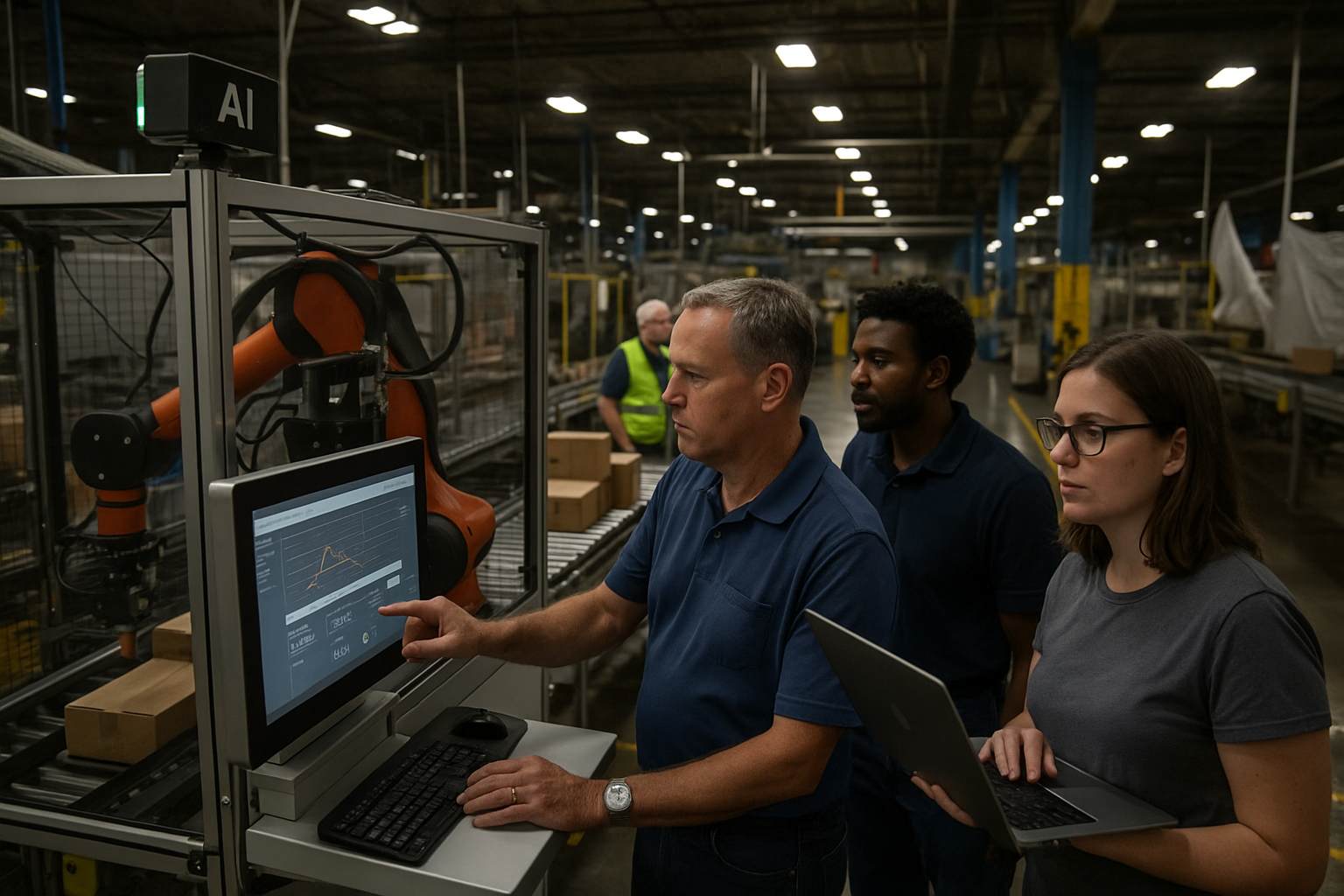
In plain English: this is the computing layer between a camera seeing a defect and a machine rejecting the defective part. Between a forklift getting too close to a person and an alert arriving in time to matter. Between a sensor picking up a problem and an automated system acting on it.
Omron calls the prize “physical AI”. Fine. The phrase has already been worked pretty hard by people selling slide decks. But the underlying idea is real: AI becomes much more valuable when it can sense, decide and act in the physical world rather than merely generate another paragraph, image or meeting note.
OnLogic has been demonstrating exactly those sorts of edge-computing applications, including factory safety systems, machine-vision quality inspection and workloads run locally rather than sent to a distant cloud. The local bit is the point. If a factory process needs instant action, latency is not an academic problem. It is lost output, damaged equipment or somebody getting hurt. ([onlogic.com](https://www.onlogic.com/about/news/onlogic-automate-2026/?utm_source=openai))
The $675 million price tag is really for distribution and speed
Here is the smarter reading of the deal: Omron is not simply buying boxes with processors in them.
It is buying a route into customers it wants, in markets where it needs more depth. Omron says more than 90% of OnLogic’s sales come from the Americas and Europe, and it wants to use that customer base to cross-sell both companies’ products. That gives Omron a more direct path into the very customers buying automation, sensors, controls, robotics and industrial computing as one connected problem. ([omron.com](https://www.omron.com/jp/ja/news/2026/10/c1013.html?utm_source=openai))
That is why the company is preserving OnLogic as an independent operation. Founders and acquirers love saying that after a deal. Often it lasts until the first budgeting cycle. But in this case, keeping the brand and management intact makes commercial sense.
OnLogic has a direct-sales, build-to-order model. Omron is a massive industrial automation group with channel relationships, product lines and layers of process. You do not spend $675 million to acquire a nimble customer engine and then suffocate it with your corporate calendar invites. Or at least, you shouldn’t.
There is another useful detail buried in the mechanics. Interlogic’s founders, Roeland and Lisa Groeneveld, controlled 91.94% of the equity as of October 9, while 167 employee shareholders held the remaining 8.06%. Omron’s merger structure allows it to acquire all shares in one go rather than chase individual transfers. That is not glamorous, but it tells you this was a properly engineered transaction, not a loose strategic partnership dressed up as M&A. ([omron.com](https://www.omron.com/jp/ja/news/2026/10/c1013.html?utm_source=openai))
Omron is changing its portfolio, not just adding a shiny AI badge
The purchase also makes more sense when you look at what Omron has been doing this year.
In March, the company agreed to sell its Device & Module Solutions business to Carlyle. That business is rooted in components such as relays, switches and sensors. Carlyle said the standalone business would need faster decision-making and more agile investment to compete globally. ([carlyle.com](https://www.carlyle.com/media-room/news-release-archive/carlyle-announces-strategic-partnership-omron%E2%80%99s-device-module))
Then Omron turns around and spends $675 million buying into edge computing and industrial AI.
That is portfolio surgery. Sell a business where ownership is no longer the best way to win. Buy capability where ownership might matter a great deal.
Omron’s Industrial Automation Business generated ¥409.5 billion in revenue in fiscal 2025, up 12.3%, while the group projected ¥820 billion in fiscal 2026 revenue and ¥62 billion in operating profit. It has been leaning into semiconductor investment, battery manufacturing, inspection systems and factory automation tied to AI demand. ([omron.com](https://www.omron.com/global/en/assets/file/ir/irlib/20260513_presentation_script_e.pdf))
The company is also explicit about its agenda: more high-value products, more R&D, more data flow from the factory floor, and a bigger customer base. It plans to launch 22 new products in fiscal 2026. Buying OnLogic gives it a computing platform that can help bind those ambitions together. ([omron.com](https://www.omron.com/global/en/assets/file/ir/irlib/20260513_presentation_script_e.pdf))
This is what competent M&A should look like. Not “we need an AI story because the market likes AI.” More like: “we already have control, sensing and robotics; we need more capable compute at the edge, stronger US and European customer access, and a faster way to turn all of it into a working system.”
That is a thesis. Whether Omron can execute it is another matter.
The overlooked risk: hardware is not the hard bit, integration is
Let’s not get carried away. Buying OnLogic does not automatically make Omron the winner in physical AI.
Industrial customers do not buy “AI” in the abstract. They buy uptime, safety, throughput, lower scrap, fewer labour bottlenecks and a payback period they can defend to a finance director. If the combined Omron-OnLogic offer becomes a beautiful technical bundle that takes 14 months to specify and another six to integrate, customers will go elsewhere.
The real work begins after closing.
Omron must make its sensors, control systems, robots and software easier to deploy with OnLogic hardware. It needs simple reference architectures for actual jobs: visual inspection, predictive maintenance, warehouse safety, energy optimisation, line control. Not a menu of 400 compatible components and a cheery invitation to call a systems integrator.
The greatest risk is the usual big-company disease: confusing ownership with capability. Omron can own the industrial PC maker and still fail to make the combined offer simple enough to buy, install and support.
The company’s shares were roughly flat in Tokyo after the announcement, even as the Nikkei 225 fell about 2.2%. That is not a verdict on the deal. But it is a reminder that investors have not awarded Omron instant genius points for saying “physical AI”. Sensible people will wait for revenue, margin and customer wins. ([investing.com](https://www.investing.com/news/stock-market-news/japans-omron-to-buy-us-industrial-pc-firmonlogic-for-675-million-in-physical-ai-push-4945294))
The contrarian angle: boring infrastructure may beat glamorous AI
The market has spent years obsessing over the most visible part of AI: models, chips and data centres.
But plenty of durable value will be built in the plumbing.
The companies that help a plant collect reliable data, run inference locally, connect old equipment, manage security, control machines and prove a return on capital may not get the loudest headlines. They may, however, own the customer relationship where budgets actually get approved.
That is why this deal is more interesting than it first appears. Omron is buying a potential control point. If OnLogic hardware becomes the standard edge-computing platform inside a wider Omron automation stack, Omron gets a better chance to sell more of everything around it.
And if it does not? It has paid $675 million for a capable, internationally positioned industrial PC company with an established customer base, rather than a pre-revenue AI startup promising to revolutionise factories sometime after the next funding round.
That is a far more grown-up risk.
What this means for you
If you are a founder, stop calling your product “AI-powered” and ask a tougher question: what physical or financial decision becomes faster, cheaper or less risky because we exist? If you cannot answer that in one sentence, you have marketing, not a business.
If you are an operator, look at your bottlenecks. Where does information arrive too late? Where do people manually inspect, reconcile, approve or react? The best automation projects start with a painful, measurable constraint — downtime, defects, injuries, freight cost, wasted energy — not with a technology shopping list.
If you are an investor, pay attention to companies that own a useful layer in a real workflow. The sexy story is rarely the whole profit pool. The money often sits with whoever makes complex systems dependable enough to use every day.
And if you are considering an acquisition, nick Omron’s basic logic: buy what lets you sell more of your existing strength, reach customers you cannot efficiently reach today, or move faster in a market you already understand. Do not buy a fashionable noun. Buy a bottleneck.
That is the difference between doing a deal and building an advantage.