Pixxel’s $100M Series C Is a Bet That Satellites Alone Are a Dumb Business
A satellite is not a business. It is an expensive camera with a terrifying depreciation schedule — unless Pixxel can turn its $100 million into intelligence customers cannot live without.
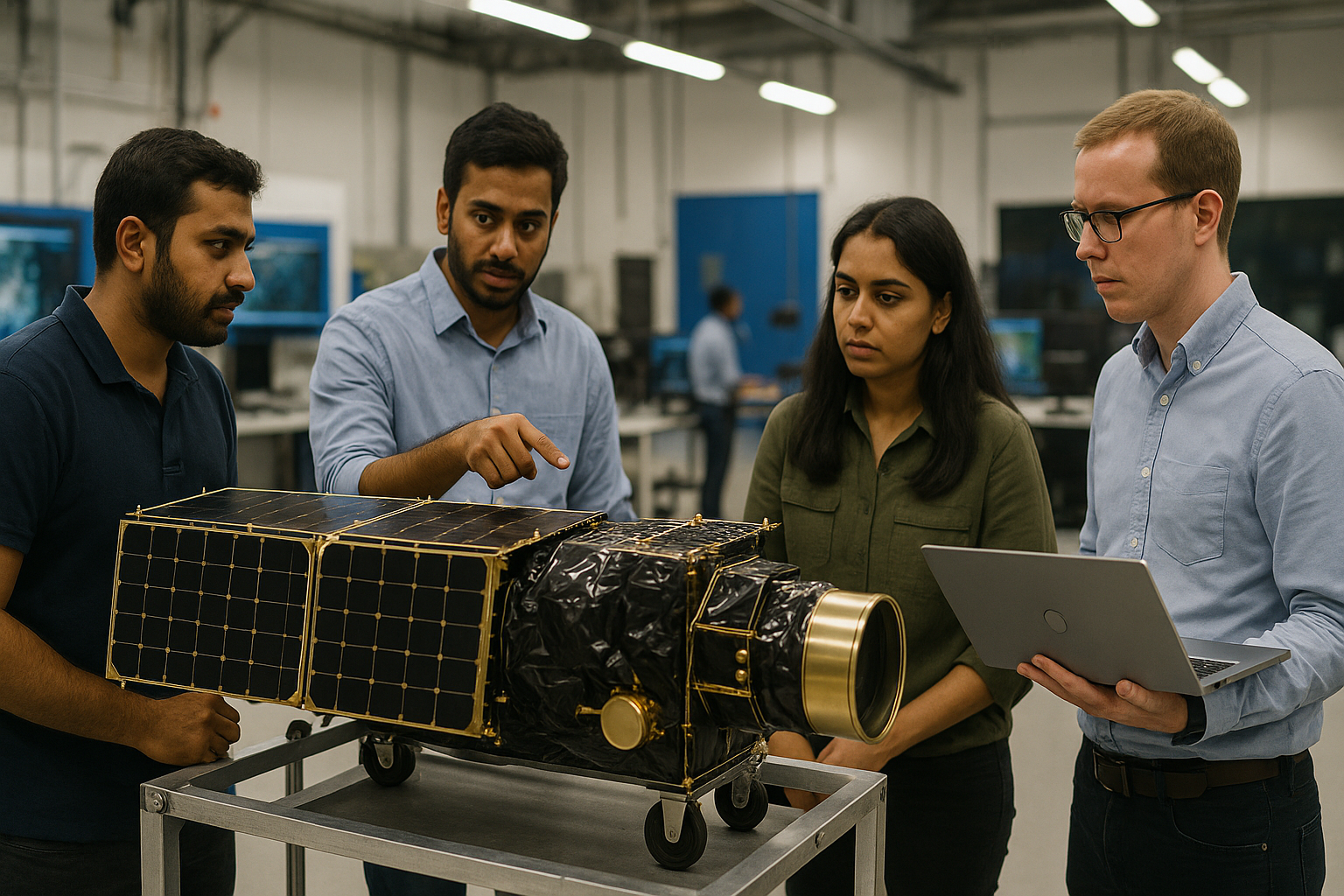
A satellite is not a business. It is an expensive camera with a terrifying depreciation schedule — unless Pixxel can turn its $100 million into intelligence customers cannot live without.
That is the real wager behind Indian space startup Pixxel’s Series C, announced on September 7, 2026. The company has raised $100 million, taking total funding to $195 million, in what it says is the largest funding round ever for an Indian space-technology company. Temasek and Seraphim co-led the round, joined by 360 ONE Asset and IMM Investment, while existing backers including Radical Ventures and growX ventures put more money in.
Good. Now the hard part starts.
Pixxel is trying to sell decisions, not pretty pictures
Pixxel was founded by Awais Ahmed and began with hyperspectral imaging satellites. In plain English: instead of taking ordinary satellite photos, hyperspectral systems capture a much broader range of wavelengths. That can reveal material properties that a conventional image misses.
That matters because a standard satellite image can show you that something is there. Better spectral data can help tell you what it is, what condition it is in, or whether it has changed.
For agriculture, that might mean detecting crop stress before it becomes obvious. For mining, it could help identify geological signatures. For energy and infrastructure, it could help monitor assets and changes across vast areas. For governments, it has obvious civil, defence and intelligence uses.
But here is the bit founders in hard tech need tattooed somewhere painful: having better data does not automatically mean customers will pay more for it.
Customers do not wake up desperate to buy hyperspectral imagery. They wake up wanting to reduce crop losses, find problems earlier, allocate field crews better, protect infrastructure, or make a decision before a competitor does. The imagery is merely the raw ingredient.
Pixxel seems to understand this. It is using the money not only for satellites but to broaden across sensing, software, sovereign space systems and manufacturing. Its Aurora platform is meant to turn Earth-observation datasets into decision-ready intelligence. That move is the whole ballgame.
The satellite gets attention. The software layer is where the business might get good.
The $100 million is buying a much larger ambition
Pixxel has already deployed six Firefly satellites over the past two years, which it describes as the world’s highest-resolution commercial hyperspectral constellation. It has also launched Aurora and secured contracts with NASA and the U.S. National Reconnaissance Office, according to the company.
The Series C is designed to fund four big moves.
First, Pixxel plans to build its next-generation Honeybee hyperspectral constellation, including shortwave infrared capability. Its first Honeybee satellite is expected to launch in 2027.
Second, it plans to add synthetic aperture radar and ultra-high-resolution optical imaging. That matters because the company is not content with being excellent at one sensing modality. It wants a broader stack of ways to observe the planet.
Third, it is investing further in Aurora, the software layer that combines datasets and turns them into usable intelligence.
Fourth, it plans to expand manufacturing capacity in India and the United States while pursuing sovereign Earth-observation systems for governments.
That is not a tidy little software company with a cheerful gross-margin slide. It is an attempt to become vertically integrated across hardware, data and applications. It is capital-intensive, operationally ugly and full of ways to lose money.
Which is precisely why it could matter.
Most founders run from difficult businesses because difficult businesses are difficult. Fair enough. But when a business requires technical talent, capital, regulatory competence, manufacturing know-how, launch relationships, data infrastructure and long sales cycles, it also becomes much harder for some bloke with a slick landing page to copy it over a weekend.
The moat is not the satellite. The moat is getting the entire machine to work reliably, commercially and repeatedly.
India’s space opening created the opportunity. Execution decides who keeps it.
Reuters noted that Pixxel is among the Indian space startups that emerged after the country opened the sector to private players. That policy shift matters more than the usual startup press-release fluff because space has historically been a government-controlled game in much of the world.
A private market changes the incentive structure. Entrepreneurs can move faster. Investors can fund risk. Governments can become customers rather than the only builders. And a country with deep engineering talent can turn capability into companies rather than merely contracts.
But national enthusiasm is not a business model.
The space sector has a habit of attracting people who confuse strategic importance with commercial inevitability. Something can be hugely important to a nation and still be a terrible standalone investment. Plenty of hardware companies have discovered this after raising serious money and discovering that their customers love pilots, panels and press releases far more than long-term contracts.
Pixxel’s early government traction is useful. NASA and NRO contracts are not decorative logos. They provide validation and potentially demanding customers. But government sales can also be slow, procurement-heavy and lumpy. If the company wants to become genuinely large, it needs repeatable commercial demand as well.
That means products that fit into a customer’s existing workflow, prove a financial return quickly and become painful to remove.
The winning pitch is not: “Look at our incredible satellite data.”
It is: “We saved you money, prevented a loss, reduced the time to make a decision, and here is the evidence.”
The overlooked angle: Pixxel is taking on the economics of raw data
There is a glamorous version of the space-tech story: launch satellites, collect data, save the world. Investors love it because it looks like science fiction with a revenue slide appended.
The less glamorous truth is that raw data tends to become cheaper, more available and less special over time.
When more satellites go up, the supply of imagery grows. When AI tools make analysis easier, basic interpretation becomes more accessible. When customers can switch between providers, everyone starts competing on price and imagery becomes a commodity with better branding.
That is why Pixxel’s shift towards a full planetary-infrastructure pitch is more sensible than simply selling images by the square kilometre.
The company is trying to own more of the value chain: collect the data, process it, combine it with other sensing technologies, package it in software and deploy it into sovereign missions. If that works, Pixxel does not just sell a file. It becomes embedded in the decision process.
That is a far better business.
But vertical integration has a nasty habit of creating vertical complexity. More products mean more engineering. More hardware means more supply-chain exposure. More government work means more compliance. More software means higher expectations for reliability and user experience. More manufacturing means more capital requirements before the revenue arrives.
This is where a lot of well-funded founders get drunk on ambition. They add layers because the strategy slide looks brilliant, then discover they have built five businesses badly instead of one business properly.
Pixxel must be ruthless about sequencing. The company does not need to win every sensing category at once. It needs a few markets where its data is distinctly better, its workflow is sticky and its customers have money.
A contrarian view: the biggest risk is not launch failure
Everyone sees the obvious risk: rockets fail, satellites fail, capital dries up, geopolitical tensions complicate supply chains. All real risks.
I think the bigger commercial risk is more boring: Pixxel could become technically impressive but economically vague.
That happens when a company speaks to every industry — climate, agriculture, resources, energy, infrastructure, defence — but does not dominate a must-have use case in any of them. The addressable market sounds enormous. The sales pipeline becomes a museum of endless trials.
Founders love broad optionality. Customers buy narrow certainty.
The test for Pixxel is whether Aurora becomes a product people use daily or merely a nice interface shown during fundraising. Does it shorten a decision? Does it replace an existing budget line? Does it slot into a system a customer already trusts? Can it show a hard dollar return?
If the answer is yes, the satellites become a formidable distribution advantage for proprietary intelligence. If the answer is no, they remain expensive hardware orbiting above a very crowded PowerPoint market.
What this means for you
Whether you build software, sell physical products or invest your own money, Pixxel’s move contains three useful lessons.
First: never confuse the asset with the business. Your code, factory, patent, audience or data set is not the business. The business is the repeatable outcome a customer pays for. Ask yourself: what decision do we improve, what cost do we remove, and what risk do we reduce?
Second: build where value accumulates. If your product creates a commodity output, move closer to the workflow and the result. Pixxel is not stopping at imagery; it is trying to own the intelligence layer. In your world, that may mean analytics, automation, payments, compliance, fulfilment or a service layer. Find the point where leaving you becomes inconvenient.
Third: sequence ambition. Big visions are fine. I have more respect for a founder aiming at planetary infrastructure than another AI wrapper pretending it has changed civilisation. But you earn the right to expand by making one wedge work brutally well first. Pick the customer with the most urgent pain, prove the economics, then widen the map.
Pixxel has $100 million more to prove it can do exactly that. The money is impressive. Turning orbital data into an indispensable operating system for the physical world would be far more impressive.