PlusAI’s $800M SPAC Deal Faces a 2027 Deadline
An $800 million valuation for a truck that still needs a human nearby is not optimism. It is a very expensive deadline.
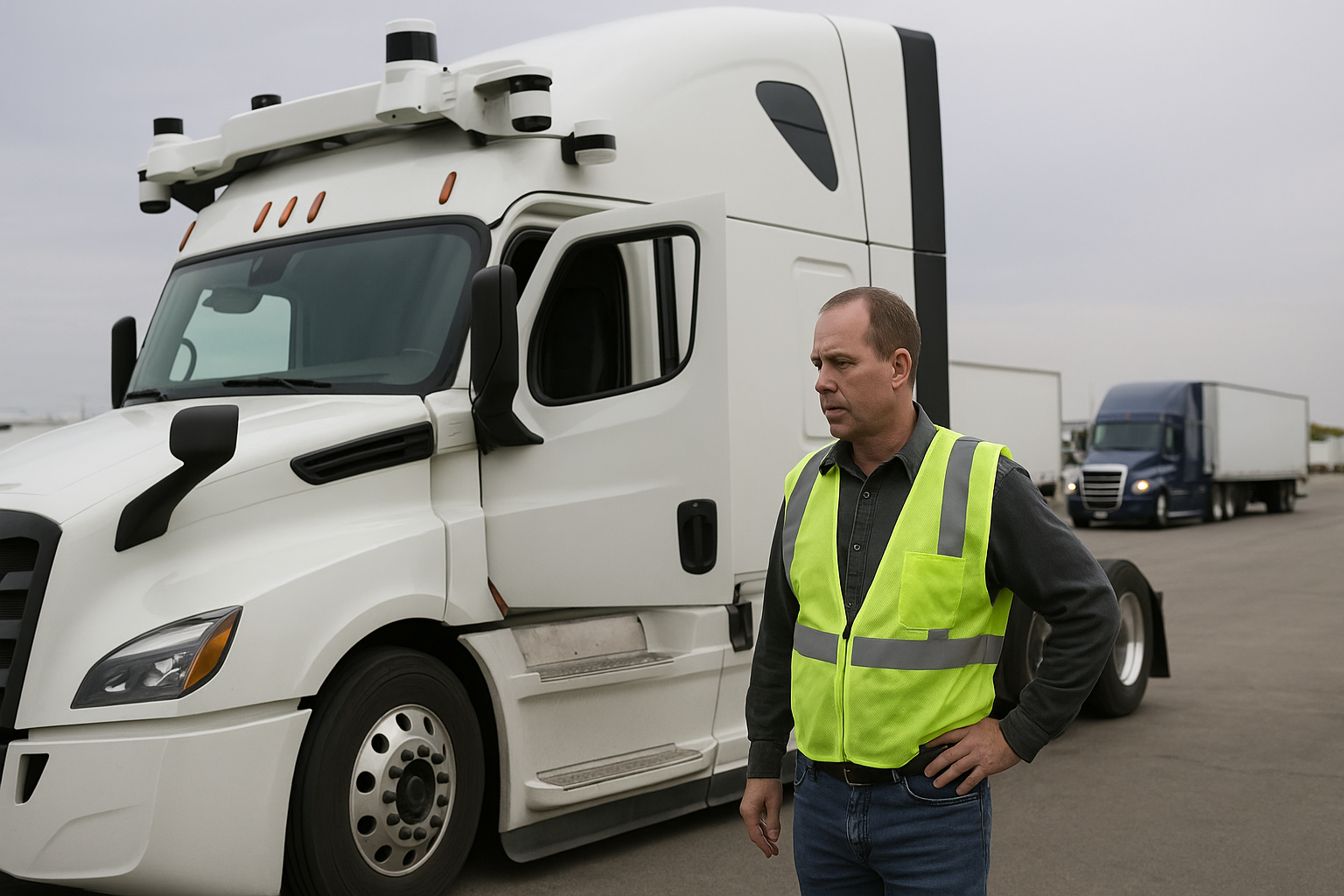
PlusAI is asking public-market investors to value a 2027 promise at $800 million today. That is not optimism. It is a very expensive deadline.
On September 3, PlusAI agreed to merge with Texas Ventures Acquisition III Corp, a SPAC, in a transaction that values the autonomous-trucking software company at roughly $800 million pre-money. The deal could deliver up to $300 million of capital: more than $60 million in committed financing and about $236 million sitting in the SPAC trust. ([sec.gov](https://www.sec.gov/Archives/edgar/data/2033991/000110465926104858/tm2619716d3_ex99-1.htm))
I like a big bet when the economics are real. But this is not a software company getting applause for a slick demo. PlusAI now has to prove that its virtual driver can survive actual freight operations, win factory integration from global truck makers, earn fleet trust and get to commercial launch in 2027. Miss any one of those steps and the $800 million starts looking less like ambition and more like a receipt for optimism.
The deal is really a race against the calendar
PlusAI builds SuperDrive, a Level 4 autonomous-driving system for heavy-duty commercial trucks. Its pitch is refreshingly clear: sell the autonomy software through truck manufacturers rather than own trucks, run a giant fleet or build a sci-fi logistics empire. The OEM installs the system at the factory, sells the vehicle through its existing channels, and PlusAI collects recurring, usage-based revenue as the truck drives autonomous miles. ([sec.gov](https://www.sec.gov/Archives/edgar/data/2033991/000110465926104858/tm2619716d3_ex99-1.htm))
That is the right commercial shape. Owning fleets is a capital-eating nightmare. Manufacturing vehicles is worse. Software embedded in a product that somebody else manufactures, finances, services and distributes? That can be a very good business.
But there is a brutal gap between the shape of the business and the proof of it.
PlusAI says HyperFoundry, its software-development and validation platform, has generated $25 million in revenue. It is targeting $40 million to $50 million in contracted revenue for 2026. It is also operating autonomous freight routes in Texas with Ryder and International, while working with TRATON, Hyundai and IVECO toward factory-built autonomous trucks. Commercial launch is targeted for 2027. ([sec.gov](https://www.sec.gov/Archives/edgar/data/2033991/000110465926104858/tm2619716d3_ex99-1.htm))
Read those numbers properly. Twenty-five million dollars of platform revenue is evidence that customers will pay for useful technology. It is not yet evidence that the core driver-as-a-service model works at industrial scale. A target of $40 million to $50 million in contracted revenue is encouraging. It is also a target, not cash in the bank.
The market is being asked to bridge that gap with patience and a few hundred million dollars.
Why trucking is a smarter AI battlefield than robotaxis
Everyone wants to talk about cars driving around cities because it looks futuristic. Freight is where the business case is cleaner.
A long-haul truck runs structured routes, spends much of its life on highways and earns money only when it is moving freight. The operating environment is still hard—construction zones, bad weather, reckless drivers, breakdowns, weird cargo and the odd animal crossing—but it is less chaotic than dropping a driverless car into a city centre on a Friday night.
PlusAI’s own materials make the commercial logic plain. It is focused on hub-to-hub freight, OEM factory integration and per-mile software economics. The company says it has collected more than 5 million miles and 200,000 hours of real-world driving data across the United States, Europe, Australia and Japan. Its presentation also describes Texas trials on the I-35 corridor and a pathway to factory integration with partners including TRATON, IVECO and Hyundai. ([cms.plus.ai](https://cms.plus.ai/assets/plusai-2026-analyst-day-presentation_vf.pdf))
That OEM angle matters more than most investors realise. Trucking is not an app store. Fleets do not want a clever startup bolting a science project onto a truck and disappearing when something breaks at 2 a.m. They want a vehicle backed by the manufacturer, with known servicing, parts, warranties, insurance conversations and someone accountable when things go wrong.
PlusAI is betting that the winners in autonomous freight will not be the companies with the flashiest demo. They will be the ones that become part of the manufacturing and fleet ecosystem before the industry wakes up.
That is a sensible bet. It is also slow, political and full of committees—the exact sort of work that founders who love “moving fast” tend to underestimate.
The overlooked number is not $800 million. It is $25 million.
The $800 million valuation gets the headline because people like big numbers. I am more interested in the $25 million of revenue PlusAI says HyperFoundry has produced.
Why? Because it suggests the company has found a way to monetise the picks and shovels while the biggest prize is still being built.
HyperFoundry is described as PlusAI’s integrated platform for developing and validating autonomous and physical-AI systems. In plain English: the company is selling some of the painful infrastructure required to train, test and validate machines operating in the real world. That is valuable whether or not every truck becomes driverless next year. ([sec.gov](https://www.sec.gov/Archives/edgar/data/2033991/000110465926104858/tm2619716d3_ex99-1.htm))
This is the part I would pressure-test if I were looking at the deal. Is HyperFoundry a genuine product with repeatable demand and attractive margins? Or is it mostly a services wrapper around PlusAI’s own engineering expertise?
There is nothing wrong with services. Services can fund a company, teach you what customers need and create relationships. But services do not deserve software multiples just because somebody put “AI” on the slide deck.
The brilliant version of PlusAI’s strategy is that HyperFoundry pays for learning while SuperDrive becomes the scaled per-mile revenue engine. The ugly version is that the company keeps selling bespoke validation work while the autonomous-truck launch keeps sliding right.
Those are two wildly different businesses wearing the same logo.
The real product is not the autonomous truck. It is trust.
The word “autonomous” makes people think the hard problem is technical. It is not only technical. The hard product is trust.
For PlusAI, trust has at least four buyers: the truck manufacturer putting the system into a factory vehicle; the fleet operator handing over valuable freight and equipment; the regulator allowing operations on public roads; and the insurer deciding how much everybody pays when the worst day eventually arrives.
PlusAI says its architecture includes a primary driving system, remote operation, human-in-the-loop monitoring, redundancy and a fail-safe fallback system. It also reports internal measures of safety-case readiness and remote-assistance-free trips as it moves toward launch thresholds. ([cms.plus.ai](https://cms.plus.ai/assets/plusai-2026-analyst-day-presentation_vf.pdf))
Good. That is how adults should talk about physical AI: not magic, not inevitability—layers of verification, defined operating conditions and evidence.
But internal readiness metrics are not the finish line. The finish line is boring operational proof over a lot of miles: safe runs, reliable uptime, fleet economics that survive real maintenance and weather, and a system that does not require so much remote babysitting that the labour-saving story falls apart.
This is where plenty of AI analysis gets childish. People see a model make an impressive decision and assume the business is done. In the physical world, the demo is the beginning. The business starts when the exception rate, service cost, insurance bill and customer confidence all line up.
A SPAC is not free money, and 2027 is not far away
I am not automatically anti-SPAC. A SPAC can be a useful way for a company with a long commercial runway to access public capital. But it does something dangerous to management teams: it puts a market price on the dream before the operating numbers have caught up.
PlusAI has been valued at $800 million pre-money, but the company itself says the transaction could provide up to $300 million. “Up to” is doing a lot of heavy lifting. The capital outcome and the company’s ability to execute against its 2027 plan are now the figures that matter—not the valuation printed in today’s headline. ([sec.gov](https://www.sec.gov/Archives/edgar/data/2033991/000110465926104858/tm2619716d3_ex99-1.htm))
The contrarian view is this: being public may actually help PlusAI if it uses the scrutiny properly. Autonomous trucking needs credibility with OEMs, fleets and industrial partners. A public-company clock can force cleaner reporting, clearer milestones and less Silicon Valley fog.
Or it can force management to feed quarterly expectations while trying to solve a decade-long safety and manufacturing problem. We will find out soon enough.
What this means for you
If you are a founder, steal the commercial architecture—not the buzzwords. PlusAI is trying to avoid owning the expensive assets while plugging into the distribution channels that already exist. Ask yourself: who already manufactures, sells, services and finances the thing around my product? Build through them where you can. Distribution is usually worth more than another feature.
If you are an operator, do not buy an AI story because the demo is impressive. Demand four answers: what task is being automated, what human work remains, what happens when the system fails, and how is the result measured in dollars or hours? If those answers are fuzzy, you are funding theatre.
If you are an investor, separate the revenue you can see from the revenue the company hopes to earn after a major technical and regulatory leap. PlusAI’s $25 million of stated HyperFoundry revenue and its $40 million to $50 million contracted-revenue target are useful markers. The real question is whether factory-installed SuperDrive trucks enter commercial service on the 2027 timetable and begin producing recurring per-mile revenue. ([sec.gov](https://www.sec.gov/Archives/edgar/data/2033991/000110465926104858/tm2619716d3_ex99-1.htm))
That is the whole game. Not the SPAC. Not the valuation. Not the AI label.
Can they turn a very clever virtual driver into a boring, dependable machine that makes fleets more money every day? If they can, $800 million will look cheap. If they cannot, the market has just paid dearly for a deadline.