Presidents Cup’s $25.5M Player Tab Proves Golf’s ‘Honour’ Is Now Payroll
Golf’s supposedly purest team event now has a $25.5 million player-pay tab. That is not the scandal; pretending elite golfers should work for sentiment is.
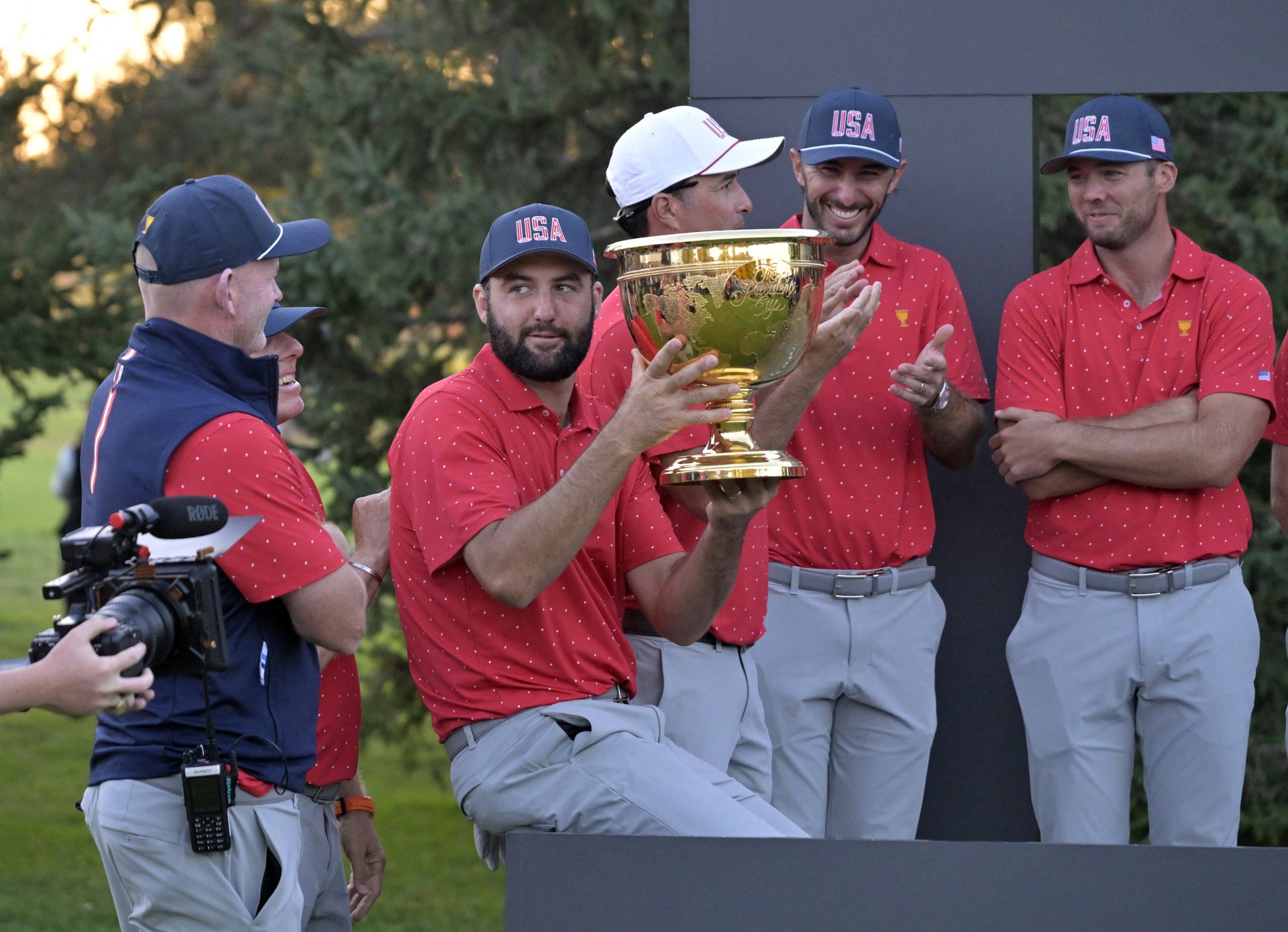
Golf’s supposedly purest team event now has a $25.5 million player-pay tab.
That is not the scandal. The silly bit is that golf still expects us to pretend Scottie Scheffler, Hideki Matsuyama, Adam Scott and Min Woo Lee are turning up at Medinah this week purely for a flag, a handshake and the warm inner glow of tradition.
The Presidents Cup is paying for labour — finally
When the Presidents Cup begins at Medinah Country Club outside Chicago on September 24, every player, captain and assistant captain across the U.S. and International teams will receive $250,000 from the PGA Tour.
That means 17 people per side — 12 players, one captain and four assistants — and $4.25 million per team. Across both teams, the 2026 event carries an $8.5 million stipend bill. It is the third Presidents Cup under this structure, taking cumulative payments since 2022 to $25.5 million. ([frontofficesports.com](https://frontofficesports.com/article/presidents-cup-stipends-cross-the-25m-mark-this-week/))
The U.S. side is led by Scheffler, with Cameron Young, Wyndham Clark, Sam Burns, Russell Henley, Collin Morikawa, Xander Schauffele, Justin Thomas and Patrick Cantlay among the names in the squad. Brandt Snedeker is captain. Geoff Ogilvy captains the International side featuring Matsuyama, Scott, Lee and the rest of a team trying to stop the Americans extending one of the more lopsided records in elite sport.
Now, before somebody clutches their pearls: $250,000 is not why these blokes become professional golfers. Scheffler has earned proper money. So have Schauffele, Thomas, Cantlay, Matsuyama and Scott. The stipend will not alter their tax planning, let alone their lifestyle.
But that is exactly why the argument matters.
This is not about whether rich golfers need another cheque. It is about whether a sports business with sponsors, broadcasters, ticketing, hospitality, merchandise and global distribution can keep calling its most valuable performers “volunteers” with a straight face.
It cannot.
Stop calling it tradition when it is a commercial product
The Presidents Cup began in 1994, designed by the PGA Tour to give leading players from outside the U.S. and Europe a team competition that the Ryder Cup did not offer them. It has become a marquee week on golf’s calendar, even if it lacks the Ryder Cup’s history, ugliness and properly unhinged crowd energy.
The product is still built on the same thing every sports product is built on: elite talent under pressure.
Nobody buys a corporate package, turns up to Medinah, watches NBC or Golf Channel, or opens a sponsor’s email because they are desperate to see an administrative structure. They come for Scheffler’s ball-striking, Thomas’s fire, Matsuyama’s pedigree, Scott’s elegance and Lee’s ability to make golf look less like an annual general meeting.
The PGA Tour understands this. That is why it moved from a charitable-allocation approach to unrestricted $250,000 stipends in 2022. Before then, the event directed money to charitable causes chosen by participants rather than paying the people actually generating the value. ([frontofficesports.com](https://frontofficesports.com/article/presidents-cup-stipends-cross-the-25m-mark-this-week/))
Charity is good. I am for it. But charity should not be the accounting trick that lets a wealthy sports enterprise avoid admitting the obvious: the athletes are workers in a commercial machine.
The Ryder Cup learned the same lesson, noisily. The PGA of America introduced a U.S. payment structure that gives each player a $200,000 stipend plus $300,000 to direct to charity. That is $500,000 of value per player, though only 40% is personal compensation. ([apnews.com](https://apnews.com/article/78c776cb811ee70faa7543755889b25b))
Predictably, people reached for the old line: they should pay to play.
Easy thing to say when it is not your face selling tickets, advertising and television rights.
The overlooked number is not $250,000 — it is $100 million
The real business lesson from Medinah is not that players are being paid. It is that the venue has spent serious money to earn the right to host them.
Medinah’s more than 1,100 members funded a $23 million renovation of Course No. 3, completed in 2024. The club says its total investment in transforming the property since hosting the 2012 Ryder Cup is now well above $100 million. ([frontofficesports.com](https://frontofficesports.com/article/presidents-cup-gives-medinah-mount-rushmore-major-golf-events/))
That is the number operators should stare at.
A famous event does not land on your doorstep because you own a nice golf course, stadium, hotel or precinct. You pay up front. You improve the asset. You create an experience that works for broadcasters, sponsors, wealthy guests, normal punters, traffic managers, security teams and the athletes themselves. Then you wait years for the return.
Medinah will become the first golf venue to host the Presidents Cup, Ryder Cup, PGA Championship and U.S. Open. That is not merely a bragging-rights plaque in the clubhouse. It is brand equity with a very long shelf life. ([frontofficesports.com](https://frontofficesports.com/article/presidents-cup-gives-medinah-mount-rushmore-major-golf-events/))
The club is betting that elite-event scarcity makes the course more valuable to members, future sponsors and future governing bodies. It is also betting that a one-off global spotlight creates value that a normal weekly tour stop cannot.
That is an intelligent bet — but it is not risk-free.
Big infrastructure spend becomes dumb money if you have not built a pipeline of future uses. A shiny renovation and one glamorous week are not a strategy. They are an invoice.
Medinah’s leadership appears to understand that. With U.S. Open sites mostly committed through 2050, and the next open U.S. Ryder Cup date not until 2041, the club is reportedly looking at major women’s, amateur, collegiate and other marquee events. ([frontofficesports.com](https://frontofficesports.com/article/presidents-cup-gives-medinah-mount-rushmore-major-golf-events/))
That is the grown-up approach: do not build an asset around one customer or one payday.
The contrarian view: paying players protects the event’s meaning
There is a lazy view that money ruins team events.
Rubbish.
Money does not ruin sport. Misaligned incentives ruin sport.
If a player believes an event, sponsor or governing body is exploiting his name and labour while hiding behind a speech about heritage, resentment eventually leaks into performance, selection politics, media comments and negotiations. You can call that greed if you like. I call it predictable.
Clean compensation can do the opposite. It says: we know the event has value because you are here, and we are not going to insult your intelligence by denying it.
The more interesting question is whether the Presidents Cup can turn that clarity into a stronger product. The U.S. leads the series 13-1-1, which is a commercial problem disguised as sporting dominance. A competition needs jeopardy. The International side needs more than noble losses and flattering press conferences. ([frontofficesports.com](https://frontofficesports.com/article/presidents-cup-stipends-cross-the-25m-mark-this-week/))
Here is where Ogilvy’s role matters. He was part of the Australian-based OCM design group behind Medinah’s renovation, then returns as International captain. There is a nice symmetry in that: he has helped reshape the stage and now has to deliver a contest worthy of it. ([frontofficesports.com](https://frontofficesports.com/article/presidents-cup-gives-medinah-mount-rushmore-major-golf-events/))
For the PGA Tour, a competitive International win would be worth more than any carefully worded marketing campaign. It would create memory, rivalry and a reason for casual fans to believe Sunday matters.
And that is the thing sports executives too often miss: the best return on investment is not a new hospitality tent. It is uncertainty.
What this means for you
Whether you run a startup, a sports business, a venue or a team, take three lessons from this week.
First: pay the people who create the value. Do not hide behind mission statements, exposure, culture or tradition when your best people can see the revenue. If the business wins because of their work, build a compensation system that acknowledges it before they force the issue.
Second: treat capital expenditure like a pipeline, not a trophy. Medinah’s $100 million-plus transformation only makes sense if it keeps attracting valuable events and customers long after the Presidents Cup leaves town. Before you spend big, write down the next five ways the asset will earn.
Third: never confuse a famous brand with a durable product. The Presidents Cup has elite golfers, global sponsors and a beautiful course. It still needs competitive tension because fans do not buy inevitability. In your business, identify the bit that creates real suspense, urgency or emotional pull — then protect it like mad.
Golf is not becoming less romantic because the players are paid.
It is becoming more honest. And honest businesses tend to last longer than ones built on ceremonial nonsense.