Samsung and SK Hynix Pushed South Korea Past $709.4B — That’s Not All Good News
South Korea beat its entire 2025 export record by 5 September. That is either a staggering industrial win or a warning that the world has put too much money behind one AI bottleneck.
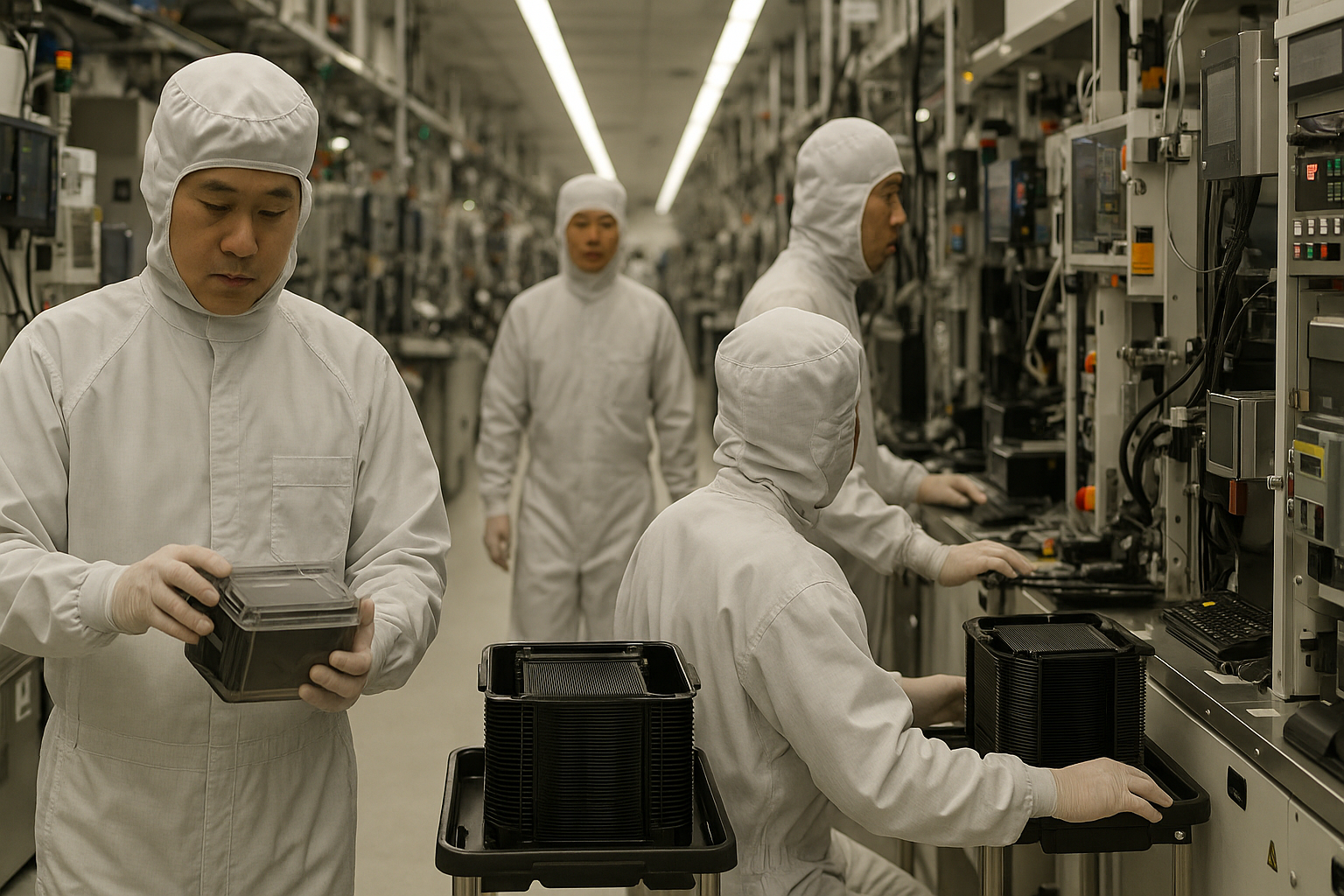
A country does not beat its entire prior-year export record by 5 September because everything is healthy. It does it because the world has become wildly dependent on one bottleneck.
South Korea’s exports reached US$709.4 billion so far in 2026 by 5 September, edging past the US$709.3 billion it exported in all of 2025. The country is now on track to reach US$1 trillion in annual exports by early December — a club that currently includes only the United States, China and Germany. ([finance.yahoo.com](https://finance.yahoo.com/economy/articles/south-korea-exports-surpass-full-061313000.html?utm_source=openai))
That is an extraordinary result. It is also a flashing yellow light for anyone who thinks the AI boom is broad, evenly spread and therefore automatically safe.
Samsung Electronics and SK Hynix are not merely riding a technology cycle. They are supplying a scarce, essential input into the global race to build AI infrastructure: advanced memory chips. The result is that a country of roughly 52 million people is becoming one of the clearest economic scoreboards for whether the AI spending frenzy is still real.
For founders, investors and operators, this matters because the numbers tell you where the pricing power is — and, more importantly, where the fragility is hiding.
A US$709.4 billion reality check
The headline is simple: South Korea has already exported more goods in the first part of 2026 than it did during the whole of 2025.
The monthly figures explain why. In August, South Korea exported US$98.255 billion of goods, up 68.7% year on year. Imports rose 22.5% to US$63.507 billion, producing a monthly trade surplus of US$34.748 billion. Adjusted for the number of working days, export growth was an even more absurd 72.5%. ([customs.go.kr](https://www.customs.go.kr/kcs/na/ntt/selectNttInfo.do?bbsId=1362&mi=2891&nttSn=10175205&nttSnUrl=c275bd6a7843e9591d59b988ab338cc3&utm_source=openai))
This is not a nice little recovery after a soft patch. It is an export machine running flat out.
From January through August, semiconductor exports rose 169.6% to US$281 billion, accounting for 41% of South Korea’s total exports in that period. In August alone, Reuters reported that the chip boom extended South Korea’s overall export-growth streak to 15 straight months. ([ca.finance.yahoo.com](https://ca.finance.yahoo.com/news/south-korea-exports-surpass-full-061313000.html?utm_source=openai))
Read that again: 41 cents in every export dollar came from semiconductors.
That is the good news and the problem in the same sentence.
A great business wants exposure to a powerful growth market. A dangerous business has no meaningful plan beyond that market continuing forever. Countries are not immune to the same rule, no matter how many bureaucrats are standing around the spreadsheet.
Samsung and SK Hynix have found the real toll booth
The popular version of the AI story is that Nvidia wins because it sells the shovels. Fair enough. But somebody needs to provide the high-performance memory that lets those systems do serious work.
That is where Samsung and SK Hynix come in.
Global AI investment has turned memory chips from a historically ugly, cyclical commodity business into a strategic choke point. When cloud providers and technology companies build data centres, they do not just buy compute chips. They buy the surrounding hardware, power, networking, storage and — critically — memory. The current shortage and rising prices are handing South Korea’s two memory champions a magnificent commercial moment. ([finance.yahoo.com](https://finance.yahoo.com/economy/articles/south-korea-exports-surpass-full-061313000.html?utm_source=openai))
This is the bit many investors miss: the biggest money is often not made by the company with the best product story. It is made by the company sitting at the point where everyone else’s plans fail without it.
That is pricing power.
You see the same thing in ordinary business. The business that owns the customer relationship, controls the distribution channel, has the licence, owns the scarce input or can deliver faster than everyone else gets to set the rules. Everyone else gets a motivational poster and lower margins.
Samsung and SK Hynix are benefiting because advanced memory is scarce precisely when demand is becoming urgent. AI companies can delay a product launch. They cannot conjure hardware capacity out of thin air.
The export boom is real. So is the concentration risk.
Let’s not be silly and call this a fake boom. South Korea’s trade surplus is massive, chip demand is genuine and the country has built capabilities that competitors cannot replicate in a weekend.
The Korean Customs Service’s preliminary data puts cumulative exports through August at US$693.318 billion, up 52.8% from the same period in 2025. The cumulative trade surplus was US$202.507 billion. ([customs.go.kr](https://www.customs.go.kr/kcs/na/ntt/selectNttInfo.do?bbsId=1362&mi=2891&nttSn=10175205&nttSnUrl=c275bd6a7843e9591d59b988ab338cc3&utm_source=openai))
That is serious cash flowing into the country.
But the composition matters more than the headline.
Over January to August, passenger-car exports fell 4% even while overall exports surged. Semiconductor exports were doing the heavy lifting. Exports to China jumped 76% and shipments to the United States rose 57% over the period. ([ca.finance.yahoo.com](https://ca.finance.yahoo.com/news/south-korea-exports-surpass-full-061313000.html?utm_source=openai))
So South Korea has three concentrations stacked on top of each other:
- A huge reliance on semiconductors. - A big reliance on AI-driven demand for advanced memory. - Material exposure to two giant end markets: China and the United States.
That setup is lucrative. It is not diversified.
If memory prices stay high and AI infrastructure spending keeps rising, this becomes a national-scale profit engine. If AI spending pauses, customers digest inventory or a supply response arrives faster than expected, the same concentration can make the numbers turn very quickly.
Anyone who has survived a proper cycle knows the pattern. The boom looks permanent at the top because the money is real. Then demand normalises, capacity catches up and everyone discovers that “record revenue” did not mean “permanent economics.”
The overlooked angle: this boom is a warning for AI buyers
Most commentary treats South Korea’s export numbers as a reason to buy more chip exposure. Maybe. But that is the lazy conclusion.
The sharper conclusion is that the cost of building AI is still moving upstream.
If memory exports are growing this violently, and memory prices are benefiting from a shortage, then some of the companies spending billions on AI infrastructure may be facing tougher unit economics than their glossy presentations suggest. They are all fighting to own the customer, but the suppliers of scarce infrastructure are quietly taking a bigger slice of the pie.
That matters for every founder putting “AI” into a fundraising deck.
If your business model depends on permanently falling compute costs, permanently cheap model access or permanently abundant hardware, you do not have a strategy. You have a hope dressed up in a pitch deck.
I like AI businesses. I am building Agave Finder because technology can make a messy market clearer and more useful for people. But I have built enough businesses to know that being in a hot category is not the same as having good economics.
The winners will be the operators who use AI to improve an existing advantage: better distribution, better workflow, proprietary data, a stronger product or a lower cost to serve customers. The losers will be the ones paying premium infrastructure bills to produce features their competitors can copy by Friday.
Don’t confuse a national trade number with an investment thesis
There is another trap here: seeing South Korea’s export record and deciding that every Korean technology stock, every semiconductor name and every AI-adjacent business is automatically cheap.
Absolutely not.
A brilliant industry can still contain overpriced shares. A strong company can still be bought at a stupid price. And a country can have record exports while parts of its domestic economy are less healthy than the headline suggests.
The trade figures tell us that demand for Korean semiconductors is exceptional. They do not tell us what is already priced into Samsung, SK Hynix, their suppliers or the entire AI supply chain.
As an investor, separate three questions:
1. Is demand real? In this case, clearly yes. 2. Who captures the profit? Right now, memory suppliers have a strong claim. 3. What are you paying for that profit? This is where people get hurt when they stop doing the work.
Markets do not punish people for being optimistic. They punish them for paying tomorrow’s perfect outcome today.
What this means for you
Here is the useful bit — the part you can apply tomorrow rather than merely nodding along to over a coffee.
First, find the bottleneck in your own industry. Do not ask, “What is growing?” Ask, “What has become hard to get, hard to replace or hard to deliver?” That is where margins live. If you run a business, build closer to that choke point. If you invest, study who owns it.
Second, audit your concentration. South Korea’s numbers are a reminder that a phenomenal growth engine can also become a single point of failure. List your top three customers, suppliers, channels and revenue lines. If one of them disappeared for 90 days, would you be inconvenienced or cooked? Be honest.
Third, make AI earn its keep. Stop buying tools because they sound clever. Measure whether a tool cuts labour time, lifts conversion, reduces errors, improves retention or lets you charge more. If it cannot move one of those five levers, cancel it.
Finally, do not chase a headline after it has become a parade. The better opportunity is often one layer away from the obvious winner: the supplier, service provider, distribution owner or unsexy operator collecting the toll.
South Korea’s US$709.4 billion export milestone is a spectacular vote of confidence in the AI buildout. But it is also a brutal reminder of how quickly value piles up around scarcity.
The lesson is not “buy chips blindly.” The lesson is simpler: own something other people cannot easily do without — and never mistake a booming cycle for a permanent law of nature.