Scott Bessent’s $6B Buyback Didn’t Calm Yields — and Borrowers Will Pay
Scott Bessent’s Treasury lifted a buyback to $6 billion. The 10-year yield still hit 4.85%. That is a warning: liquidity support is not control of the cost of money.
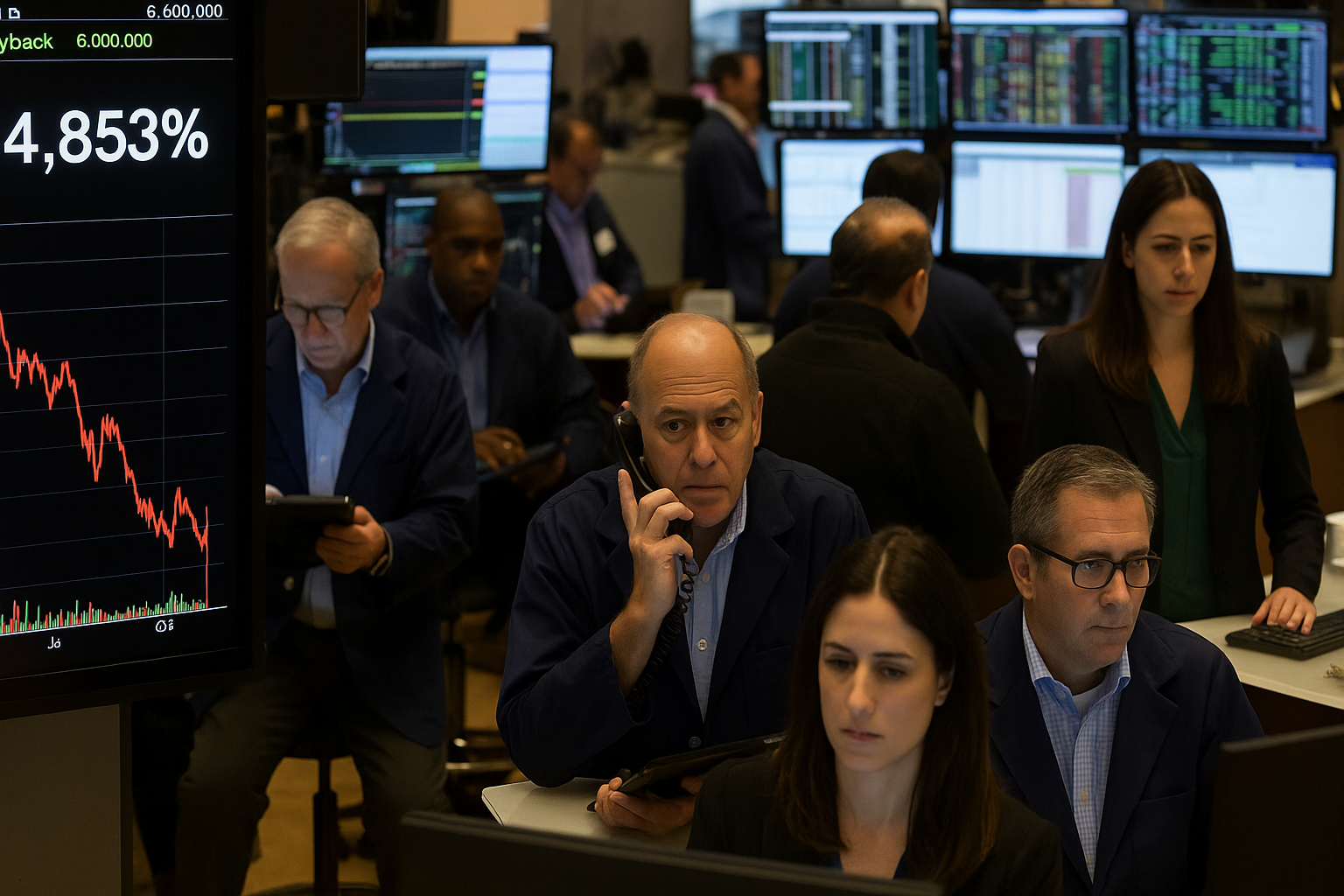
The US Treasury lifted its long-end buyback to $6 billion, and the 10-year yield still hit 4.85%.
That is not a market wobble. It is a warning that arithmetic has finally stopped taking orders.
Scott Bessent brought $6 billion to a $32 trillion fight
On September 9, Treasury Secretary Scott Bessent’s department said it would buy back up to $6 billion of longer-dated government bonds in its first enlarged liquidity-support operation. That was triple the old $2 billion maximum and above the $4 billion minimum Treasury flagged in August.
The immediate market signal was brutally clear: this was not enough to deliver instant relief.
The 10-year Treasury yield rose as high as 4.85% after the announcement. Later that day, Treasury sold $39 billion of 10-year notes at a 4.834% yield, the highest auction yield since 2007.
Read that again. The government announced it was buying bonds to support the long end of the market, then later had to pay the highest rate in nearly two decades to sell fresh 10-year debt.
That is the entire story.
For weeks, investors had convinced themselves that Bessent had created a “Treasury put”: an unofficial floor under bond prices, meaning a ceiling on yields. The theory was simple enough. If long-end yields surged too far, Treasury could buy old bonds, improve market liquidity and calm the panic.
Nice theory. Wrong conclusion.
A buyback can help market plumbing. It can give banks and dealers a place to sell older, less-liquid securities, freeing balance-sheet capacity to participate in new auctions. That matters. Functional plumbing matters when you run the world’s largest bond market.
But a $6 billion buyback does not erase the need to sell vastly more debt. It does not make investors forget about deficits. It does not change the return they demand for lending money to a government for 10, 20 or 30 years.
You cannot outsmart a balance sheet with a press release.
The distinction Wall Street conveniently blurred
Treasury has been quite direct about the stated purpose of these operations: liquidity support in longer-dated nominal securities. The expanded programme applies to the 10-to-20-year and 20-to-30-year sectors, beginning September 9 and running through the current refunding quarter, which ends November 4.
Liquidity support is not yield control.
Those are wildly different jobs, and anyone treating them as interchangeable is either confused or selling you something.
Liquidity support says: “We want the market to trade cleanly, even when conditions get ugly.”
Yield control says: “We will buy enough bonds to dictate the price of money.”
The first is a sensible piece of market maintenance. The second is a massive policy choice with enormous consequences. It would involve Treasury or the Federal Reserve standing against the market with a balance sheet big enough to overwhelm genuine sellers. That is not what a $6 billion operation is.
Bessent himself has acknowledged the key point: Treasury cannot change the equilibrium price of its debt. It can try to slow a disorderly move. It can try to stop a nasty feedback loop. But it cannot make the long-term cost of money cheaper simply because cheaper money would be politically convenient.
That honesty is refreshing. The trouble is that markets had heard the earlier messaging and priced in something more muscular.
So when the number arrived at $6 billion rather than something meaningfully bigger, the market reassessed the value of the alleged backstop. Bonds sold off. Yields rose.
That is what happens when you create an expectation you cannot—or should not—meet.
Why a 4.85% 10-year Treasury yield is everyone’s problem
Most people do not own 10-year Treasury notes. Fair enough. But the 10-year yield owns a fair chunk of your financial life.
Mortgage rates are not set directly by the Federal Reserve. They are heavily influenced by long-term Treasury yields. So are the borrowing costs faced by businesses funding warehouses, equipment, acquisitions and expansion. So are valuations for commercial property, infrastructure projects and companies whose profits are supposedly coming a long way down the track.
When the risk-free rate rises, everything else has to reprice around it.
The bloke trying to refinance a house feels it. The founder raising money feels it. The private-equity operator rolling over debt feels it. The investor holding a portfolio built for permanently cheap capital feels it.
And here is the unpleasant bit: a higher yield is not automatically proof that something has broken. It may simply be the price required to persuade a buyer to own a long bond in a world with big funding needs and plenty of uncertainty.
Markets are not obligated to provide governments with cheap financing. Nor are they obligated to validate the forecasts of people who bought assets assuming rates would magically fall back to the old normal.
That old normal did a lot of damage to people’s judgement. Cheap money made mediocre businesses look investable. It made debt feel like intelligence. It encouraged operators to value growth without properly valuing cash flow.
Now the bill is arriving, and it has a coupon attached.
The overlooked risk: intervention can make the next test worse
The contrarian view here is not that Treasury should do nothing. A deep, liquid Treasury market is a public good. If market functioning becomes disorderly, officials should have tools to keep the pipes open.
The overlooked risk is that every public attempt to calm yields can train the market to demand a bigger rescue next time.
That is the trap behind the phrase “Treasury put.” Once traders believe the government is defending a level rather than supporting liquidity, they stop asking whether the level makes economic sense. They start testing the defence.
Then each increase in yields becomes a referendum on official resolve.
If the response is bigger buybacks, markets ask for still bigger buybacks. If the response is no action, the market has to unwind the protection it previously assumed existed. Either way, officials have made themselves part of the trade.
That is why predictable policy is usually better than theatrical policy.
Treasury’s August announcement was unusual partly because it arrived outside the standard quarterly-refunding rhythm. It caught attention. It helped create the sense that a new lever had appeared. But surprise is useful only when you have the firepower and intent to follow through.
In business terms, this is the difference between keeping a cash reserve and announcing you will personally guarantee every customer’s bad decision. One makes you resilient. The other invites people to test whether you mean it.
The adult lesson: liabilities do not care about your narrative
There is a reason the bond market is often called the adult in the room. It is not because bond investors are morally superior. Have a beer with a few and you will quickly disprove that.
It is because a bond is a promise with dates and numbers attached.
A lender asks basic questions: How much are you borrowing? For how long? What inflation-adjusted return do I get? What else could I do with my money? How confident am I that you will keep the terms stable?
Those questions are harder to spin than an earnings call.
A government can be extraordinarily powerful and still face those questions. The United States has exceptional advantages: the dollar’s global role, deep capital markets and huge institutional credibility built over decades. But exceptional is not the same as exempt.
The $6 billion buyback did not cause America’s funding challenge. Nor did the move deliver a lower long-term borrowing cost on the day. It merely exposed the gulf between market mechanics and economic reality.
A modest liquidity tool can be sensible. Pretending it changes the cost of capital is how people get surprised.
What this means for you
Do three boring things tomorrow. Boring is where money is made when the world gets expensive.
First, stress-test your debt. Do not ask whether you can service it at today’s rate. Ask whether you can service it if refinancing costs another 1% to 2% more than you expect. If that exercise frightens you, good. Better frightened now than insolvent later.
Second, stop valuing your business—or your portfolio—using the interest-rate assumptions of 2021. A strong business can survive a higher discount rate. A weak business dressed up with distant revenue projections cannot. Favour cash generation, pricing power and low refinancing risk.
Third, keep liquidity without becoming lazy. Cash is not a personality. But optionality is priceless when competitors are forced to sell assets, cut staff or accept ugly funding terms. The operator with cash and no urgent refinancing is not merely safer; they can become dangerous.
Bessent’s $6 billion buyback was not a disaster. It was more useful than that. It was a live demonstration that markets eventually price the real thing.
Debt has a cost. Time has a cost. Capital has a cost.
Build and invest as if those facts are permanent, because they are.