Snap’s $2,195 Specs Bet Puts Ronan Harris’s 19% Growth to the Test
A $2,195 pair of glasses is about to expose whether Snap’s ad business is real or just having a good quarter. Ronan Harris now has to make the revenue engine pay for Specs.
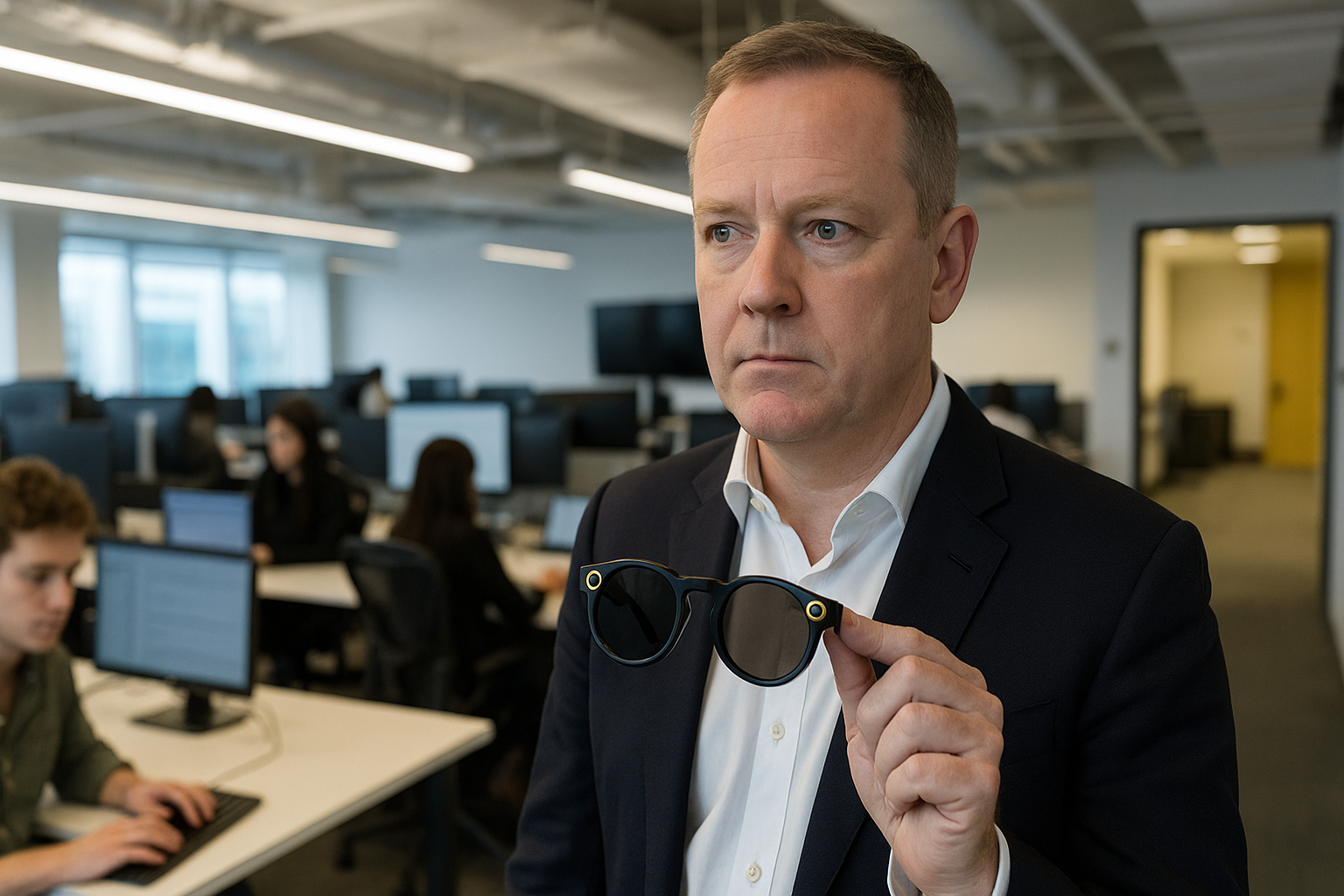
A $2,195 pair of glasses is about to expose whether Snap’s ad business is real or just having a good quarter. Snap doesn’t need another visionary right now. It needs somebody who can turn advertiser money into enough cash to pay for a $2,195 pair of glasses.
That is why Evan Spiegel has promoted Ronan Harris to chief commercial officer, replacing outgoing chief business officer Ajit Mohan. Harris is not taking a cosmetic title bump. He now owns Snap’s global advertising sales and go-to-market operation while the company is trying to prove two things at once: that its ad business has genuinely improved, and that its expensive Specs AR glasses are more than a founder’s science project.
The promotion is a commercial verdict
Harris had been Snap’s president for Europe, the Middle East and Africa since joining in 2022. That region delivered 10 consecutive quarters of double-digit year-on-year revenue growth through the second quarter of 2026. Revenue there grew nearly 40% in the first half of this year.
That is the bit that matters. Not the LinkedIn-friendly language about partnerships or leadership. The bloke ran a large territory, grew it consistently and has now been handed the global number.
Before Snap, Harris spent more than 17 years at Google, including as vice president and managing director for the UK and Ireland. In other words, Spiegel has put a career advertising operator in charge of a business that has spent years trying to convince brands it can be more than a quirky social app for young people.
The timing is no accident. Snap reported second-quarter revenue of $1.599 billion, up 19% from $1.345 billion a year earlier. Daily active users reached 493 million, up 5%. Monthly active users were 971 million. Free cash flow was $121 million, against $24 million in the comparable quarter last year.
Those are proper improvements. But they do not mean Snap is home and hosed. The company still posted a net loss of $164 million for the quarter. That is better than the prior year’s $263 million loss, but better is not the same as good.
Spiegel’s move says he understands the distinction. A stronger ad platform has bought Snap credibility. Harris now has to convert that credibility into a durable commercial machine before the company starts spending like a hardware company with something to prove.
Snap is restructuring around the thing advertisers actually pay for
The more interesting part of this reshuffle is not Harris’s title. It is where Snap is moving the work.
The company is restructuring parts of the business to put more emphasis on engineering and ad products. Axios reported that ad product will move under engineering. That sounds bureaucratic until you understand the problem it is trying to solve.
Advertising businesses die slowly when sales teams promise things product teams cannot deliver. Sales says targeting will improve, measurement will get cleaner, creative tools will work better and campaigns will drive outcomes. Then the customer discovers the dashboard is average, the tools are clunky and the proof is thin. A few polite calls later, the budget moves to Meta or Google.
Putting ad product closer to engineering is a sensible attempt to stop that nonsense. It makes the people selling the product and the people building it answerable to the same commercial reality.
Harris will oversee the revenue side. Engineering will have greater weight in the product side. That can be a very effective structure, provided the two leaders are forced to share metrics rather than just attend the same meeting.
If I were running this, I would give both teams three common numbers: revenue retained from existing advertisers, time from advertiser feedback to shipped product improvement, and independently measured return on ad spend. Not slide-deck optimism. Actual numbers, reviewed every month.
Because the risk for Snap is obvious: a 19% growth quarter can make management feel clever enough to create three new committees. What it should do is make them more ruthless about fixing the bottlenecks that produced mediocre advertising performance in the first place.
The $2,195 Specs bet changes the stakes
Snap will hold a major Specs event in Los Angeles on September 16, where Spiegel is expected to give the public its first in-depth look at the new augmented-reality glasses. The company began taking pre-orders in June at $2,195.
I like ambitious product bets. I’m building Agave Finder because a big enough market can be improved by a product that takes its users seriously. But hardware has a nasty habit of making smart software founders look like they have discovered gravity late in life.
Hardware eats cash. It creates supply-chain risk, returns, support problems, inventory exposure and the very real possibility that consumers simply do not want the thing badly enough at the price you need.
Snap has a decent balance sheet: $2.7 billion in cash, cash equivalents and marketable securities at June 30. It also generated positive free cash flow in the quarter. That gives the company room to make a serious go of Specs. It does not give it an unlimited licence to indulge itself.
Spiegel has framed the glasses as a long-term bet on more real-world, in-person connection. Fair enough. But investors do not fund long-term bets because the story is lovely. They fund them when the core business throws off enough cash to survive the inevitable false starts.
That is Harris’s real job. He is not merely there to sell more ads next quarter. He is there to make Snap’s advertising engine dependable enough that Specs can have time to become useful, affordable and culturally normal.
The overlooked angle: Snap promoted its best regional proof, not its loudest executive
Founders regularly make one of two mistakes when a business starts improving.
First, they hire an external superstar because they think a famous name will impress the market. Usually, that person spends six months learning where the bodies are buried and another six months redesigning an org chart nobody asked for.
Second, they promote the internal loyalist who is great in meetings but has never carried a meaningful commercial number.
Spiegel has avoided both traps. Harris is an internal operator with a measurable record in a major region, plus deep experience in the advertising industry from Google. That is a far more defensible succession logic than picking the best storyteller in the room.
There is also a useful message here for founders: your next senior leader does not need to have done your exact job globally before. They need to have demonstrated the underlying skill where the stakes were real.
Harris did not run all of Snap. He ran EMEA. But he grew it for 10 straight quarters. That gives Spiegel evidence, not hope.
The contrarian point is this: internal promotion is not inherently safer than an external hire. It is safer only when the person has earned it through visible operating results. Loyalty is nice. Repeated execution is better.
What this means for you
If you are a founder, operator or investor, take three things from Snap’s move.
First, promote on proof, not promise. Before giving someone a global role, ask: what number did they own, for how long, and did the result hold up through different conditions? “Everybody likes her” is not a succession plan.
Second, put product and revenue in the same cage. Your sales team should not be able to sell fantasies, and your product team should not be able to hide behind usage metrics that never turn into money. Give both sides shared commercial measures and make the trade-offs painfully visible.
Third, fund the risky bet from a healthy core, not from wishful thinking. Specs may become a huge platform or a very expensive reminder that consumers are hard to change. Either way, Snap’s ad business has to pay the bills. The same rule applies whether you are launching a new product line, opening another market or hiring 50 people for an AI initiative.
The lesson is dead simple: moonshots are optional. Cash-generating execution is not.
Ronan Harris has been handed the job because Snap finally has evidence its commercial engine can work. Now comes the harder part: proving that one good growth run is a system, not a lucky streak.