Socure Raises $156M at $5.2B to Fight Fraud
$100 billion a year goes into fraud, compliance and risk operations in the US. Socure just raised $156 million to automate the casework buried inside it.
US organisations burn $100 billion a year on fraud, compliance and risk operations. Socure just raised $156 million to automate the casework buried inside that bill.
That is where the real money is. Not in another chatbot pretending to be your intern. In the expensive, repetitive, high-consequence work that companies cannot afford to get wrong.
Socure bought the boring bit—and that is exactly the point
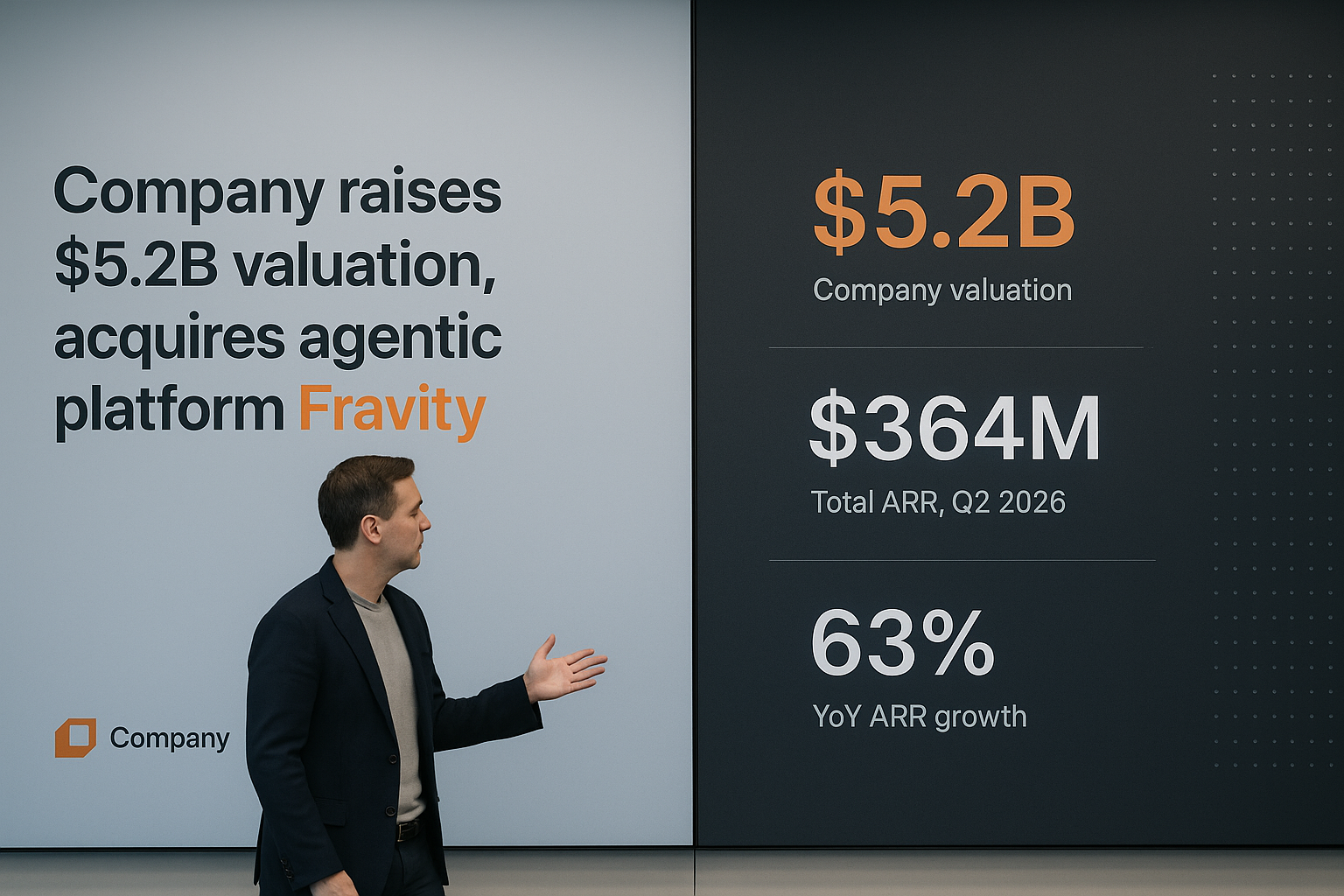
On August 27, Socure announced a $156 million strategic growth investment at a $5.2 billion valuation, led by Summit Partners. Goldman Sachs Alternatives, Wells Fargo, DocuSign and others participated. At the same time, Socure acquired Fravity, an agentic AI platform focused on fraud, risk and compliance operations.
The headline number is big. But the structure matters more.
This was not simply $156 million dumped into a startup bank account to burn on branded hoodies and a bigger San Francisco lease. The investment includes both primary capital and a secondary tender offer for existing employees. Socure has not disclosed how much goes into each bucket.
Founders need to understand the difference. Primary capital funds the company. Secondary capital lets existing shareholders sell some stock. Both can be sensible. But they do completely different jobs.
The tender is not a red flag. Quite the opposite: at a company operating at Socure’s scale, giving employees some liquidity can be a practical way to retain people without forcing an IPO. Still, whenever you see a monster round, ask the boring question: how much is actually going into the business? It separates financial theatre from operating firepower.
Socure says it ended the second quarter of 2026 with $364 million in annual recurring revenue, up 63% year on year. It reported 133% net dollar retention, 0.01% logo churn and more than 3,000 customers. Those are not vanity numbers. They are the reason a $5.2 billion valuation is plausible.
Do the simple maths: $5.2 billion is roughly 14 times that $364 million ARR figure. That is not cheap. But it is a far more grown-up valuation conversation than the usual AI circus, where a startup with a slick launch video gets priced as if it has already conquered an industry.
The product is not AI. The product is fewer bad decisions.
Socure sells identity verification, fraud prevention and compliance tools. In plain English, it helps businesses decide whether the person opening an account, applying for credit, making a transaction or accessing a service is who they claim to be—and whether something dodgy is underway.
That job has become nastier thanks to AI.
Criminals now have cheaper tools to create fake identities, manufacture convincing documents, automate attacks and impersonate real people. The defensive response cannot be “hire more analysts and ask them to work harder.” That model breaks the moment the volume gets serious.
Socure’s acquisition of Fravity is a bet that fraud and compliance teams need more than a good scoring model. They need an operating system that can orchestrate investigations and actions around those scores.
That distinction matters.
A fraud model can flag a suspicious payment. An agentic workflow can gather the relevant data, assemble the case, route it to the right person, request more information, document the decision and trigger the next action. The first is a feature. The second is where labour costs and operational bottlenecks start to disappear.
That does not mean every fraud analyst suddenly disappears. The immediate target is the back-office casework around an investigation: gathering data, routing cases, requesting information and documenting decisions. The people handling exceptions and accountability still matter. But if software does more of that repetitive work, the same team can handle more cases without simply throwing more people at the problem.
Socure plans to fold Fravity into its RiskOS platform as RiskOS_Agents. The company says the two businesses already shared enterprise customers, while the founding teams at Socure, Fravity and Effectiv—which Socure acquired in 2024 and later rebranded as RiskOS—have worked together across companies for more than a decade.
That is not just a neat founder-network story. It lowers integration risk. Buying a product is easy. Making its people, data, product roadmap and customers work together without creating a mess is the hard bit.
Why Summit Partners is buying a machine, not a pitch deck
The best part of this deal is that Socure did not need investors to imagine a market appearing someday.
The market already exists. Every bank, fintech, marketplace, insurer, government agency and large online business has to manage identity, fraud and compliance. They are already spending money on it. Socure cited research from Liminal estimating that US organisations spend $100 billion a year on fraud, compliance and risk operations through internal and outsourced staffing.
Whether that precise estimate lands at $90 billion or $110 billion is beside the point. The spend is enormous, recurring and painful. That is venture gold when you have a credible way to make the customer faster, safer and cheaper.
Socure’s reported 133% net dollar retention is especially important. It means the average existing customer cohort is spending materially more over time than it did a year earlier, even after accounting for customers that left or reduced spend. That is what a real platform looks like: you land with one painful job, prove you can be trusted, then expand.
The company also says international volume has grown from near zero to a double-digit share of its network over the past two years. Global expansion is hard in identity because regulations, data sources, document types and fraud patterns vary wildly. But the opportunity is obvious: a business that becomes embedded in a customer’s trust infrastructure is very hard to replace.
That is a much better moat than being the 47th company with access to the same underlying large-language model.
The overlooked angle: the AI winners will often look like risk departments
Here is the bit founders miss because it is less sexy than consumer AI: the biggest AI businesses may not look like AI businesses at all.
They will look like payments infrastructure, insurance software, audit tooling, logistics systems, healthcare administration and identity platforms. Their customers will not buy them because they want “AI transformation.” They will buy because the alternative is losing money, failing a compliance review or hiring another 200 people to shovel paperwork uphill.
That is why Socure’s deal is more interesting than another giant funding round for a general-purpose assistant.
The company has proprietary data, existing enterprise relationships, decisioning workflows and a clear economic owner inside the customer. Fravity gives it a way to turn those inputs into action. That is a proper strategic fit.
The contrarian lesson is this: don’t assume agentic AI automatically makes vertical software irrelevant. It may do the opposite. The vertical platform that owns the data, the rules, the integrations and the accountability becomes the best place to deploy agents.
An AI agent without access to the customer’s workflow is just a clever bloke standing outside the pub shouting advice through the window.
The risk Socure still has to manage
None of this means Socure gets a free run.
The company is operating in a category where a bad decision can cost a customer money, create regulatory trouble or lock out a legitimate user. Automation has to be accurate, explainable and controlled. More automation can reduce labour, but it can also magnify mistakes if the underlying system is sloppy.
There is also the classic platform risk. Integrating Fravity into RiskOS sounds logical; delivering a genuinely useful, reliable product to thousands of customers is another thing entirely. Enterprise buyers do not care that you acquired an “agentic” company. They care whether their fraud team clears cases faster without letting more fraud through.
And at a $5.2 billion valuation, Socure must keep proving that growth is durable. Sixty-three per cent ARR growth is excellent. Expectations get brutal when you are already doing hundreds of millions in recurring revenue.
But I would rather own that problem than the problem facing thousands of AI startups with no distribution, no proprietary data and no clue who will pay once the free trial ends.
What this means for you
If you are a founder, stop asking where you can sprinkle AI over your existing product. Ask where your customer is paying skilled people to make repetitive, high-stakes decisions.
Then get painfully specific:
- Identify one workflow where delay, error or manual labour has a real dollar cost. - Work out who owns that cost in the customer organisation and make them your buyer. - Build into the existing system of record instead of asking customers to adopt another dashboard. - Measure the commercial result: cases resolved, hours removed, fraud avoided, conversion lifted or compliance risk reduced. - Treat proprietary workflow data and trust as assets. A model can be copied. Embedded operational credibility cannot.
For investors, the lesson is just as blunt. Ask whether the company has distribution, data and a clear path from AI output to customer action. If the answer is “we have a great model,” keep your wallet in your pocket.
Socure’s $156 million round is not exciting because it says AI on the label. It is exciting because the company is using AI to attack a budget that already exists, inside a workflow customers cannot ignore.
That is where durable businesses get built: not where the hype is loudest, but where the pain is expensive enough that somebody has to pay you to make it stop.
Sources
- Socure Announces Strategic Growth Investment at $5.2B Valuation and Acquires Fravity
- Axios Pro Rata: Socure raises $156M and acquires Fravity
- Socure Secures $156M at $5.2B Valuation, Acquires AI Fraud Investigation Startup Fravity
- Socure hits $5.2bn valuation with latest funding round, acquires Fravity