SoftBank’s $18B Allied Universal Bet Is a Physical AI Land Grab
$18 billion is not a guard-company price tag. It is a bet on who controls the sites where physical AI gets deployed first.
$18 billion is not a guard-company price tag. It is a bet on who controls the sites where physical AI gets deployed first.
That is the uncomfortable read on SoftBank’s reported interest in Allied Universal, America’s largest security-services company. And if you run a business with a big frontline workforce, you should pay attention — because Masayoshi Son is not shopping for another app. He is shopping for a real-world distribution network for machines.
SoftBank is weighing an $18 billion doorway into the physical economy
Bloomberg reported on October 16 that SoftBank Group is considering an acquisition of Allied Universal that could value the privately held security company at about $18 billion. Reuters separately reported that the discussions are preliminary, no final decision has been made and even the price is not settled.
That distinction matters. This is not a signed deal. It may never become one. Anyone presenting it as done is either lazy or trying to make the story sound bigger than it is.
But the logic is already obvious.
Allied Universal is not some tiny guard company with a bloke in a fluorescent vest sitting outside a warehouse. The company says it employs roughly 800,000 people globally and generates about $23 billion in revenue. It provides security and facilities services across businesses, venues and critical sites. Its own materials say it has worked on more than 50 million square feet of data-centre projects since 2014.
That last bit is the kicker.
Data centres are becoming the factories of the AI economy. They are expensive, security-sensitive, power-hungry and increasingly everywhere. They also need controlled access, monitoring, incident response and boots — or wheels — on the ground. If you own the service relationship at thousands of those sites, you are sitting in the best possible seat to introduce automation.
SoftBank is reportedly looking at Allied in part because of its data-centre exposure and because Son wants to deploy AI-powered robots across industries. Read that again slowly: the target is not simply a cash-flowing services company. It is a vast installation base where SoftBank could sell, test, train and eventually operate physical AI.
The guards are the present revenue. The sites are the strategic asset.
This fits Masayoshi Son’s much bigger physical-AI wager
A lot of investors still think of SoftBank as the company that made spectacular technology bets, including some that went sideways in public. Fair enough. The WeWork episode did not exactly scream disciplined capital allocation.
But Son’s current thesis is much more coherent than the old spray-and-pray Vision Fund caricature suggests. He has been assembling pieces of what SoftBank calls “physical AI”: intelligence that does not merely sit in a chatbot window but moves, sees, handles tasks and operates in the real world.
In October 2025, SoftBank signed a definitive agreement to acquire ABB’s robotics business for $5.375 billion. ABB Robotics generated $2.3 billion of revenue in 2024 and employed about 7,000 people. That deal gave SoftBank industrial robotics capability, established customer relationships and a serious installed base in automation.
SoftBank has also made clear that it sees frontier AI models, semiconductors, computing infrastructure and robots as the essential layers of its strategy. The company is not hiding the ambition. Son wants the stack.
The potential Allied deal would add something less glamorous but arguably more valuable: recurring access to places where automation can be deployed under contract.
That is where plenty of AI commentary gets childish. People obsess over whether a humanoid robot can walk up stairs or carry a box without falling over. Fine. That is a technical problem. The commercial problem is harder: who buys it, who installs it, who maintains it, who wears the liability when it fails, and who has enough sites to make the economics work?
Allied could help answer those questions.
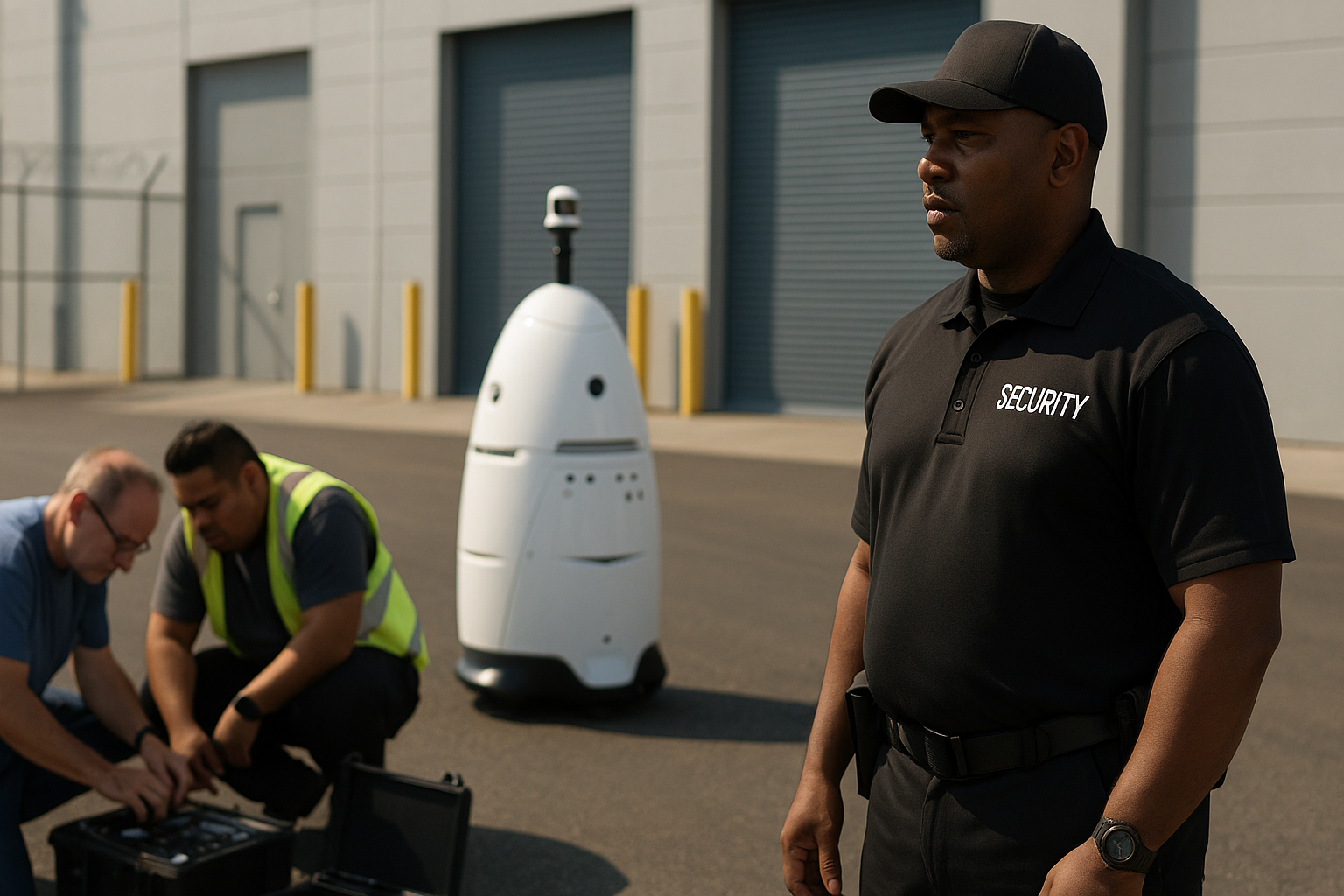
A robot guarding a single office lobby is a novelty. A security operator rolling out cameras, autonomous patrol machines, remote monitoring and access-control software across a large customer base is a business.
The overlooked asset is not robots. It is permission.
Here is the contrarian angle: SoftBank does not need robots to replace every guard for this deal to make strategic sense.
That is the glossy slide-deck version, and it will get plenty of attention because it is provocative. But the near-term value is more mundane. Allied already has contracts, supervisors, operating processes, customer trust and people showing up at sites that cannot afford to be unsecured.
That gives SoftBank a pathway to introduce technology gradually.
Think smarter surveillance, automated perimeter patrols, incident detection, credential checks, remote command centres and robots doing repetitive rounds in controlled environments. In many settings, the first win will not be firing a guard. It will be allowing one person to supervise more coverage, reducing boring patrol work, improving response times or making a site safer without simply doubling headcount.
That is a much more believable commercial sequence than a Hollywood-style overnight replacement of hundreds of thousands of jobs. It is a deployment play, not a fantasy that every security role disappears overnight.
And it is precisely why the deal could be powerful. Companies do not buy labour-saving technology because it looks futuristic. They buy it because labour is difficult to recruit, hard to schedule, expensive to manage and inconsistent at scale. Security is especially exposed because customers are paying for vigilance — something humans are not brilliant at delivering at 3:40 in the morning during the sixth quiet hour of a shift.
Machines do not get bored. They do break, need charging, create false alerts and occasionally make fools of their owners. But they do not get bored.
The winner in physical AI will not necessarily build the flashiest robot. It will own the workflow, the customer relationship and the operating discipline around the robot. SoftBank appears to understand that.
The deal also comes with some very ugly execution risks
Now for the bit the AI evangelists hate: buying access to a market is not the same as winning it.
An $18 billion valuation for Allied Universal would be a serious cheque for a labour-heavy services business. The whole point of paying up would be the option value of transforming that workforce-and-site footprint with automation. Options are valuable — but they are also easy to overpay for when everyone is drunk on a theme.
There are at least four obvious risks.
First, customer adoption. Security buyers are not ordering novelty toys. If an autonomous system misses an intrusion, creates a privacy problem or fails during a real incident, the buyer does not care about the demo video. They care that their site was exposed.
Second, regulation and liability. Security sits close to public safety, personal data and critical infrastructure. The more autonomy you introduce, the more questions follow: who is accountable, what is recorded, how is data stored, and when must a human make the call?
Third, labour relations and reputation. Replacing people is easy to say in a boardroom. It is harder in communities where those jobs matter and in customer environments where a human presence is part of the service. SoftBank would need to sell a story of safer, higher-productivity operations — not just cheaper labour.
Fourth, integration. SoftBank would be combining high-tech ambition with an enormous, operationally messy service business. That is not impossible. It is just not a clean software acquisition where you cut some overlapping costs and call it synergy.
The danger is buying Allied as a giant science experiment. The opportunity is buying it as a disciplined deployment platform.
Those are wildly different management jobs.
Why founders and investors should care even if they never touch security
This is a deal about a rule that applies far beyond guards, robots or SoftBank: the valuable AI companies will own a painful workflow, not merely a clever model.
Founders love saying they are “AI-native.” Terrific. So what? If you do not have distribution, trusted data, a repeatable installation process and a clear budget line you can replace, you may just be another feature waiting to be copied.
Allied has something most early-stage AI companies would kill for: a huge workforce embedded in customer operations. That is both a cost base and a moat. If SoftBank can turn that footprint into a channel for automation, it will have done something much smarter than buying a robot manufacturer alone.
For investors, the lesson is equally blunt. Stop valuing AI exposure as though all exposure is equal. A company that owns the physical workflow where AI can create measurable savings is worth studying. A company that merely says “AI” 19 times on an earnings call is not.
What this means for you
If you are an operator, do three things this week.
First, list the jobs in your business that are repetitive, measurable, unpopular and difficult to staff. Not every role. Start with the work that creates cost, delay or compliance risk every single day.
Second, map the workflow before you buy technology. Where does information enter? Who makes decisions? Where do mistakes happen? What does failure cost? If you cannot answer that, an AI vendor will happily sell you an expensive solution to the wrong problem.
Third, protect your distribution. The company that owns the customer relationship and the workflow gets to decide which technology wins. Do not casually hand that control to a supplier because their product demo has flashing lights and a robot arm.
SoftBank may or may not buy Allied Universal. As of October 16, it was still only considering the move. But the strategic message is already on the table: AI’s next serious money will not just chase software. It will chase the unsexy, real-world systems where work actually gets done.
That is where the margins are. And, whether people like it or not, that is where the robots are heading.