S&P 500 at 7,817 While 30-Year Treasuries Hit 5.70%: Don’t Chase AI
A 30-year US government bond briefly yielded 5.70%, and investors still pushed the S&P 500 to a record. That is not a green light to throw more money at AI stocks.
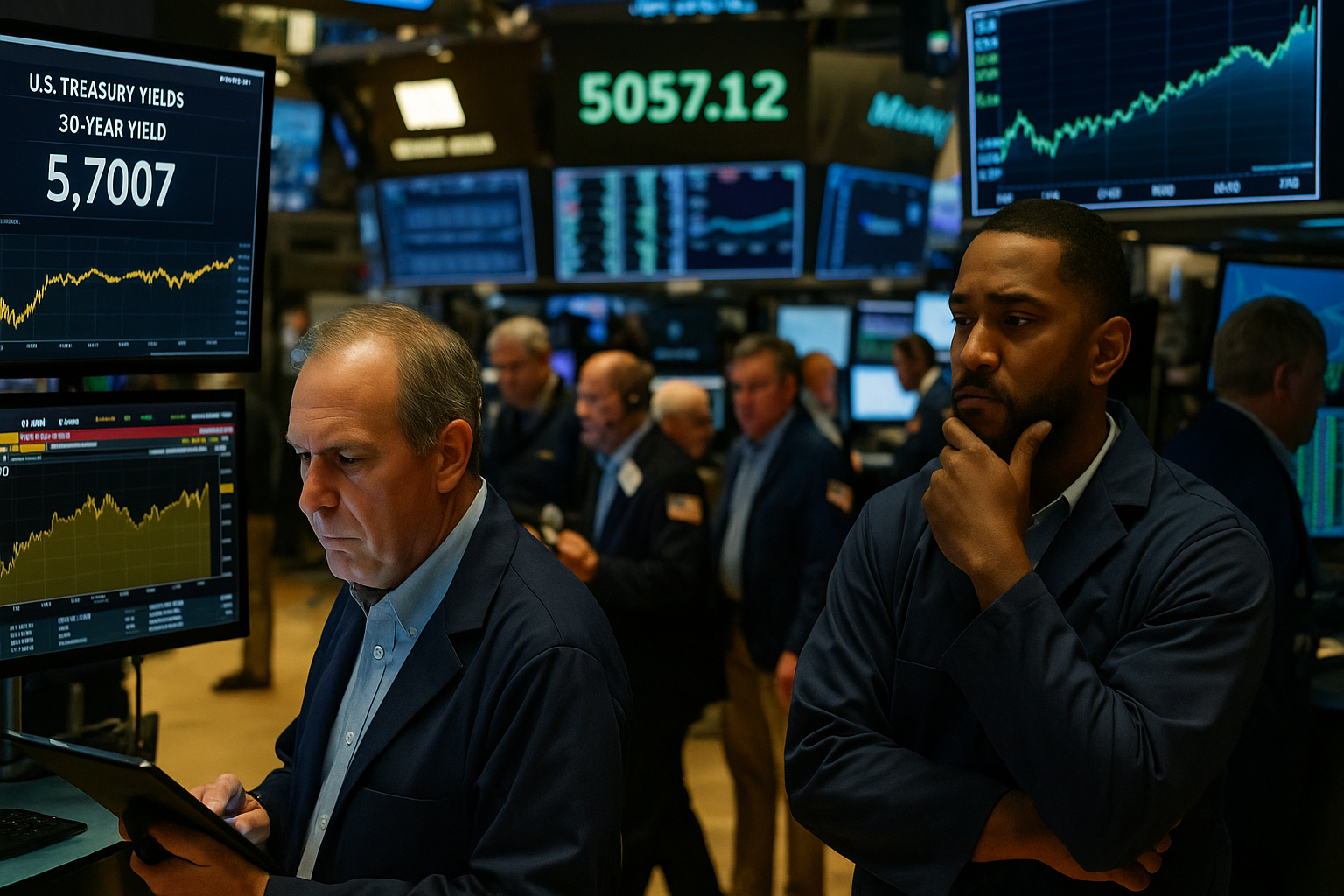
A 30-year US government bond briefly yielded 5.70% this week, and investors still shoved the S&P 500 to a record. That is not a green light to throw more money at AI stocks. It is a warning that people have stopped doing the bloody maths.
The market is pricing perfection twice
On Tuesday, October 6, the S&P 500 briefly hit 7,817.13, edging past its previous intraday record of 7,816.70 set on August 13. The Nasdaq also traded at record levels. The driver was familiar: investors remain convinced that AI investment will turn into a long, fat river of corporate profits.
Fair enough. Nvidia, Microsoft, Meta, Amazon and the rest are not penny-stock fantasies. They sell products, have customers and generate serious cash. AI will change plenty of industries. I run a technology business myself; I am hardly going to tell you software and data are going backwards.
But the other side of the screen matters just as much. On Monday, the 30-year Treasury yield touched 5.702%, its highest level since 2002. The 10-year yield reached 5.3493%, also a level not seen since 2002. By Tuesday, yields had eased a little — roughly 5.26% on the 10-year and 5.66% on the 30-year — and that relief helped stocks rally.
Read that again. Shares rallied because yields fell from very high to merely still very high.
That is the bit investors are casually stepping over on their way to buy another AI ETF. A US government bond is now offering a return that was considered properly attractive for most of the last decade. To beat it, equities need not just good stories, but durable earnings growth after tax, after inflation and after the inevitable bouts of market panic.
The market is paying premium prices for technology leaders while demanding higher returns to lend money to the US government for 10 or 30 years. One of those prices may be wrong. Possibly both are.
Reuters reported that the S&P 500 had been lifted by AI optimism and hopes for strong earnings even as higher energy prices and a volatile bond market raised concern about tighter financial conditions. Bloomberg made the broader point: Wall Street’s obsession with AI has been overwhelming risks that include sharply higher long-term yields. ([investing.com](https://www.investing.com/news/economy-news/sp-500-hits-intraday-record-high-as-ai-rally-continues-4934747?utm_source=openai))
Why a 5%-plus bond yield changes the rules
For years, investors had a simple problem: cash paid next to nothing, government bonds were uninspiring, and expensive shares looked like the only game in town. That pushed capital into growth stocks, private markets, property, venture capital and anything with a decent pitch deck.
That world is gone.
At yields above 5%, bonds are no longer the boring cousin at the family barbecue. They are competition. Real competition.
A higher risk-free return affects almost every financial decision. It raises the hurdle rate for a business investment. It makes borrowing more expensive for companies and households. It puts pressure on commercial-property values. It makes dividend shares compete against an income stream backed by the US government. And it reduces the value investors are willing to pay today for profits that might arrive years from now.
This is especially important for the companies adjacent to the AI winners. The leaders may have balance sheets strong enough to build data centres, buy chips and fund the race from operating cash flow. Plenty of smaller firms do not. They need capital markets to stay friendly. They need customers to keep spending. They need investors willing to fund losses now for a potential payoff later.
That is where higher yields bite first.
The obvious AI names can keep climbing while the economic plumbing underneath them becomes less forgiving. That creates a nasty split market: a handful of enormous companies pull the indexes higher, while smaller businesses, heavily indebted companies and rate-sensitive sectors cop the cost.
Fortune noted that only technology and communication services had been positive over the preceding month, while every other S&P 500 sector was down. Whether that exact split persists is not the point. The point is that an index at a record can hide a market that is much narrower and shakier than the headline suggests. ([fortune.com](https://fortune.com/2026/10/06/bond-market-crisis-would-be-a-good-thing-wall-street-government-debt/?utm_source=openai))
The overlooked risk is not an AI bust — it is concentration
The lazy bear case is: “AI is a bubble.” Maybe. Maybe not. That sentence is too blunt to be useful.
The better question is whether your portfolio has quietly become one giant bet on the same outcome: lower rates eventually, massive AI profits, strong corporate spending, stable energy prices and no serious economic slowdown.
If you own an S&P 500 index fund, a Nasdaq fund, a global growth fund and a few individual megacap technology shares, you may feel diversified because you have four account lines. You may not be diversified at all. You may simply own the same trade in four different outfits.
That does not mean sell everything and hide under the doona. It means know what you own.
The US market has become heavily influenced by its largest technology companies. When those companies rise, they can make the broad index look healthier than the average business actually is. When they fall, the reverse happens. This is not a moral issue. It is arithmetic.
And here is the part many retail investors miss: a great company can still be a mediocre investment if you pay too much for it. I have made that mistake. Most people who have invested long enough have. You can be right that AI changes the world and still lose money if you buy the beneficiaries after everybody else has priced in a decade of flawless execution.
The market is currently treating earnings season as the next proof point. Reuters said investors were looking ahead to quarterly results expected to be powered by continued AI-led growth. Good. Let the businesses prove it. But do not confuse an expectation of strong earnings with strong earnings already banked. ([marketscreener.com](https://www.marketscreener.com/news/world-shares-advance-as-oil-falls-bond-yields-retreat-ce785dd9d980f224?utm_source=openai))
The contrarian move is boring — and that is why it works
The overlooked opportunity is not trying to predict the exact day the AI trade turns. Nobody knows that. Anyone claiming otherwise is selling something.
The smarter move is to make your portfolio less dependent on one answer being right.
A 5%-plus long-term Treasury yield changes the return available from assets that do not require a heroic growth forecast. It does not make bonds risk-free — bond prices can fall if yields climb further, particularly for longer maturities. But it does mean fixed income deserves to be evaluated as an investment again, rather than treated as dead weight.
For people with money sitting in low-interest transaction accounts, the first question is even simpler: why? Cash has a job, but it should have a defined job. Emergency money, a house deposit, tax reserves, near-term business commitments — fine. But idle cash earning a lazy rate while you take concentrated equity risk elsewhere is poor portfolio design.
The same goes for debt. If your mortgage, business loan or other borrowing cost has reset higher, your guaranteed return from reducing expensive debt may beat the speculative return you are chasing in a hot share market. There is no glamour in that. There is also no glamour in being overextended when markets get moody.
Wealth is mostly built through sensible repetition, not clever predictions. Earn. Save. Buy productive assets. Keep fees low. Avoid leverage you do not need. Rebalance when enthusiasm makes one part of the portfolio too large. Then give compounding enough time to do its job.
That last bit is painfully unsexy. It is also why most people do not do it.
What this means for you
Do not make a dramatic all-in or all-out decision because the S&P 500 touched a record. Use the moment to conduct an adult review of your money instead.
First, list every investment you own and work out your genuine exposure to the big US technology and AI trade. Look through your ETFs, managed funds, superannuation options and direct shares. If the same handful of names dominate several holdings, stop pretending that is diversification.
Second, separate money by time horizon. Cash needed in the next one to three years should not be gambling on the Nasdaq. Money you will not need for 10 years can tolerate more equity volatility. Mixing those buckets is how people become forced sellers at the worst possible time.
Third, compare every speculative investment against the return available from safer alternatives and the cost of your debt. A higher yield environment gives you choices. Use them. You do not need to own only government bonds, but you should understand the hurdle they now set.
Fourth, rebalance with rules, not feelings. If AI winners have become an oversized slice of your portfolio, trim enough to get back to the allocation you chose before the excitement. That is not pessimism. That is how you sell some expensive assets without needing the courage to call the top.
Finally, keep buying quality assets regularly if your horizon is long. Records are not a reason to stop investing, just as sell-offs are not automatically a reason to sell. The mistake is letting headlines choose your allocation for you.
The market is telling us two things at once: AI may produce extraordinary businesses, and capital is no longer cheap. Believe both. The investor who respects that tension will be in better shape than the bloke chasing whatever went up last Tuesday.