SpaceX’s $100B Louisiana Starbase Is a Brutal Bet on Starship
SpaceX has promised $100B for Louisiana before Starship has proved it can fly, land and turn around like an airline. That’s not confidence. It’s forcing the future.
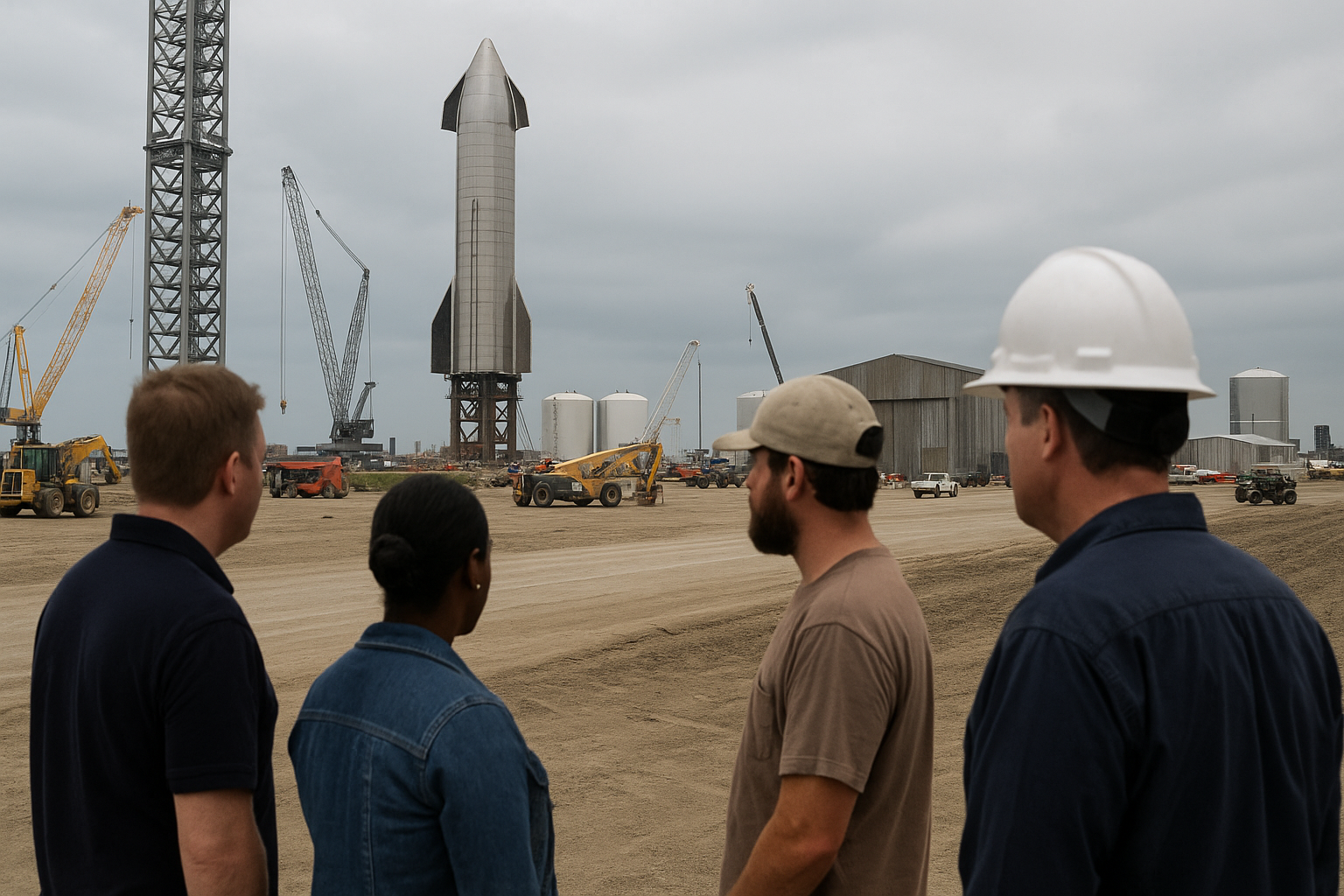
SpaceX has promised $100 billion for a Louisiana spaceport before Starship has proved it can fly, land and turn around like an airline. That’s not confidence. It’s an extraordinarily expensive way of forcing the future.
On August 25, SpaceX announced Starbase Louisiana: a proposed 125,000-acre Starship complex in Vermilion Parish, near Pecan Island. The company says it will invest $100 billion, build a self-sustaining launch site and ultimately support thousands of Starship flights a year. If it happens as advertised, it will be the largest spaceport on Earth. ([opportunitylouisiana.gov](https://www.opportunitylouisiana.gov/news/spacex-launches-new-era-of-commercial-spaceflight-with-100-billion-louisiana-campus?utm_source=openai))
Here is the bit most people will miss while staring at the stupidly large number: this is not mainly a rocket story. It is a manufacturing, logistics, energy and cadence story.
Musk is not building another launchpad. He is trying to build the industrial machine that makes space cheap enough to become a proper economic frontier rather than a government-funded science project with excellent photography.
A $100 billion promise is not $100 billion of value
Let’s be adults about the headline. SpaceX has announced an intention to invest $100 billion. It has not spent $100 billion in Louisiana. Big projects are built in stages, subject to approvals, engineering reality, capital availability and the annoying habit physics has of refusing to read press releases.
Still, the scale matters because it tells us what SpaceX believes is holding it back. The planned Louisiana site is not simply a launch tower in a paddock. It is designed to include propellant production, power generation, deep-water shipping, vehicle-processing facilities and an airport. In plain English: SpaceX wants a vertically integrated industrial city that can manufacture, fuel, move, launch and service Starships without waiting on everyone else. ([opportunitylouisiana.gov](https://www.opportunitylouisiana.gov/news/spacex-launches-new-era-of-commercial-spaceflight-with-100-billion-louisiana-campus?utm_source=openai))
That is a far more serious proposition than “we’re adding capacity.” Capacity is what you buy when demand is clear. SpaceX is building an entire operating system around the assumption that demand will become enormous once launch cost and launch frequency stop being the bottleneck.
Louisiana Economic Development says the project is expected to create 3,000 direct jobs over 10 years, with average annual pay of $92,600, plus an estimated 8,100 indirect jobs. The state’s announcement also makes clear that its incentives are conditional on investment and job creation, and include a required $25 million charitable donation for regional needs. ([opportunitylouisiana.gov](https://www.opportunitylouisiana.gov/news/spacex-launches-new-era-of-commercial-spaceflight-with-100-billion-louisiana-campus?utm_source=openai))
That is useful local economic development. But it is not the investment case.
The investment case is whether SpaceX can turn Starship into something closer to an airline fleet than a bespoke moonshot: launch, recover, inspect, refuel, repeat. Again and again. Without needing an army of engineers to nurse every vehicle back to life.
Starship is still the whole bloody bet
SpaceX has performed 13 Starship test flights since 2023. The programme has made real progress, but the hard commercial proof is still ahead: orbital performance, reliable recovery and rapid reuse at a meaningful tempo. TechCrunch notes that SpaceX has yet to return both the booster and upper stage to the launchpad on a single flight, and that it must show it can refurbish vehicles fast enough to meet its own ambitious launch-rate goals. ([techcrunch.com](https://techcrunch.com/2026/08/25/spacex-will-build-a-second-100b-starbase-spaceport-in-louisiana/?utm_source=openai))
This is why the Louisiana announcement deserves more scrutiny than applause.
A rocket that gets to orbit once is impressive. A rocket that gets to orbit repeatedly is useful. A rocket that does it cheaply, safely and predictably enough for customers to schedule their businesses around it is a different beast entirely.
SpaceX knows this better than anyone. Falcon 9 changed the economics of launch because reuse became operational, not theoretical. Starship is intended to take that logic much further, with vastly more payload capacity and a design that could support high-frequency flights. The Louisiana buildout is the company putting concrete, steel and capital behind the proposition that the next bottleneck will be physical throughput.
That proposition also explains why the project is tied to AI. Reuters reported that Starbase Louisiana is meant to support SpaceX’s Starship ambitions and the launch of AI-related satellites. More launch capacity means more ability to deploy massive satellite networks and, potentially, orbital computing infrastructure. ([reuters.com](https://www.reuters.com/world/us/spacex-build-starship-spaceport-louisiana-2026-08-25/))
The fashionable conversation is about GPUs, data centres and electricity. SpaceX is making a much weirder bet: that some future compute demand may be served by putting infrastructure above the planet, and that cheap heavy-lift launch will make that remotely sensible.
Maybe it works. Maybe it doesn’t. But nobody can accuse them of thinking small.
The second-order play is control, not rockets
The overlooked angle is that SpaceX is trying to own the choke points around space commerce before the market fully arrives.
Most businesses rent the critical infrastructure: cloud capacity, distribution, fulfilment, payment rails, ports, factories or power. That works until the thing you rent becomes scarce, expensive or politically constrained. Then your margins get handed to whoever owns the bottleneck.
SpaceX is attempting the opposite. It wants the launch sites, vehicles, factory capability, propellant systems, shipping access and power generation all sitting inside one industrial loop. If the company can make that loop work, competitors will not merely need a good rocket. They will need an entire ecosystem that took decades, regulatory patience and obscene amounts of capital to assemble.
That is the moat.
And it is a proper moat because it does not show up neatly in a software demo. You cannot prompt-engineer a deep-water port. You cannot slap an API on launch approvals. You cannot hire three clever graduates and replicate coastal land, heavy manufacturing, supply chains, regulatory relationships and a launch cadence that customers trust with billion-dollar payloads.
Founders love talking about defensibility. Most of them mean a feature that takes a competitor six weeks to copy. SpaceX is demonstrating the other version: build an operating advantage so physically complicated that copying it becomes a national infrastructure project.
The contrarian view: this could be too much, too early
I like aggressive builders. I also like not going broke because I confused a vision with evidence.
The risk is straightforward. SpaceX may be building industrial capacity ahead of proven Starship economics. A $100 billion plan only makes strategic sense if Starship reaches high reliability, rapid reusability and sustained demand. If any one of those legs wobbles, a giant spaceport can become a very expensive monument to optimism.
There is also a timing discrepancy worth noting. SpaceX says construction begins in 2027 and has indicated a first Starship launch in 2029. Louisiana Economic Development’s more cautious timeline says construction should start by the end of 2027, with initial operations expected in 2030. That is not scandalous; big infrastructure timelines differ all the time. But it is a reminder to separate targets from delivered outcomes. ([techcrunch.com](https://techcrunch.com/2026/08/25/spacex-will-build-a-second-100b-starbase-spaceport-in-louisiana/?utm_source=openai))
Then there is the environmental and community risk. The site sits on Louisiana’s coast, and the project will face legitimate scrutiny over wetlands, wildlife, fisheries, public infrastructure and the practical cost of turning a rural area into a high-cadence industrial launch operation. SpaceX and the state say they are engaging relevant agencies and tying the development to coastal-protection work. Fine. Now they need to prove it in execution. ([techcrunch.com](https://techcrunch.com/2026/08/25/spacex-will-build-a-second-100b-starbase-spaceport-in-louisiana/?utm_source=openai))
That is the deal with massive ambition: you do not get to claim the upside without carrying the consequences.
What this means for you
If you are a founder, stop looking at this as a space story and look at the operating lesson.
First: identify the bottleneck that will matter after your product works. Most founders obsess over feature quality, then act surprised when sales, onboarding, supply, compliance or support becomes the thing strangling growth. SpaceX is planning for the bottleneck after the rocket: throughput.
Second: do not confuse a big market with a repeatable system. Starship can be technically remarkable and still fail commercially if launches are not frequent, reliable and economical. Your version might be a brilliant AI product that cannot retain customers, a marketplace with no liquidity, or a service business whose founder is still the only person who can deliver the work.
Third: build moats in the boring bits. The unsexy infrastructure—data rights, distribution, supply contracts, implementation capability, trust, compliance and speed of execution—is usually where enduring enterprise value lives.
Finally, keep your bullshit detector switched on. A $100 billion announcement is exciting. It is not a $100 billion result. Watch the milestones: construction, launch cadence, Starship recovery, turnaround time, customer payloads and actual economics.
That is how you separate a great story from a great business. And if SpaceX pulls this off, it will not just have built a bigger rocket base. It will have built the toll road to an entirely new industrial economy.