Stryker’s $26B CEO Succession Plan: What Boards Get Wrong
Most CEO succession plans are just a panic attack with a press release. Stryker spent years building one before handing its $26 billion machine to Spencer Stiles.
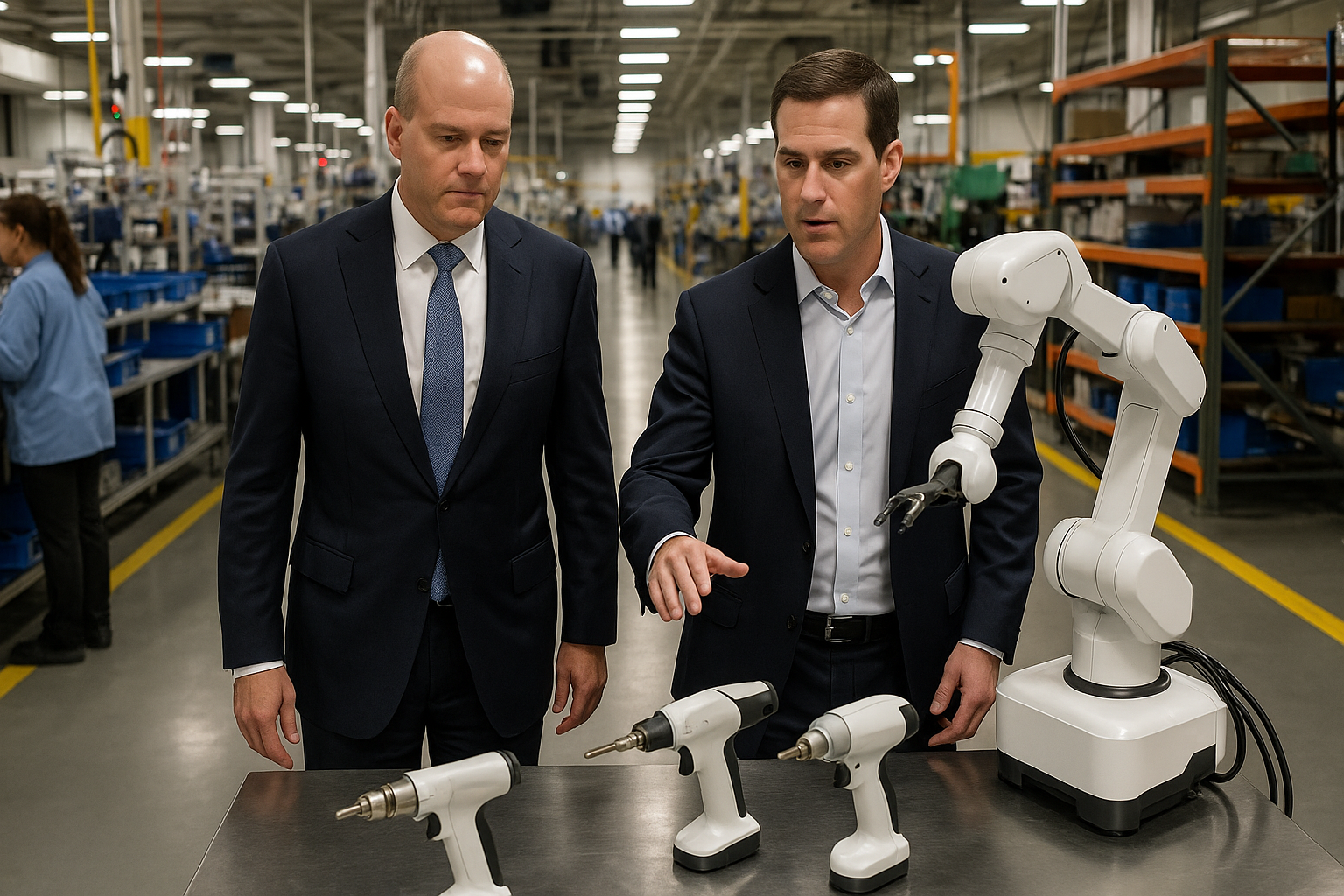
Most CEO succession plans are just a panic attack with a press release. Stryker spent years building one before handing its $26 billion machine to Spencer Stiles.
That is the real story in Stryker’s announcement this week. Not that Kevin Lobo is leaving the CEO job on January 1, 2027. Not that a polished internal candidate is taking over. The story is that a big public company has done the boring, difficult work early enough that the handover might actually preserve momentum instead of creating six months of internal politics, customer nerves and expensive executive churn.
On October 6, Stryker said Lobo will move from chair and CEO to Executive Chair on January 1, while President and COO Spencer Stiles becomes CEO and joins the board. Lobo has run the medical-technology company since October 2012. Under his tenure, annual sales rose from $8.7 billion in 2012 to more than $26 billion in 2026, and Stryker completed more than 60 acquisitions.
That is an unusually large pair of shoes. And it is precisely why this transition matters.
This was not a last-minute promotion
Stiles did not wake up on Monday and find a CEO title under the Christmas tree.
He joined Stryker’s Endoscopy business in 1999. Before becoming President and COO in January 2026, he led Orthopaedics and had exposure across the company’s major operating areas: Orthopaedics, MedSurg and Neurotechnology. He also carried responsibility for international regions, digital and robotics initiatives, enabling technologies, and Stryker’s enterprise M&A strategy.
That matters because the CEO role at a company like Stryker is not a functional job. It is a capital-allocation job, a talent job, a culture job and an operating-rhythm job, all at once. You do not learn it by being brilliant in one division.
Promoting Stiles to President and COO effective January 1, 2026 was the tell. It gave him responsibility for global businesses, strategy and acquisitions before the board named him CEO. In plain English: Stryker created a live audition. He has had a year running the machinery before he is handed the keys.
Too many boards treat succession as an event. They start hunting only when the incumbent is exhausted, sick, pushed out, bored, or about to take another job. Then they pretend a search firm and a 90-day process can identify the right person to lead a company with tens of thousands of employees, complex regulation, global customers and billions in capital commitments.
That is nonsense.
A CEO hire is not recruitment. It is risk management. And the biggest risk is not choosing someone who looks good in an investor presentation. It is choosing someone who does not understand how decisions actually get made when the company is under pressure.
Kevin Lobo leaves a business with real momentum
Lobo joined Stryker in 2011, became CEO in October 2012 and became chair in July 2014. That is a long stretch at the top by any standard, particularly for a listed company operating in healthcare technology, where execution errors have consequences beyond a missed quarterly target.
The numbers are useful because they cut through the usual farewell confetti. Sales grew from $8.7 billion in 2012 to more than $26 billion in 2026. Stryker says it completed more than 60 acquisitions during his CEO tenure. One of the notable deals was Mako, which brought robotic-arm-assisted technology into Stryker’s joint-reconstruction capabilities.
You can argue about whether any chief executive deserves all the credit for a 14-year run. They do not. Good companies are team sports. But CEOs absolutely set the rules for what gets funded, acquired, measured, rewarded and tolerated. A chief executive who makes 60-plus acquisitions has not merely managed the existing business; he has actively reshaped it.
That creates a specific succession challenge. Stiles is not taking over a sleepy industrial business with one dependable product line. He inherits a broad portfolio, an acquisition habit, high expectations and a culture built around execution. The easy mistake would be to arrive and make cosmetic changes just to prove he is his own man.
That is the sort of ego-driven nonsense that destroys value.
The harder and better question is: what should remain untouched because it is working, and where has success made the company complacent? That is the only CEO question worth asking in the first year.
The Executive Chair role is helpful — until it isn’t
There is one part of this plan that deserves a raised eyebrow: Lobo is not disappearing. He becomes Executive Chair.
This can be enormously valuable. A departing CEO with deep institutional knowledge can support the incoming CEO, maintain continuity with the board and help protect critical customer, investor and acquisition relationships. For a company that has expanded through more than 60 acquisitions, that memory matters.
The transition agreement filed by Stryker says Lobo remains CEO through December 31, 2026, then becomes Executive Chair on January 1. His base salary, bonus target and benefit eligibility remain unchanged, although he will not receive new stock awards as Executive Chair.
But let’s not sugar-coat it: an Executive Chair arrangement can also become a problem if nobody is clear about who is actually in charge.
A new CEO cannot lead effectively if executives keep wondering whether the old CEO will overrule him in the next meeting. Nor can the board run a clean governance process if it uses the Executive Chair as a back channel around the new chief executive. That is how you end up with two power centres, carefully worded public statements and a leadership team paralysed by politics.
The good news is that Stryker has given itself time. The bad news is that time only helps if roles are brutally clear.
Stiles needs full ownership of operating decisions, the executive team, strategy and capital allocation from day one. Lobo’s role should be counsel, continuity and governance — not shadow management. The board, led by Lead Independent Director Sheri McCoy, has to enforce that distinction rather than merely admire it in a transition document.
The overlooked lesson: build successors through operating exposure
The fashionable leadership conversation is obsessed with charisma. Who presents well? Who has the best personal brand? Who can charm analysts, journalists and conference audiences?
Fine. Those skills have their place. But companies are not saved by a bloke with a good LinkedIn headshot and a handful of leadership aphorisms.
They are saved by leaders who have made real trade-offs across the business before the title arrives.
Stiles’s path is instructive. He did not come in from outside with a grand turnaround deck. He has spent nearly three decades inside Stryker, beginning in Endoscopy and working across core businesses. By the time he becomes CEO, he will have had a year as President and COO and previous responsibility touching operations, international markets, technology, robotics and M&A.
That is not glamorous. It is better: it is evidence.
Founders often get this wrong because they see succession as selecting a replacement version of themselves. Boards get it wrong because they chase a celebrity outsider after a period of poor performance. Both are usually looking for a hero.
What you need is a person who understands the system well enough to improve it without breaking the bits that pay the bills.
There is also a warning here. An internal successor is not automatically the right successor. Long tenure can produce blind spots, groupthink and a reluctance to challenge sacred cows. The antidote is not hiring externally for the sake of it. The antidote is a board that tests the internal candidate properly: strategic judgement, talent decisions, capital allocation, crisis handling and the willingness to kill ideas that no longer work.
Stryker’s COO appointment in January 2026 suggests it understood that point. It made Stiles visible, accountable and measurable before granting the top job.
What this means for you
Whether you run a 12-person company, a business unit or a listed company, steal the useful part of Stryker’s playbook.
First, name the job before the person. Write down what the next leader must actually be able to do over the next three years. Not vague traits such as “visionary” or “great communicator.” List the decisions: hiring, pricing, product priorities, acquisitions, customer escalation, cash management and culture.
Second, create a real proving ground. Give your likely successor ownership of a business, a budget and cross-functional problems. Let them make calls that can succeed or fail. Watching somebody chair a meeting tells you bugger-all. Watching them allocate scarce capital tells you nearly everything.
Third, plan the founder or incumbent’s exit with ruthless clarity. If you stay involved, define your lane in writing. Who owns people decisions? Who owns strategy? Who speaks to the board? Who breaks a deadlock? If the answer is “we’ll work it out,” you are manufacturing a future mess.
Fourth, do it while things are good. Stryker is making this move from a position of strength, not amid a public meltdown. That is the time to develop a successor: when you can afford to judge them properly rather than grab the least-bad option in a crisis.
The best succession plans are almost disappointingly unexciting. No leaks. No emergency meeting. No executive exodus. No heroic outsider arriving with a slide deck and a $20 million package.
Just a capable operator, trained over time, taking charge of a business that is ready for him.
That may not make for dramatic television. It is how serious companies keep compounding.